Showing posts with label Anole. Show all posts

Thursday, May 22, 2014

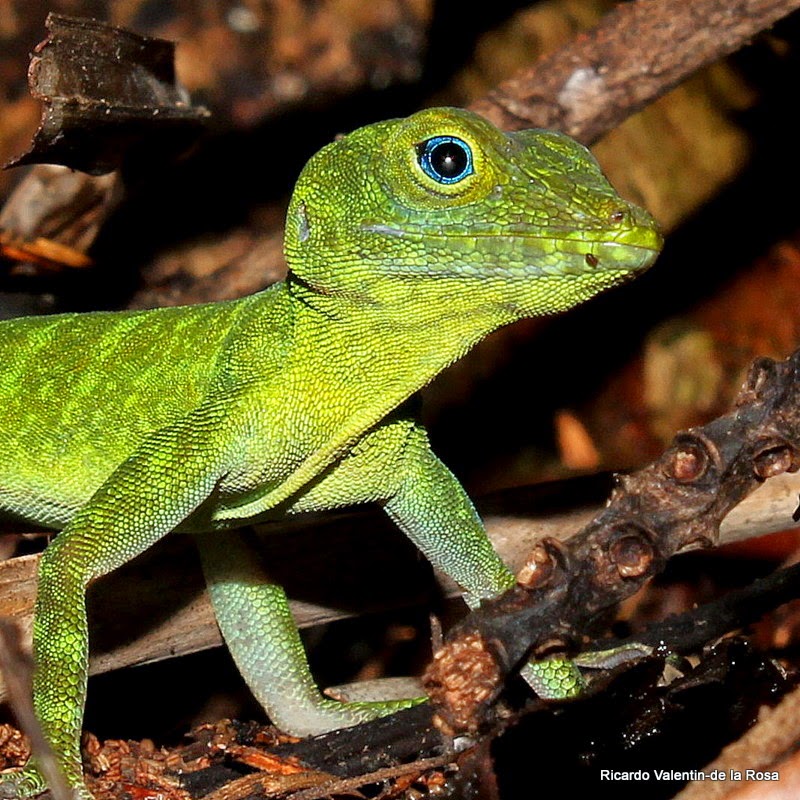
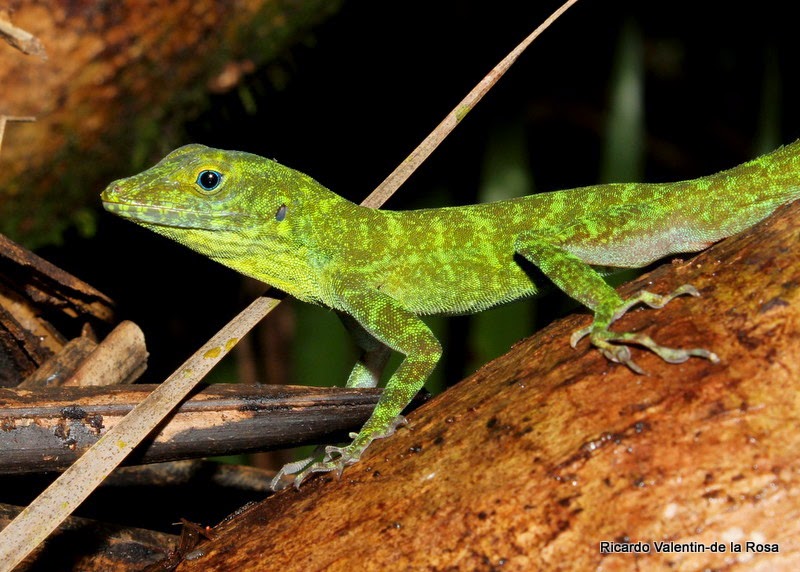
Anolis evermanni Stejneger 1904, in the forest of Rio Abajo


Today I was cleaning the patio and decided to remove an accumulation of sticks and leaves that had developed under a clump of palm stems.  When I did this, I broke several tunnels that termites had made into the leaf litter mass.  As a result worker termites were exposed, as well as a few warriors.  This is not an unusual event so I continued cleaning.  Then I noticed that an Anolis evermanni was eating the worker termites.  Anolis evermanni are normally an even green color.  This one had an overlay of darer green bands.  I attribute this to the excitement caused by the presence of an abundance of prey.  Anolis evermanni has shown a breathtaking amount of behavioral flexibility in the laboratory.  From what I saw while taking the photos, this particular lizard regarded me as an annoyance, but also as essentially harmless.  That's why I could get so close to it.  These lizard see me daily as I do garden chores or just walk around.  This might explain the boldness of this one, or maybe it was very, very hungry.  Anolis only eat the workers, the warriors have dark pointy heads full of a distasteful toxic glue that the lizards seem to loathe.

Monday, May 19, 2014

Anolis cristatellus, displaying its dewlap


Compared to most other lizards I see locally, this male Anolis cristatellus has been surprisingly bold.  Instead of running away up the tree or hiding on the opposite side of the trunk, this lizard has held its ground calmly but alertly.  It had allowed me to get very close to him.  On ocassion it has showed its dewlap, this is a territorial display in this species.  Today I was able to get images of the lizard showing its dewlap.

Sunday, May 18, 2014

Anolis cristatellus cristatellus Duméril and Bibron, 1837, that just had been involved in a territorial fight


This adult male cristatellus was just involved in a territorial fight.  The snout shows damage and the lower mandible is slightly bloody.  These lizards engage in territorial fights with neighboring males.  Sometimes, when they fight, they make hissing noises.  The fights usually happen in branches or trunks of trees or bushes.  In those fights that I have witnessed the loser is the one that falls from the trun or branch.