Saturday, April 30, 2011

Hurricane Hugo, a few photos from the aftermath of Hurricane Hugo in 1989.


This tree was defoliated and stripped of most of its smaller branches.  In this particular area most trees sustaine extensive damage but remained standing.

In this area the trees were stripped clean of leaves and lianas and only the hard woody stems remained.  Unfortunately it is not easy to get a perspective in this photo this makes trees with substantial sized look like twigs.  To get an idea of the size look at the lower left corner of the photo were the remains of a palm frond can be seen.

In this area the wind were so fierce even the bark was stripped of some trees.  The top of this was ripped away by the wind.

Seven days after the hurricane some roads were still impassable due to the massive tree fall.

This part of the forest had faced the full brunt of the wild and the main color was that of the bare trunks and surviving braches of the trees.  Leaves which usually covered everything are nowhere in sight.

Forest damage over El Verde Station.


Shattered tree trunk

The entrance to the Caribbean National Forest, blocked by massive tree fall

Tree trunk sheared off 

Making the best of a bad situation some college students from El Verde Station go out to do some research.

These photos were taken seven days after Hurricane Hugo hit the northwest corner of the Island of Puerto Rico.  I was able to take them because Hector Colon invited me and Sandra Moya to see the damage inflicted by the hurricane to the forest of the area around El Yunque mountain, then know as the Caribbean National Forest.  We were shocked by the tremendous damage that the high wind inflicted to the forest.  In some parts it looked like someone had bombed the forest.  Bird mortality was high, as I recall half of all the Puerto Rican parrots in the forest perished as a result of the hurricane.  Other species were similarly affected. We traveled around the El Verde area.  We narrowly avoided being in the middle of a shoot out between cars that left several cars riddled with bullets by the side of the Espiritu Santo river bridge.  We were unnerved because we heard the shooting from the spot we were inside the forest a few hundred feet away from the bridge.  Although in some parts of the forest the damage was severe, in some sheltered parts the forest suffered much less damage.  But huge parts of the forest were defoliated in a way that I had never thought possible.  I took these photos and forgot about them for decades.  Due to poor storage they degraded considerably and some became damaged.  But even in their decay they give a powerful testimony of the awesome and frightful power of a tropical cyclone.

Wednesday, April 27, 2011

Mona Island, Cueva del Lirio, AEB trip circa 1982


A land's view from an area near Cueva del Lirio, you can see in the top left corner the ship Alborada that had ran aground on the reef in from of Pajaros Beach
A part of the Asociacion de Estudiantes de Biologia of the Mayaguez Campus of the University of Puerto Rico.  You can see Nelly with a ton of hair, Javier alarmingly young, Jorge without big muscles and Isabel with a goat skull.
In one of the ledges of the cave we found a small nesting colony of  Sooty Terns

There were Sooty terns all around the Island but these were nesting in one  an opening of the cave that faced toward the sea
The inside of the cave is filled with a breathtaking variety of speleothems ranging from cave pearls to massive stalagmites that resemble fantastic animals.
A seaward view from Cueva del Lirio


I visited Cueva del Lirio many times during the 1980's.  My only regret is that I didn't take more photos of the inside of the caves.  Mona Island caves are laberinthic and this makes them unsettling and disorienting for those that are not accostumed to visit caves.  There are many strange and wonderful speleothems inside this cave.  Hopefully one day I will be able to go back to take photos of them.

Tuesday, April 26, 2011

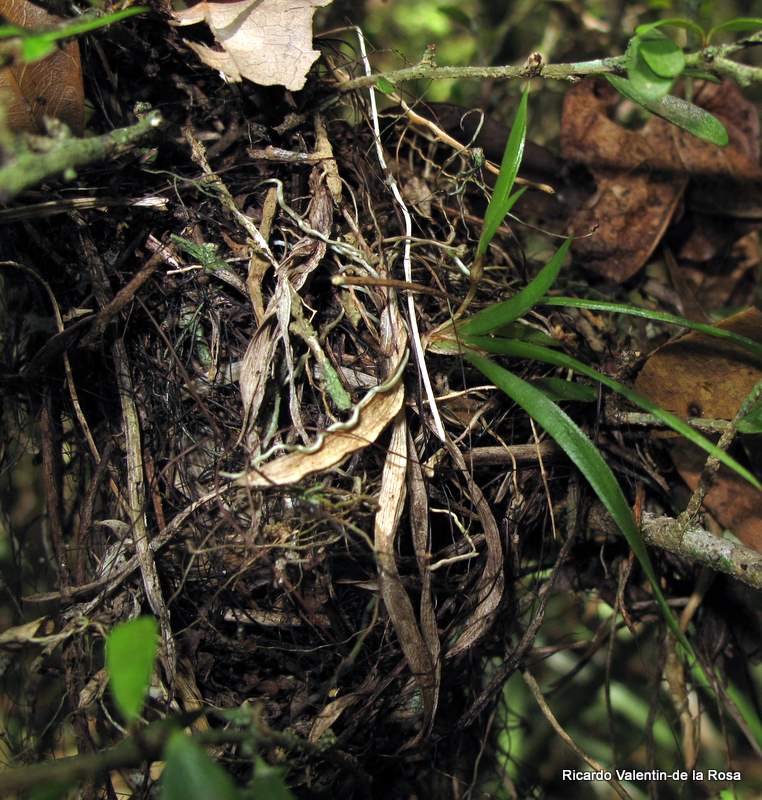
Tolumnia (Oncidium) variegata, birds weaving this orchid into their nest


Tolumnia variegata, one of our most common native orchids
A nest of an unidentified species of bird

The orchid was originally weaved into the fabric of the nest, you can see the dried  leaves trapped in the fibers.  A new fan of leaves grew free of the nest and its now producing another leaf fan on top of a stolon.


Many years ago, as I was hiking in a local forest, I found an area where the local birds would weave orchids into the fabric of their nests.  It was a charming sight but unfortunately at the time I didn't have a camera with me.  I returned to the forest last weekend and managed to find a nest with an orchid.  When I visited this area, a long time ago it was almost pristine.  Now although there were signs of human visitation, to my utter astonishment, there was no trash anywhere.  Apparently whoever has visited the spot has been respectful of the area.  Sadly, I found the orchid population in the area was just a fraction of the size it was when I first visited.   

Saturday, April 23, 2011

Mona Island, the amazing sight of waterfalls on a dry deserted island, AEB field trip 1980.

Water falling from the 200 feet tall cliffs in the area of Pajaros beach

We tried to fend off the water with anything that we could find

We had to take refuge in the area of Cueva del Caballo since the rain swamped the camping area.

Mona Island is a deserted island usually most remebered by hikers for its dryness and its endless vistas of dry fearsomely thorny scrub.  Althought the island can have periods of rainlessness that lasts months, from time to time it does gets hit with the great weather systems that make their way from Africa to the Caribbean.  In this case the Association of Biology Students was camping in Sardinera beach and decided to go to the other side of the island, to Pajaros Beach, about six miles away as the crow flies.  During the night we were camping in Pajaros beach a tropical wave or depression unexpectedly dumped an enormous amount of water over us (I know this is almost beyond belief but at the time we didn't have cellphones or even (gasp) Tweeter).  When we woke up the next day there was water everywhere and the astonishing sight of waterfalls falling from the central plateau of the island.  The previous day the island had been bone dry and now it everything was soaking wet.  We took refuge in a small cave nest to the Cueva del Caballo and made jokes as we shivered and tried to make the best of it.  I have gone back to Mona Island many times over the years but I have never again witnessed this spectacle again.

Friday, April 22, 2011

Mona Island, cave pearls, circa 1984, AEB field trip.


These are cave pearls from a cave in the Island of Mona, a small island about fifty miles to the west of the Island of Puerto Rico.  Mona Island is composed of a huge slab of limestone that rose from the sea about a million years ago.  There are two types of limestone in Mona Island, caliza lirio, the top layer, is relatively easily dissolved by rain water, the bottom layer is dolomite which is harder and resists dissolucion by rain much better.  In the boundary between the two layers of limestone you get enormous caves which can have hundred of thousands of square meters of interior space.  The easiest caves to access are all around the coast of the island. Almost all were severely altered by man early last century to extract huge quantities of guano that were deposited in the caves in the past.  The caves in Mona Island are laberinthic with many side passages and cavities going in all directions and interconnecting in all sort of ways.  They are full of a large variety of stalagmites and other speleothems, some of which seem to defy gravity.  Cave pealrs can be found in large numbers in some of the caves but they are rarely as white and pristine as these ones.  As you can see they are not necessarily round, they can be square, triangular and irregularly polyhedral.  From the empty niches you can tell that some have been taken away from the cave.  These pearls have no commercial value and are best enjoyed in their natural setting.  Hopefully these ones are still in the cave where I saw them.

Thursday, April 21, 2011

The goats on Mona Island back in 1979, ABE field trip


A startled goat running at full tilt through the scrubby vegetation in alocation a few hundred feet south of the Mona lighthouse
Part of herd of about thirty that crossed the road from Pajaros beach to the lighthouse

Two goats grazing on the median strip of the road from Pajaros beach to the lighthouse.

My first trip to Mona Island was back in 1979.  It was with the Asociation of Biology Students of the Mayaguez campus of the University of Puerto Rico.  This trip was an important event in my life as I made new friends and decided to go to study to the Mayaguez campus.  I took many photos in that trip, sadly they have become a bit deteriorated.  But they still provide a window to a time where Mona Island was not a popular destination and few people visited it.  In this trip I saw a large number of goats.  About seventy goats crossed the road ahead of me during a half hour hike between Pajaros beach and the lighthouse, undoubtably there were many times this number lurking in the vegetation to the sides of the road.  The goats seemed untroubled by our presence  and some even spent some time grazing on the median strip of the road even as we approached them.   The goats were also plentiful around the lighthouse and I even managed to get fairly close to a few before they took flight.  In the decades that have passed since my trip hunting became much more popular and large numbers of hunters would visit the island to hunt for goats and pigs.  The goat population plummeted and it became harder and harder to see them.  The last time I was in Mona, about ten years ago, you had to hike for hours away from human haunted areas to be able to glimpse even one.