Showing posts with label Puerto Rico. Show all posts

Wednesday, October 30, 2024

Begonia decandra Pav. ex A.DC. in El Yunque National Forest


 This Begonia is endemic of Puerto Rico.  It can be seen in roadsides and places where the forest canopy borders and open sunny area. 

Stelis perpusilliflora Cogn. in I.Urban 1909 in El Yunque National Forest


 This orchid was photographed in El Yunque National forest.  The flowers are tiny and remain cupped when they open.  The inflorescence is horizontal with the flowers pointing downwards or to the side.  I had to bend the inflorescence upwards to get a view of the inside of the flowers.

Monday, February 13, 2023

Myrmecophila brysiana culture: The free spirit

Myrmecophila brysiana When I received my plant of Myrmecophila brysiana from an online vendor, it was a tiny thing on a 2 inch pot. I made a custom-made wire basket for it. The plant spent the next few years producing a line of increasingly large pseudobulbs that were tightly clustered. So far everything was unremarkable. Last year, I noticed that it was producing its largest pseudobulb yet, but it was growing sidewise, into the side of the basket (large red oval). I made a hole for the pseudobulb to grow through. A few months later I was startled to discover it was producing a new growth, downwards directly into the media (red circle). I had to remove most of the media in the basket, as well as one side, to allow the new growth to enlarge and expand to full size. Then a few weeks ago, It started a third new growth, this one points straight up (small red oval). Given that the plant seems determined to grow in all directions at the same time, I will eventually let it hang from a wire and grow in whichever direction it wants.

Monday, February 24, 2020

A pair of Amazona vittata. the puertorican amazon calling from a tree near their nest


It has been an unusually rainy 24 of February.  Normally this month is one of the driest ones of the year.  But the arrival of a cold front ushered non stop rain and drizzle that has lasted the whole day.  In some parts of the island the rain has set records that had stood since the 1940's.  It has been a rainy and cloudy afternoon.  Every afternoon, I do a round to check the captive breeding pairs.  I do this every day during the breeding season, at a specific time.  The captive parrots become habituated to my presence and are not alarmed when I go by.   Some wild birds have territories inside the aviary and they also become habituated to my presence.   This pair is perching in a tree near to where their nest is located.  You can hear their calls and also the calls of other parrots who are near.  Their calls serve to mark their territory and to warn other birds away.   There was another pair who had a territory close to that of this pair.  The male of that pair died.  In an unusual turn of events, this pair tolerates the female in their territory rather than chasing her away as they do with other birds.  You can see the widowed female arrive after second 18 of the video.  The male is a captive bird that was released a few years back, you can see the antena of his radio transmitter.  The is lacking a few feathers from the top of his head, probably he lost them in a territorial fight.

Wednesday, May 29, 2019

Tolumnia variegata (Sw.) Braem 1986, with flowers that appear to lack anthocyanin, these flowers are unlike any I have ever seen in the wild.


Photograph with flash

Photograph with natural light


Tolumnia variegata is one of the most common orchids in Puerto Rico.  It is often found in association with coffee plants, so its common name is "little angel of the coffee plantation".  Over the years I have seen, hundreds, maybe thousands of flowers of this species, in inflorescences of plants growing in the forest in Rio Abajo and in other types of habitats, from dry coastal scrub to moist karst forest.   The flowers usually have the same colors although they vary in size and number of flowers in the inflorescence.   A friend showed me this plant.  The flowers seem to lack anthocyanin, the pigment that produces purple and red color in the flowers.  My friend, who has seen even more Tolumnia flowers than me agrees that this plant is unique.  Sadly because it has been raining copiously in the last two weeks, only one of the flowers was in good condition.  The others were spotted or had sooty mold over them.  I am not sure what is the way to describe this variant of the species.  But it reminds me of an alba type flower.  There will be an effort to self the flowers so that seed might be collected.  Hopefully it will be successful so that the genetics of this variant might be preserved.

Typical Tolumnia variegata from the locality this plant was seen


Thursday, April 25, 2019

When resting among the foliage, the green color of the puerto rican parrot, Amazona vittata, serves as a great camouflage


The puerto rican parrot is one of the Amazons with the the least color aside from green.  When resting or hiding among the vegetation it is very hard to see.  These two parrots were photographed just after sun down.  As you can see by the retracted foot inside the plumage of the left parrots, it is quite at home and relaxed in the tree stump.  The left parrot vocalizing loudly, something they do at sundown and at sunrise.  The bird to the left has a radio transmitter.

Saturday, April 20, 2019

Sacoila lanceolata (Aubl.) Garay 1982, for many year this plant eluded me, I found it at a roadside. I expected the flowers to be red, but the flowers I found were orange


Sacoila lanceolata is a terrestrial orchid that is widespread in the Antilles and tropical America.  In the photos I have seen of the species, the flowers are bright red.  But the population I saw in the west of the island of Puerto Rico, is pale orange.  Apparently there are also yellow ones, but I have not seen them only heard about them.

Monday, April 15, 2019

Spiranthes torta (Thunb.)Garay & H.R.Sweet, I photographed this little plant in a grassy area in the town of Lares, Puerto Rico


I saw this plant in a grassy area in the town of Moca.  The plants are small and easily missed among the grass.  I had to get into my belly to be able to take a close up of the flowers.   It is native of Puerto Rico and many other places.

Sunday, April 7, 2019

Bletia patula Graham 1836 a flower without any trace of pigmentation


Alba forms of Bletia patula are very rare in Puerto Rico.  For many years no local plants that are pure white were seen.  There was a single clone, cultivated in Mayaguez that was awarded by the American Orchid Society.  This plant was photographed "in situ" in a swampy area in the northern karst region.  It is part of a very tiny population.  Most of the flowers were grievously damaged either by insects or some kind of fungal or bacteria spotting of the pure white floral segments.

Thursday, August 9, 2018

After the storm: A view of a patch of forest in El Yunque rainforest, before and after hurricane Maria.


\

This is a view from the Iguaca Aviary, of a patch of forest 
in El Yunque rainforest, before hurricane Maria.


The same place, after Maria.

Saturday, April 22, 2017

Pelexia adnata (Sw.) Poit. ex Rich 1818, Bosque de Rio Abajo, Puerto Rico


Most afternoons, when it doesn't rain, I jog in the forest trails.  Most of the vegetation by the trail sides is either ferns or weeds, but occasionally I see something unusual.  A few weeks ago I noticed this orchid.  However the flowers are tiny and the plant is small so it hardly stands out from the surrounding plants.

Thursday, March 30, 2017

Dendrobium Yellow Jacket 'Olimpia', Puerto Rico Orchid society 2017 show Grand Champion


A massive plant with hundreds of flowers.  An excellent example of the impressive size these plants can attain when cultivated by a knowledgeable grower and in the climatic conditions that suit it best.

Tuesday, December 27, 2016

Bletia patula Graham 1836, a vigorous plant with cerulean flowers


This plant is a variant of the normally pink flowered species.  It was found in a vacant lot that was going to be cleaned along with plants of the typical form.  It has proven to be a floriferous and vigorous grower.  This species is not difficult to grow as long as you replicate the way they grow in the wild.  They grow in places where, when it rains, the water percolates quickly and the ground doesn't stay soping wet.

Thursday, December 22, 2016

Ponthieva ventricosa (Griseb.) Fawc. & Rendle, a few close ups of the flowers of this Caribbean endemic


The group of plants of this species that grows near my house suffered greatly during the drought of 2015.  This year has been much wetter which has allowed he clump to recuperate somewhat.  However it is still smaller than when I first found it due to the stress it underwent during the long dry spells of last year.  It only has a fraction of the inflorescences that it used to produce.

Sunday, December 18, 2016

Laelia anceps var. veitchiana


This plant is cultivated close to the coast in the town of Isabela, in the north coast of the Island of Puerto Rico.  It is grown in a shadehouse near the top of a hill, with plenty of air movement and humidity.  

Tuesday, December 13, 2016

Dendrobium delacourii Guillaumin 1924, this is the first plant of this species that I have seen blooming in Puerto Rico


Many years ago I tried to grow this species.  In spite of my best efforts, it eventually left my garden for the great, happy, terracota pot in the sky.  I regarded it as a cool grower that would slowly shrivel and die if cultivated in the sweltering climate of coastal Puerto Rico.  But it is now clear that this plant will not only grow and thrive in the hot coastal lowlands of the island but also bloom.  My friend Karlo Javy allowed me to photograph the flowers of its plants.  The true Dendrobium delacourii is a miniature plant with canes that are quite small and measure only a few inches, between four and six.  There are other species with similar flowers but in those, the canes are larger than those of delacourii.  This orchid is in a garden in the very heart of the metropolitan area of San Juan, the capital of the Island of Puerto Rico.  The coastal lowlands of Puerto Rico can get pretty hot, with temperatures reaching into the high nineties.  On windless days it can feel as if the whole island had been dropped into an oven.  But this plant is doing well and has bloomed repeatedly.
I find the flowers of this orchid particularly interesting due to their ciliate lip, a feature that is not common in the genus Dendrobium.  

Monday, December 12, 2016

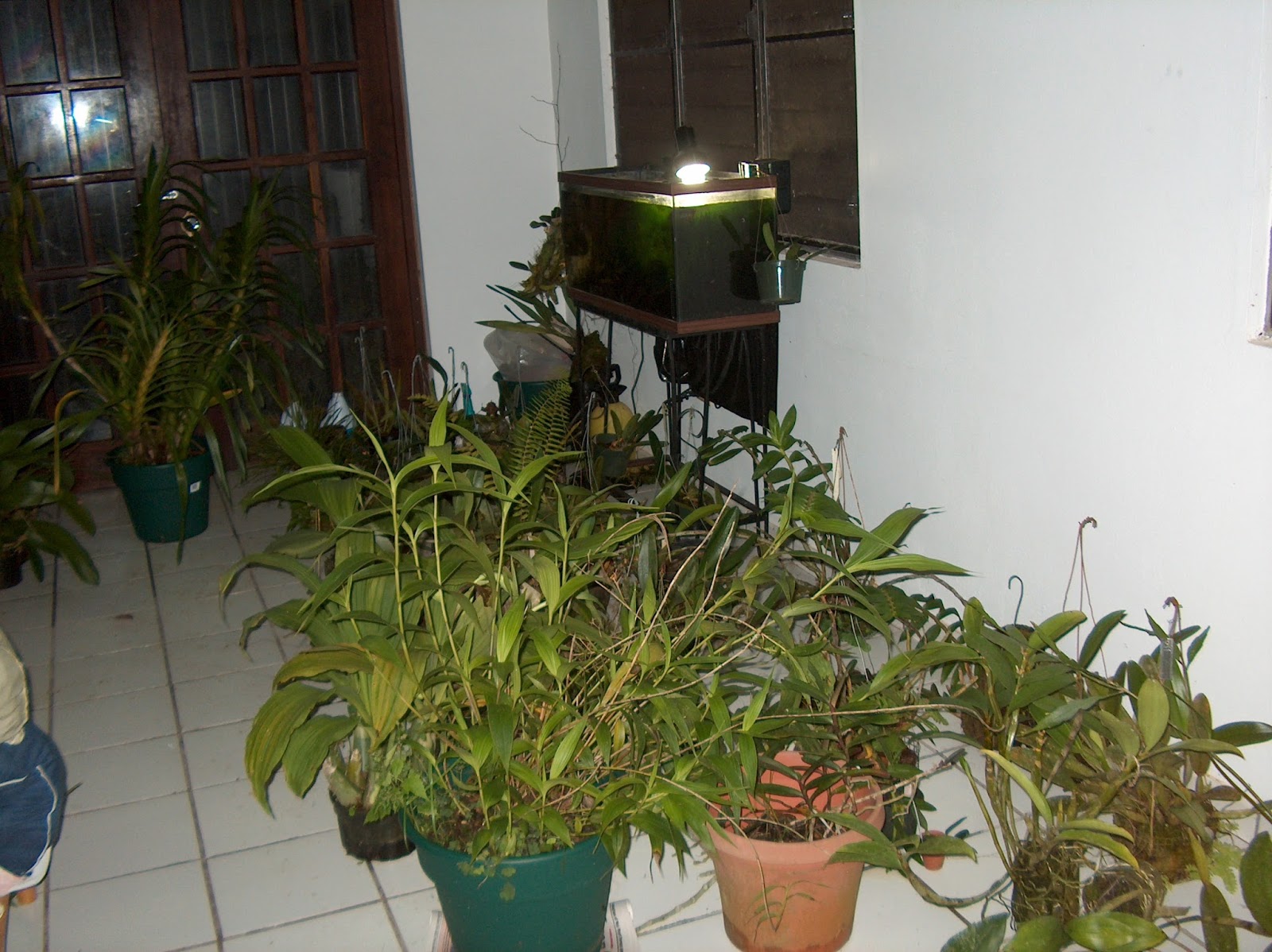
In 2004, I moved many of my orchids indoors because tropical storm Jeanne was menacing the island. It passed over Puerto Rico and went on to became the deadliest hurricane of 2004


In September of 2004 the island of Puerto Rico came under a tropical storm warning.  I was so concerned my plants would get damaged by the winds and falling branches, I moved a lot of them indoors.  The storm made landfall in the south east of the Island near Maunabo at midday September 15, it exited the Island through Mayaguez at 11 pm.  The strongest winds measured over the island were 117 km/h in San Juan, in the north of the island.  Rainfall fluctuated between 152mm and 610mm.  My location experience only light defoliation to the canopy, and very little damage to the houses.

The orchids I left outside were unharmed.  However, after I took the plants outside, I spend the next week finding frogs, spiders and cockroaches that had come in to the house hidden in the orchid pots.  It was the last time I brought such a large number of plants indoors.