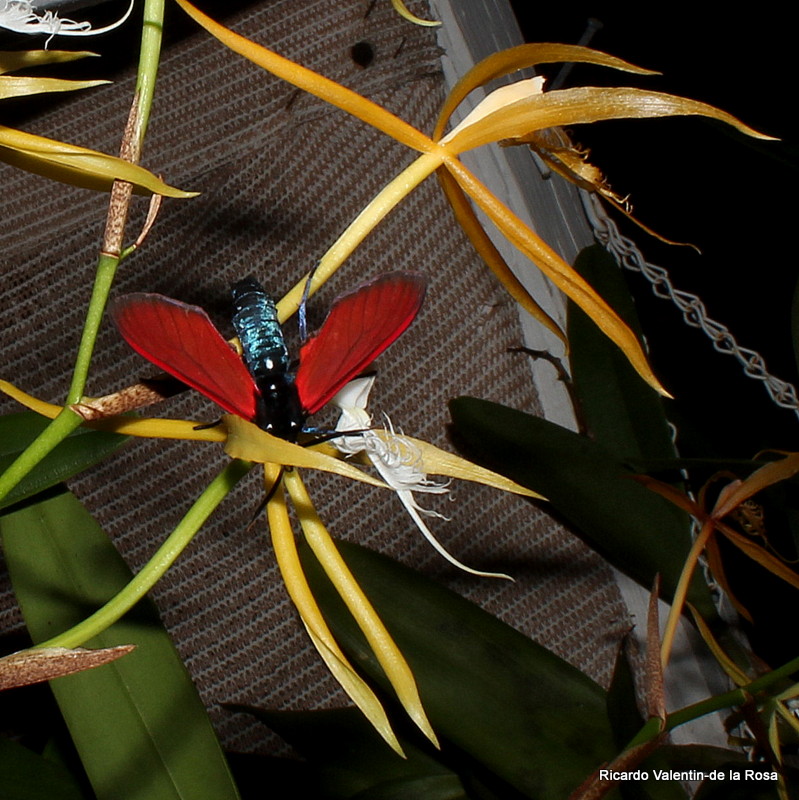
This hybrid is a cross of Rhynchodendrum Cabalgata en Verde (Epidendrum ciliare x Rhyncholaelia digbyana) and Brassavola cucullata. It has a fimbriate lip that shows mainly the influence of Epi. ciliare and B. cucullata.

This hybrid is a cross of Rhynchodendrum Cabalgata en Verde (Epidendrum ciliare x Rhyncholaelia digbyana) and Brassavola cucullata. It has a fimbriate lip that shows mainly the influence of Epi. ciliare and B. cucullata.




 |
This orchid is a cross of Rhyncholaelia digbyiana and Epidendrum
ciliare. Both species have notable
fringed lips. Epi. ciliare has green
sepals and petals and a relatively narrow lip that is white with fringed side
lobes and has a long central projection.
Rhyncholaelia dygiana generally has green sepals and petals and a wide,
deeply fringed green lip. The Epi. ciliare parent of this cross is a
particularly fine representative of the species, its flower has the largest natural spead of any ciliare awarded under the AOS system and was awarded a FCC in 2011. The Rhyncholaelia
parent is the cultivar “Laura” AM/AOS. When I
saw this Rhychodendrum it had two inflorescences, one with two flowers and another
with three. The flower count is reduced from the number the Epidendrum parent produces because of the Rhycholaelia influence.
The Epidendrum parent dominates
the appearance of the flower of the cross.
The Rhycholaelia influence
shows as a widening of the side lobes and of the projection of the lip that is
a particular feature of the Epi. ciliare
lip. The plant form is similar to the
Epidendrum parent. Since I saw this
plant early in the morning I could discern no fragrance, but since both species
are known to produce fragrance at night, I would expect it to be fragrant after
the onset of darkness.
I have learned that only a few
plants of this cross survived to bloom.
I have been told that there are just two clones of this cross. I was told the other clone has even wider flower segments and produces more flowers, I hope one day I will see it. I have seen three Epi. ciliare crosses and in two the Epidendrum is dominant in the shape and size of the hybrid. I the third, a cross with Blc. Toshie Aoki, the flower is much
larger than ciliare but from the appearance
of the flower you would have a hard time guessing that the other parent..
|
 |
| Coilostylis ciliare, this is the presentation of the lip of a newly opened flower |
 |
| Inflorescence, top view |
 |
| Inflorescence, side view |
 |
| A flower that has been open for a few days |
 |
| A flower that has been open for more than a week, the reason for the color change is unclear but may be a signal for pollinators |
 |
| The flower of a cross of Blc. Toshie Aoki and Coi. ciliare Coilostylis ciliare is part of a group of green and white flowered orchids that have similar - looking flowers which are native of Puerto Rico. This group of orchids is comprised of Epidendrum caphoporum, Epidendrum tridens, Epidendrum nocturnum and Coilostylis ciliare. Of all these orchids the only one with a fringed lip is Coilostylis ciliare. Coilostylis ciliare has a wide distribution on the island of Puerto Rico, I have seen plants from several places in the island. Lately this plant has been renamed Coilostylis ciliare. I received as a gift a plant that originally came from the area of Utuado. This plant had pseudobulbs only five to six inches tall and produced inflorescences of two to four flowers, it bloomed in the spring. Sadly this I lost this plant which was among the smallest of all Coi. ciliare I have ever seen. I also have a plant that hails from the east of the island and whose pseudobulbs reach nine to ten inches tall and that produces inflorescences that have four to nine flowers. This plant ranks among the hardiest of my orchids. It has survived everything that I or the weather has thrown its way from drought and deep shade to overwatering, neglect and very bright light conditions. My plant usual response to adversity is to produced dwarfed pseudobuls that don’t bloom. James Ackermann says in his book that the plants of Puerto Rico might represent a conglomerate of sibling species. He suggest that the population of plants of the Karst area in the north may be a different species, however this issue remains unresolved as far as I know. My plant blooms between December and January. I have seen large moths flying around the flower but have not seen them actually take the pollinia away from them. The care of this plant is among the simplest. It demands a well drained, airy media and strong light to do well. However it will survive under and grow reasonably well shady conditions but blooming will be poor if the shade is too deep. In my experience it will grow and bloom even if not fertilized as long as it is planted in some sort of organic media but the pseudobulbs will be smaller than those of a well cared plant. Some of these orchids are reported to have nice fragrances, but my plant is not one of those. The way I perceive the fragrance of my plant is as if I was smelling a bunch of upset stinkbugs. When there are many flowers open at the same time I find the smell overpowering but not in a good way. In the early eighties I visited the island of Culebra and found an enormous population of this plant growing along the sides of a ravine in one of the most remote and little traveled sections of the island. I haven’t forgotten the sight of thousands of plants of this species blooming at the same time. None of the plants were growing on trees they were all growing on large boulders at the sides of the ravine. Some of the boulders were covered with masses of plants that were several feet wide. Unfortunately at the time I saw all these plants growing and blooming together I was not interested in growing or even photographing orchids so I regarded it as an interesting but not a particularly photo worthy subject. How I have come to regret that judgment! In 1989 hurricane Hugo went over the island of Culebra as a category four hurricane. The damage to the vegetation and the infrastructure was severe. I returned to the island and thought about visiting the colony of orchids, but it turned out that reaching the colony was an impossible dream. I managed to get to nearby hill from which the area of the colony could be glimpsed with binoculars. The colony showed the most pitiful aspect imaginable. Practically every large tree had fallen exposing the whole colony to harsh sunlight. As a result you could see the remains of thousands of sunburned, bleached, dead stems among the shrubs that had managed to survive the tremendous force of the winds. Reaching the colony was impossible due to the tremendous damage the forest had received which rendered the whole area nearly impassable due to the large quantity of fallen branches and trees quite a few of which were fearsomely spiny. But even among the destruction and carnage you could see here and there a few plants that had survived because they had been growing in narrow crevices between the huge boulders and had been sheltered from the worse of the winds, the falling debris and the sun. By the time I visited Culebra many months had passed since the hurricane and already the vegetation, although mightily beaten, was showing signs of recuperation. It has been many years since the last time I was in the island of Culebra, I wonder if I returned to the ravine whether I would find the orchids thriving again. The area where the orchids grew is a protected area so the chances that the surviving plants managed to reseed the whole area are high. The orchids of the Caribbean have live for millions of years on the island and probably have endured many cycles of destruction and rebirth. I only hope one day I can return to the nearby hill where I last glimpsed the orchids to see how they have fared and maybe even glimpse their blooming even if from afar. I have seen this orchid from time to time in local collections but, judging from the times I have seen exhibited at orchid shows, it seems it has become rarer in the last few years as orchid hybrids have become the focal point of many collections. Some of the plants of this species at I have seen at orchid shows appeared to be from commercial sources outside the island. There have been a few plants of this species that have exceptionally fine flowers but they are not often seen. I saw a hybrid of Blc. Toshie Aoki and Coi. ciliare at an orchid show. I also saw a photo of a Rhycholaelia digbyana/ Coi. ciliare cross. But both plants are unavailable commercially. Eli of Utuado had cross of Coi. ciliare with pastel pink flowers but I don’t remember which plant was the other parent. |


