
This Begonia is endemic of Puerto Rico. It can be seen in roadsides and places where the forest canopy borders and open sunny area.

In my experience, this Dendrobium does well and its easy to grow in Puerto Rico. Once the canes have reached mature size, they will produce long lasting flowers. The canes can vary in size depending on the genetics of the plant and the care it receives. Sadly, I lost it because I became too complacent about its care. The thing is, once the cane reaches the side of the pot, its a must to repot it taking care to damage the roots as little as possible. Neglecting repotting can cause the loss of the plant once the roots that are in the pot die.
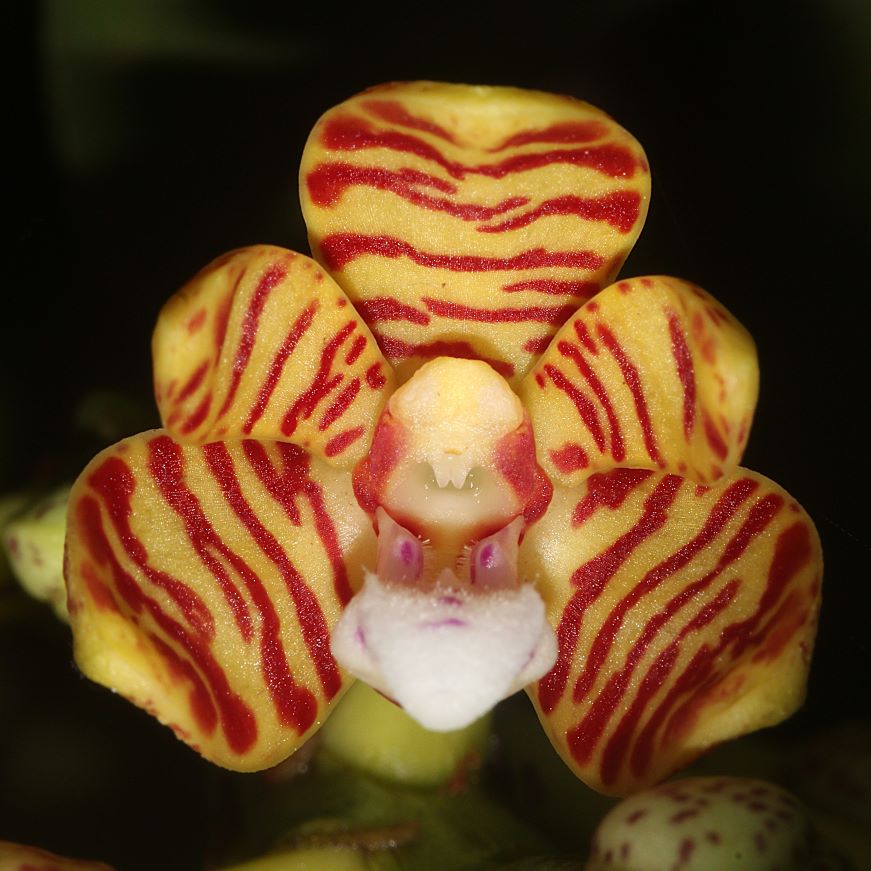


Bulbophyllum stellatum Ames 1912, is a species that is from the Philippines. Its a small plant with small flowers on an umbellate inflorescence.
.JPG)
In photos
of this plant in Asia I noted that the plants were in many cases much thicker
and longer than my plants and produced more and larger flowers. After observing my plants, I concluded that
the issue was that the plants were in baskets and pots that dried too fast for
this species. As a result, a plant that
could potentially produce a six feet cane, would top out at a third of that
size.
To rest
this hypothesis, I put a three-cane plant of this species in plastic soda
bottle that was cut in a way that there is a water reservoir at the bottom of
the bottle that the roots of the orchid can reach. I also made holes that allowed plenty of air
to reach the roots, this is to avoid rot.
The results
were highly gratifying. The plant
produced a five and a half foot cane, much thicker than usual. In the second year in the pot its on its way
to produce an even larger cane. This year it bloomed with many flowers, sadly
marred by thrips. I expect that next
year it will produce even more flowers.
I have a nasty surprise prepared for any thrip that might show up to eat
the flowers.
In the
future, I plan to make a basket that will allow for four or five canes to grow together.
Given the large size that such an arrangement would
achieve the basket and pot would need to be quite strong not to be turned upside
down by the sheer weight of the canes.
On a final
note, the size of a plant is influenced by many things, light, fertilizer,
watering, genetics, temperature and others.
It may be that some plants of this species are naturally small. The plant I used for the test came from a
parent that I knew can produce at least six foot long canes and maybe longer if
given optimal care. So don’t be
frustrated if you plant doesn’t suddenly becomes a giant.
.jpg)
.jpg)
For most
orchid growers nowadays, Phalaenopsis are the gateway drug to bigger and more expensive
plants. But the Phalaenopsis that are
now widely available are the product of many decades of hybridizing toward producing
a plant that will survive in the average home even when (shudder of horror),
watered with ice cubes. Orchids species
are an entirely different beast. With
30,000 species (at least) species orchids show growing patterns and seasonal
cycles very different from your average hardware store Phalaenopsis. That
is why it is important to read about the plants you buy. A lot of orchid growers do impulse buying and
then are bewildered by the way their plants react.
This is an adaptation to the cold dry season when the trees lose their leaves and it rains little. The orchids then have to endure months of drought and harsh sunlight. My plant blooms in April, just before the local rainy season starts. For months it looks like a mass of dead and shriveled stems. But this is deceptive. In the nodes of those leafless stems the flower buds are maturing. A well flowered plant is quite impressive.
If you look
at the top photo, the orchid looks like its in a wretched condition, ready to be
thrown into the trash can. But if you
look closely, you can see the remains of many inflorescences in the second
longest cane. Note the very small root ball. That is not unusual, if a plant is well fed
and watered it will produce just the minimum of roots it needs to fill its
needs. In the bottom photo you can see
the cane covered with flowers.
.jpg)
.jpg)
So, what I
have done is I have put the plant in an empty wire basket with no media. I am lucky that in my locality the climate offers a level of environmental humidity that is good for tropical orchids. Once or twice a day, depending on the
weather, I soak the plant. In hot, dry,
windy weather, I soak it twice a day.
Before soaking, I check it to make sure it is perfectly dry. For two months the plant stayed
inactive. But in August I saw three
basal buds start developing. Also a few
roots have started growing.
.jpg)
.jpg)
The best performing of all my Den anosmum huttonii plants is potted in a home-made wire basket. The wire basket is five inches deep and four inches wide. It looks small for an orchid that is several feet long, but it is the best option for me since this plant is growing outdoors and gets soaked almost every day during summer and fall which is the time of the rainy season. The plant has been growing since February and still have four months to go to finish its growing season. The plant has some keikis that I have kept on the plant so they will be larger and stronger when they are removed next year after the plant blooms. During the peak of the rainy season, it rains so much that the media can become coated in patches with white fungus. In a pot this would be really, really bad for the plant since the fungus accelerates the decay of the media and interferes with the capacity of the roots to absorb water. But in the basket, the roots still have access to moisture and oxygen in spite of the fungus. With the onset of the dry season the fungus dies out. Normally this type of fungus is kept in check by the daily cycle of drying that the media experiences every day. But during the rainiest days of the year, the media can remain wet for weeks or months even in the baskets.
This orchid
is growing so well I plan to move all my other var. huttonii to baskets. Because some of my plants are grown in the
north coast of Puerto Rico which is drier and windier than my current location,
I plan to grow them in plastic pots with a small water reservoir. I will try this because in the coast the winds
dries the media in the baskets much faster than in the mountains.
.jpg)
Some years ago, I started cultivating a Dendrobium cretaceum plant with the aim of eventually getting a specimen plant with many flowers. For aesthetic reasons I decided to cultivate the plant so that the canes hang from the bottom of the basket. The orchid is planted in a way that is extremely different from what is the usual way of growing Dendrobium. The plant was originally attached to the center of the bottom of the basket. That way the roots would grow up into the potting mix and the canes would grow downward. That is the exact opposite of how these plants are grown. The basket is six inches wide and three and a half inch deep. The potting media is bark, and fills the basket to a depth of two inches. Den cretaceum is not a big plant so this arrangement allows plenty of space for it to grow for years.
There two-inch
layer of media in the basket allows for plenty of air to reach the roots. This
is a very important detail. You would
think that is a very small quantity of media for a plant that one eventually
wants to become large and bushy. But due
to the local climatic conditions it is the perfect amount. The reason is that during summer and fall in
my locality it rains almost daily. At
the peak of the rainy season the media can stay wet for weeks or months. In a plastic pot this would mean a waterlogged
media that would quickly become devoid of oxygen, will start rotting and turning
into slush under the influence of fungi, bacteria, high temperatures and
fertilizer.
If all goes
well, by the start of the 2024 dry season, the canes will have reached their
full size. When the canes reach full
size, I stop watering and fertilizing the plant, it gets only the scant amount
of rain we get during the dry season. The
plant loses all its leaves and looks dead for a time. In
April I will start looking for the swelling flower buds along the length of the
canes. Then in May I expect the plant to
produce a mass of flowers. You can see on top the 2023 blooming. The plant as it is now is in the photo below.
.jpg)
.JPG)
Encyclia
alata is a species that can produce dozens of small fragrant flowers. In my garden in coastal Northwest Puerto
Rico, it does very well growing outside.
It can handle the dry season with no complaint and is unfazed by the
high temperatures of summer. But there
is a trick to growing this species successfully. It demands media that drains freely and doesn’t
get waterlogged. I have a plant that
has been growing for many years in a metal basket full of river pebbles. The
plant produced a tiny side growth. I
decided to mount the side growth when it had a number of pseudobulbs. I mounted it in a piece of wood. in the
lowest part of the mount so that it would eventually climb. The plant took its time growing but it
finally produced a larger pseudobulb. It is very, very important to attach the plant firmly to the piece of wood, otherwise it will not be able to grab the wood with its roots. The roots are growing upwards into the wood
mount. Note that the surface of the
piece of wood is slightly rough and uneven.
The roots are following the contours of the piece of wood. The plant is also producing aerial roots,
some of my plants have long aerial roots along with the roots that are growing
into their pots and mounts. An
unexpected problem is that the wood proved to be less resistant to decay than I
thought. What I will do when the wood decays
too much? I will affix the plant, piece of wood and all, to a larger piece of
wood and then allow the old piece to decay and fall to pieces, as the plant as
the plant attaches itself to the new mount.
This plant is a few years away from blooming but once it has a larger
root system its rate of growth is sure to pick up.


