 |
| This form has a flat open flower with green sepals and petals |

Cream colored flowers |
 |
Yellowish nodding, slightly cupped flowers
with lips whose sides curl back |
 |
| Relatively shorter lip on green flower |
 |
| An inflorescence with five open flowers |
 |
A very pale form with cupped sepals
|
 |
Seed capsule
|
The orchid Psychilis monensis is endemic of the island of Mona. Mona Island sits in the Mona channel which
located is between Hispaniola and Puerto Rico.
Mona Island is a deserted island only inhabited by a few personnel of
the department of natural and environmental resources of Puerto Rico. It is visited by fishermen hunters and
campers but lately, mainly due to a number of deaths on the island caused by
sunstroke, dehydration and accidents, the number of visitors has reduced
significantly. Mona Island is part of
the United States, it was ceded to the nation after the Hispano-American war
along with Puerto Rico and other islands of the Puerto Rican Bank.
The main terrain in Mona Island
is a flat limestone plateau mostly at an elevation of one to two hundred feet
above the sea. The island receives a
comparatively low quantity of rain, 30 inches a year, and most of the
vegetation is composed of drought resistant plants. The limestone plateau is a particularly
challenging place for plants to grow due the harsh conditions that prevail on
it. Most of the ground in the plateau consists of
bare, rain eroded limestone, this terrain can severely damage even the most
sturdy footwear faily quickly. There are
trees in the plateau but they are small and occur where there is a pocket of
soil in the rocky terrain. Sunlight is
fierce and temperatures high which makes dehydration and sunstroke a constant
threat.
In these surroundings, which not
in the least resembles what most people think as the ideal orchid growing
environment, Psychilis monensis not only lives but thrives. In certain parts of the islands plants are
downright abundant. I visited Mona Island
in July 2012 and one of my goals was to see this orchid. I went for a short walk to look for orchids
about an hour before sunset, when temperatures are tolerable and sunlight is
considerably reduced in intensity. I
found that in a particular area of low shrubs these orchids were exceedingly
common. Many shrubs had Psychilis
growing in the middle of them, some of the plants were large specimens. In the largest plants almost every pseudobulb
had an inflorescence.
Psychilis plants were growing everywhere in this area, on the
ground, on cacti, on dead or dying trees and on the bare rock. However plants exposed all the time to full
sun were stunted, with reddish leaves and few if any inflorescences. Plants growing in soil seemed in worse shape
than either those in bare rock or growing as epiphytes. In fact a number of the plants that were
located directly in contact with soil were dying or had dead parts. The largest and healthiest plants were those
located one or two feet over the ground on a shrub that shielded the plant from
the worst of the midday sunlight and yet allowed a considerable amount of sunlight
to pass through.
The flowers of Psy. monensis are surprisingly
variable. I heard a presentation where a
student that had done some field research argued that this was due to the fact
that they don’t give a reward to pollinators and they need to have variability
so that potential pollinators won’t learn to avoid them before pollination is
affected. Unfortunately my camera stopped
working on my second day in Mona so I have only a few photos of the flowers of
this orchid, taken on a small area near the Sardine Beach. Nevertheless I saw a bit of the variation
that one can see in the whole island. In
the flowers I saw the floral parts could be short or long, perpendicular to the
lip or almost parallel to it, green, pinkish white or pale yellow. The lip could be richly colored, white, long,
short, flat or with its sides recurved back.
Some flowers were nodding with the lip hanging straight down and others
held the lip almost horizontal. The
inflorescences can bloom repeatedly, I saw one with evidence of having bloomed
six or seven times.
No other orchid compares in
abundance with Psychilis in Mona
island. You can find a few plants of Domingoa here and there, Oeceoclades in forested areas of the
coast and Vanilla, Tolumnia and Broughtonia in particular locales in the interior of the island,
but all of the previous orchids have a patchy distribution and, when compared
to Psychilis, take an effort to find. I have read accounts of orchid collectors
from the eighteen and nineteen century that remark on finding orchids in the
hundreds and even in the thousands growing all over the landscape. In Mona Island you can still see a glimmer of
how a pristine orchid population looked to those early explorers.
Happily the orchids of Mona Island are pretty
safe from human depredations and likely to remain so for the foreseeable
future. The main thing that protects
these orchids is that the average orchidist reaction to the flowers of Psychilis is probably “meh”. The relatively small flowers of Psychilis can hardly compete, in the
eyes of an average orchidist, with the very many brightly colored, large
flowered hybrids that are currently the norm in the orchid market. I know that visitors occasionally take
plants, but this collecting doesn’t seem to make even the tiniest noticeable
dent in this orchid population and must be very light indeed as you can find
large plants at a few minute walk from the camping grounds, something that
would not happen if any amount of collecting was happening as usually it is the
largest and most handsome plants the ones that are collected first. Without a doubt probably almost all of the
plants that have been taken from the island have died. In all my years of orchid growing I have only
seen a single plant of Psychilis monensis growing successfully out of
Mona Island. It was twenty years ago in
Cupey, in the garden of a non-orchidist that had tied the plant to a wooden
post in his garden when he had arrived back from a visit to Mona and had
subsequently given it absolutely no care or attention to it. I have heard that there are a few plants in
cultivation, but unlike Psy. kranzlinii,
Psy. macconellia and Psy. krugi which show up regularly in
orchid shows, I have yet to see a Psy. monensis at a show. My suspicion is that Psychilis monensis just can’t survive the way in which most
orchidist treat their plants as it is radically different from what these
plants experience in their natural habitat.
This Psychilis is so common in its habitat because it is supremely well
adapted to conditions that few other plants can tolerate. In the coastal areas of Mona, where
conditions are much more moderate you are hard pressed to find plants of Psychilis growing anywhere. These plants have adapted to high levels of
sunlight, strong desiccating winds and weeks or even months without any
measurable rain. Move a plant such as
this to a shady, humid spot with stagnant air where it gets drenched with water
every two or three days and im all probably it won’t survive, particularly if
its roots are buried in bark and kept wet all the time. So my advice is simple, leave these plants in
its natural habitat.
 |
| Large plant with many inflorescences |
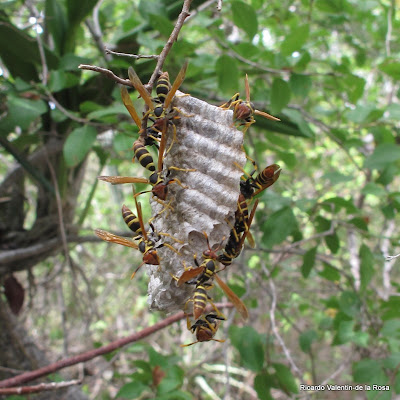 |
| A common hazzard in Mona Island |
 |
| Psychilis monensis inflorescenses can rebloom several times |


