Showing posts with label Coelogyne. Show all posts

Tuesday, October 22, 2019

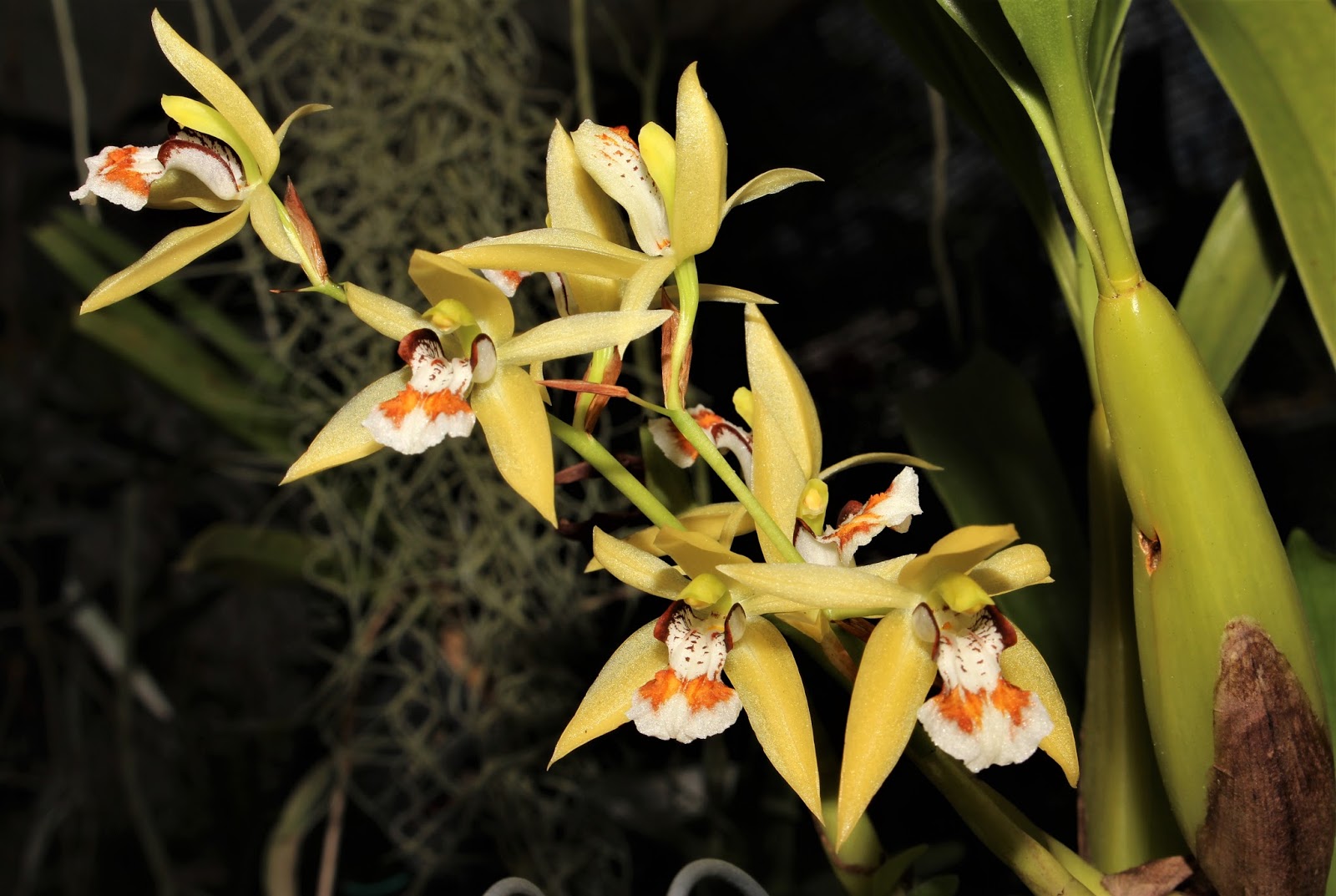
Coelogyne rochussenii de Vriese 1854. Beautiful and with a powerful fragrance


I brought this plant about five years ago.   Initially it didn’t do well.  For reasons that I could not decipher the new growths kept dying from rot.  This is a very unusual thing to happen to a Coelogyne in my garden.   None of the other Coelogynes I grow, Burfordiense, mayeriana, parishii and an unknown one similar to schielleriana, has ever lost a new growth from black rot.   After the plant had initiated, and lost several new growths I decided that it was just not doing well in my growing area in the mountains of Puerto Rico.  I took the plant to my other growing area, which is in the lowlands near the northwest coast of the island.  It is warmer and drier that the other location.  Since the plant didn’t have that many roots and no new growths, I put it over a pond, where it would be in a humid environment but without the constant wetness of the other area in the mountains.

The plant slowly began producing new growths and thankfully they didn’t rot.  I was not paying too much attention to it since I worried that I might have been killing it with kindness.  The plant spent years over the pond, including staying there during two hurricanes, which didn’t have the slightest effect on it.

Last week as I was walking in the garden, I noticed that it had some green growths, I initially thought they were young pseudobulbs, but on closer inspection I found out they were inflorescences.  I was delighted.  The plant produced an inflorescence las year, but it was short and not impressive.

I took the plant with me to the mountains so I could enjoy the flowers.  The flowers opened today, the 22 of October.   Initially the fragrance was slight.  But by 10 am the fragrance was powerful, in fact so much so that it was cloying.   It is a nice fragrance, but as I stood close to the two inflorescences, it was so strong I could almost taste it.   In the afternoon, the flowers started to close and the fragrance abated considerably, by night fall I could detect no smell.  Many of the photos I have seen in the internet show flowers that are partly closed.
I plan to grow this orchid into a specimen plant.  It grows well with little special care.  My suspicion is that I was watering it too much.   It seems to like environmental humidity but not being wet all the time.  I plan to use a flat plate to grow it to allow it to ramble at will, the conical pseudobulbs are separated by stolon that is a few inches long.  This means that this orchid will escape from a typical pot in one or two years at most.

Monday, August 27, 2018

Coelogyne pulverula Teijsm. & Binn. 1862, a specimen plant


This orchid was seen the 2018 Puerto Rico Orchid society show.  It is a large and healthy plant with long inflorescences and beautifully colored flowers.  It is labeled Coelogyne dayana "pipping rock".   Coelogyne dayana is a synonym of Coelogyne pulverula.

Sunday, February 26, 2017

Coelogyne lentiginosa Lindl. 1852


This plant is being grown in the central part of the island, in a mountainous area where the local temperatures are usually cooler than on the rest of the island.

Saturday, November 12, 2016

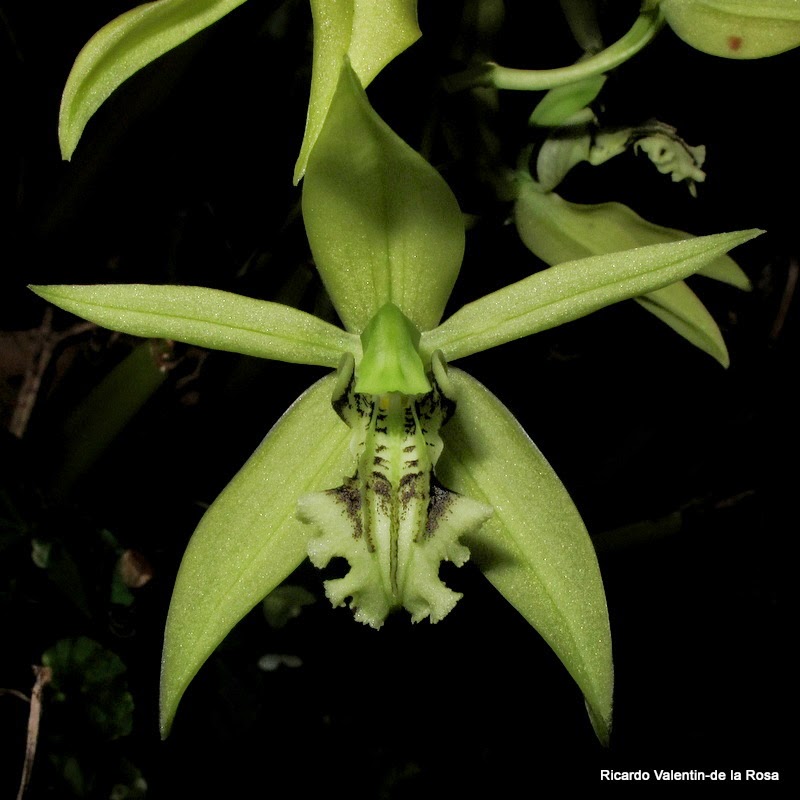
Coelogyne assamica Linden & Rchb. f. 1857, the flowers look different from what is identified in other places as assamica. But that is what the label said.


I brought this plant in the Puerto Rico orchid society show last spring.  I wanted to see if it would grow and bloom in my area.  Green flowered Coelogyne thrive and bloom well in my location and will even endure relative neglect with little complain.  This species is a refreshing change from the green flowers of my other Coelogyne.  I have tried to grow white flowered Coelogyne with little success.  I tried mooreana and it died.  I also tried lactea, this one grew well but flowered so rarely I gave it away.  Perhaps in the case of lactea, I was growing it wrong.

Sunday, April 10, 2016

Coelogyne flaccida Lindl. 1828


I saw this plant at the April 10 meeting of the AOS judges in Ponce, Puerto Rico.  It is faily uncommon to see white Coelogyne in bloom in shows in the island.   Usually you see either Coe. parishii, a green species or Coe. Burfordiense, a green colored hybrid.  I grew Coe. lactea and it would grow well but not bloom in the hot coastal lowland, but it would bloom in the cool and humid mountains, when grown at an altitude of about a 1000 feet over sea level.

Sunday, January 18, 2015

Coelogyne parishii Hook. f. 1862, a specimen plant


In the Puerto Rico orchid society show in San Juan in 2010, this plant won best specimen plant and also was awarded a CCM/AOS of 86 points.  This award recognizes the superior culture of an orchid.  I gave it the clonal name "Juan A, Rivero".   Professor Juan A. Rivero, or the University of Puerto Rico at Mayaguez,  gave me a two pseudobulb piece of this orchid the first time I visited his garden, in 1984.  This plant has been thriving under my care since that time.  This orchid tendency to produce two leads in each new growth allows it to become a large specimen plant in a relatively short time.  At the moment it was awarded it had 254 flower.  In 2011 it also produced a large quantity of flowers but I had to cut the leaves since they were in a lamentable state, probably due to unusually sunny and dry conditions in my garden.

Sunday, February 23, 2014

Coelogyne lycastoides F.Muell. & Kraenzl. 1895


Photographed at the 2014 Ponce orchid society show, Ponce, Puerto Rico.

Tuesday, February 18, 2014

Coelogyne pulverula Teijsm. & Binn. 1862


Photographed at the 2014 Ponce orchid society show, Ponce, Puerto Rico.  This is the first time I have seen this species exhibited at an orchid show locally.  It is very nice, I hope it becomes widely available.

Wednesday, December 18, 2013

Coelogyne Burfordiense, cultural note, growing it on a wire column


My plant of Coelogyne Burfordiense (Coe. asperata x Coe. pandurata) gives me very little problems except for the fact that it has a very vexing trait.  It will escape, sometimes in less than a year, from most pots.  Planting it in a large pot is a problem due to the large quantity of media that has to be used and the almost sureity that the big mass of media will become anoxic and kill the roots.  So I decided to grow this plant attached to a column of wire, this would allow me to train the growth ups and keep the plant tidy, or as tidy as it could be.  I made a 36 inches tall wire column, I used the sturdiest, strongest wire I could find.  Then I attached the column to the side of a 12" pot.  I attached the column using wires threaded through holes in the pot.  I made sure that the column was very firmly attached to the pot, this is essential as I often move the pot by pulling the column.  I started growing this plant this way in October 2007.  My plan was to keep adding media as the plant climbed up the column.


By May 2010, the plant was producing impressive bloomings with several inflorescences opening at the same time.  Most of the growths were close to the column, but some has grown out toward the sides, those were cut out when they had two pseudobulbs or more, only those pseudobulbs that kept close to the column were allowed to remain.  However it is important to keep a close watch when the plant is producing new growths so that they don't become tangled in the wire or try to grow into the column. 


This is the plant as it is now December 2013.  It has a considerable weight and had to be moved to a location where it gets full sun for part of the day because it had so many leaves it was self shading.  The growths have reached the top of the column.  The plant stands about four feet and a half tall at the tip of its top leaves.  Last year it produced nine inflorescences during a several months blooming season.  Next year I will probably have to cut the top growths which by then may be jutting out into space.  But I expect that by then I will have another pot and column ready for them, and who knows, I might even try to make an even larger one.


As you can see the plant can send inflorescences every which way, not ony toward the side that gets the strongest light.  To the left you ca  n see a string of pseudobulbs growing away from the column with their roots all exposed.  Note that the inflrescences are at several stages of development, from just emerging to losing their flowers.

Rainfall supplies the water needs of this plant, only at the height of the dry season is there a need to water it.  Here are approximate values for rainfall in the Rio Abajo area.

                             J       F      M       A       M       J       J       A       S      O      N      D
Rainfall (mm)      99    76     84      165    283    155   141   216    237   233  176   135

(inches)               3.9   3.0    3.3    6.5    11.1    6.1    5.5   8.5      9.3    9.1     6.9   5.3

Monday, October 14, 2013

Coelogyne ovalis


This orchid was seen at the Mayaguez Orchid Festival of September 2013.  This was a large plant with several flowers open at the same time.  I have seen a number of specimen plants of Coelogyne ovalis in shows in Puerto Rico.  I have observed a variation in the size of the flowers of different plants, some have flowers that are significantly larger than others.

Wednesday, October 20, 2010

My Coelogyne Burfordiense and Coe. mayeriana and their differences (I originally thought my Burfordiense was pandurata)

Coelogyne Burfordiense 
Coelogyne mayeriana pseudobulb
Coelogyne burfordiense pseudobulb
Lip of mayeriana
Lip of Burfordiense
I have three types of tropical Coelogyne, in this post I compare my plants of Bufordiense and mayeriana.  Originally this article listed Burfordiense as pandurata because this was what was in the label when I brought my plant.  Since then I have talked with many orchid growers and I have come to the concludion that my plant is the hybrid Bufordiense (pandurata x asperata)  Key to this understanding was a group in Facebook named Coelogynes e afins in which flowers of pandurata were shown, they clearly lacked the yellow warts that come from asperata.  I thank them for sharing their knowledge.

Coelogyne Burfordiense is a huge plant with pseudobulbs and leaves that are far larger than the other related species or hybrids. As you can see in the photo a well cultivated plant can produce five to six inches tall pseudobulbs, since they are also wider than the pseudobulbs of the other species a Burfordiense pseudobulb at five inches is far more massive than a mayeriana that tops out at two.

The denomination pandurata makes reference to the fiddle shape (pandurate) of the lip of the flower. Coe. Burfordiense has inherited this lip shape.  The mayeriana I have produces smaller flowers that don't have a fiddle shaped lip. Nevertheless I have seen mayeriana with lips that approach the shape of pandurata, which muddles the issue a bit.

In both orchids the color of the lip is black. Hybrids with other species can look pretty similar to pandurata but the brownish color of the flowers on some of them, and the presence of the warts from asperata is trait that can be used to identify hybrids.

The lip ornamentation on my Burfordiense is quite elaborate with black spines, yellow warts, and keels along the long axis of the flower. The flowers of my mayeriana are similar but the warts are white.

The inflorescences of Burfordiense can produce up to 17 flowers at a single time and are large and robust. The mayeriana inflorescence is much shorter than that of Burfordiense, the stem of the inflorescence is thinner, my mayeriana plant only produces four to six flowers per inflorescence.

The Coelogne species mayeriana, pandurata and parishii and their hybrids are relatively simple to cultivate if you live in the tropics and have the space to accomodate their rambling growth. Coelogyne Burfordiense is particularly bothersome in respect to potting as a plant can outgrow a pot in just a few months because of its long internodes between pseudobulbs and the large size of the plant.