Showing posts with label blanca. Show all posts
Saturday, September 24, 2016
Cranichis tenuis Reichenbach f. 1865, found some dew covered flowers today.
Today I visited a population of Cranichis tenuis in the Maricao forest. I was surprised to find only seven plants, when last year were dozens. The place where they grow is not often visited by people so human influence is not suspect. I visited the place early in the morning and found these flowers covered with dew. I like how the flowers look.
Thursday, April 7, 2016
Dendrobium Silver Bells 'E Orchids' AM/AOS (Den. schuetzei x Den. Alice Iwanaga)
This plant was exhibited at the 2016 Puerto Rico Orchid society show. I won an American Orchid Society merit award. The plant is well cultivated and the flowers were many and huge.
Monday, January 19, 2015
Dendrobium Star Sapphire and Dendrobium nobile
| Dendrobium Star Sapphire |
| Dendrobium nobile |
Dendrobium Star Sapphire is a wonderful example of the hybridizer's art. As you can see. all the characteristics that make Den. nobile a worthwhile species to keep, have been enhaced. The flowers or the hybrid are larger, the color is deeper and the form of the flower and its presentation are much better. Unfortunately, a few years ago, my only plant of Den, Star Sapphire departed for the great happy terracota pot in the sky. This was very surprising as all the other Den, nobile hybrids I have have been very resilient and grow without any problems.
Saturday, August 24, 2013
Gaeotis una semi lapa endemica de Puerto Rico
Personalmente siempre he asociado a los Gaeotis con los grandes bosques de
palmeras Prestonea montana que
dominan el dosel a ciertas altitudes de la sierra de Luquillo. Es en
los bosques de la Sierra de Luquillo donde he visto estos animales en su mayor
abundancia y tamaño. De vez en cuando
me he encontrado uno de ellos en la cordillera central de la isla, pero nunca
en la abundancia que lo he visto en las cercanías de El Yunque. En Rio Abajo los asocio a áreas pantanosas y
a la noche. Por esta razón me sorprendió
encontrar un Gaeotis en una de las
canas de bambú que crecen en el aviario de Rio Abajo a plena luz del dia. Es el caracol Gaeotis nigrolineata, digo a menos que le hayan cambiado el nombre
de la especie o hayan descrito otras
especies recientemente. Veo que hay
algunas personas que la llaman Gae. flavolineata,
pero no he podido encontrar la razón del cambio de nombre. El área del aviario tiene periodos en que la
lluvia satura el terreno y hay charcos por doquier, pero también hay meses en que
deja de llover por varias semanas al punto que aparecen profundas grietas en el
suelo. Me imagino que la aparición de la
Gaeotis fue causada porque el 21 de
agosto de 2013 el aviario experimento 4.80 pulgadas de lluvia, casi toda en
unas pocas horas entre el medio dia y las 6 pm.
Esta importante cantidad de precipitación causo la saturación del
terreno y la aparición de niebla. Aparentemente, por algunos días, el bosque de
Rio Abajo ofreció las condiciones ambientales favorables como para que los Gaeotis estuvieran más visibles de lo
usual.
Tuesday, August 13, 2013
Stanhopea panamensis N.H. Williams & Whitten 1988,
I got this Stanhopea orchid many years ago as a two bulb division, it was a
gift from a friend. I planted it in a
basket filled with small pieces of coconut husk. I watered and fertilized it weekly. Under the climatic conditions in Aguadilla
the plant grew slowly. Originally this plant was in a garden of my
mother’s house, which is in Aguadilla, in the northern coast of Puerto Rico and
about a mile from the Atlantic Ocean.
This part of Puerto Rico is characterized by often windy conditions as
well as warm to hot weather. In these
environmental conditions the plant didn’t do too well, probably because I was
watering it less than it needs in this warm climate.
When I moved to Arecibo, to a
location about 1,000 feet above the sea, the plant started doing much better. To me the main reason is that in this
location it rains more than in Aguadilla, but maybe it helps that the new
location is cooler. During spring, summer
and fall the media in which this orchid is growing stays moist just from the
water it gets from rain. During some particularly rainy periods it remains wet for
weeks or even months. Sometimes it
rains so much that the media becomes absolutely waterlogged. I these very rainy
times, here and there, patches of white cottony fungus appear in the media. However the plant doesn’t seem to be bothered
by the fungus. The fungus dies off when
drier weather returns. The climatic
conditions in this part of Arecibo are more moderate than in Aguadilla and it
hardly gets as hot. Only for a few
months in the summer the temperatures in my location in Arecibo become hot
during the day.
In Arecibo, this orchid grew into
a large and heavy plant, but it would not bloom. The plant was moved to a sunnier spot than it
had been growing and it eventually bloomed.
I thought I had found the perfect spot for this plant among my pendent Dendrobium, but this conclusion was
produced by the fact that I moved the Stanhopea
with them in the spring. Because of the
movement of the sun along the horizon during the seasons, the Dendrobium shadehouse is sheltered from
exposure to full sunlight for most of the day during spring and summer. But in fall and winter, the shadehouse
receives full sunlight for many hours.
This is ideal for the pendent Dendrobium
but the Stanhopea could not cope with
so many hours of direct sun. As a result
of the increased exposure to sunlight the Stanhopea
lost all its leaves, happily the
pseudobulbs were not harmed and the plant recovered quickly. I had to experiment a bit to find the right
place for this plant, one where it would bloom well but not get its leaves
sunburned. Presently my plant is in a
place where it gets unfiltered sunlight until 10 am and dappled sunlight for
the rest of the day.
In my garden this plant blooms in
the summer, however it has also produced inflorescences at other times of the
year, even in December, at the start of winter.
For some reason, every year it aborts one or two inflorescences when
they are about half developed, it is not clear why that happens as it usually
has other inflorescences at the same time that develop normally. The inflorescences take six or seven weeks
from the time I find them poking out of the media to the time the flowers open. The inflorescences my plant produced carry
from four to seven flowers. The flowers
last around three days. The fragrance is
reminiscent of chocolate. My plant
cannot be classified as a prolific bloomer.
The media in which this plant was originally planted decayed
a long time ago. The plant now has a
root ball that grips the remains of the bark that I used the last time I
refreshed the media. Any kind of
repotting is out of question as Tthe roots grow in all directions, sometimes
even upwards, any attempt to remove it from the basket to change the media
would result in severe root damage. The
plant produces new growths along the edges of older pseudobulbs, which are on
top of the basket. But in early in
2013, a new growth popped out from the side of the basket, about two inches
under the top of the media. This new
growth has been developing normally, and even produced an inflorescence in
spite of being smaller that the full grown bulbs on top of the basket.
This orchid is doesn’t need much attention with two
exceptions. One is that it resents
underwatering, the other is that the basket where it is growing is a veritable
weed magnet. In the rainy season I have
to weed the basket to prevent the weed growth from becoming too heavy. Among the most persistent weeds are the ferns
and begonias.
In Puerto Rico Stanhopeas have never been particularly
common orchids in local collections.
Having said that I can attest that particularly knowledgeable growers
have been growing them for many years. I
saw my first Stanhopea plant at an open house of the Universidad de Puerto Rico
in Mayaguez about thirty four years ago.
The plant was the property of Dr. Rivero.
Tuesday, October 30, 2012
Oncidium Sharry Baby 'Sweet Fragrance'
This Oncidium hybrid has many virtues, it is relatively easy to grow, can be forgiving of neglect and if well cared for, it can produce large inflorescences of deliciously fragrant flowers that produce a powerful chocolate fragrance. A single large mature pseudobulb can produce two inflorescences at the same time and those can carry dozens of flowers. I have read that some people don't like the leaves of this orchid because they are not the smooth green of other Oncidium but can be covered with tiny blemishes, but to me this is a minor defect. The flowers are so nice that it is easy to overlook the leaves. Best of all mature plants can be found in many places from specialist orchid vendors to department stores. Good sized and well bloomed plants can often be obtained at reasonable prices.
How I cultivate this plant:
Light: Young plants get bright shade, adult plants get a few hours of sun in the morning but are sheltered from the harsh midday sunlight. Giving the plants as much light as they can stand without burning has given me the best results.
Watering: Almost every day when the plant is producing its pseudobulbs, particularly the phase where the pseudobulb is increasing in size.
Fertilizer: In every watering when the plant is producing new growths. No fertilizer when it is blooming or not growing.
Potting media: It seems to grow equaly well in bark, tree fern and coconut husk pieces.
Temperature: Summer: 85F day, 75F night, winter 75F day, 65F night.
Wednesday, October 3, 2012
Laeliocattleya Marie's Song
I love this plant, it grows well with standard care and usually produces four flowers at a time. It has survived both fungus and scale insects. The flowers are richly colored and using sunlight for the photo made the colors come out even better.
Tuesday, April 26, 2011
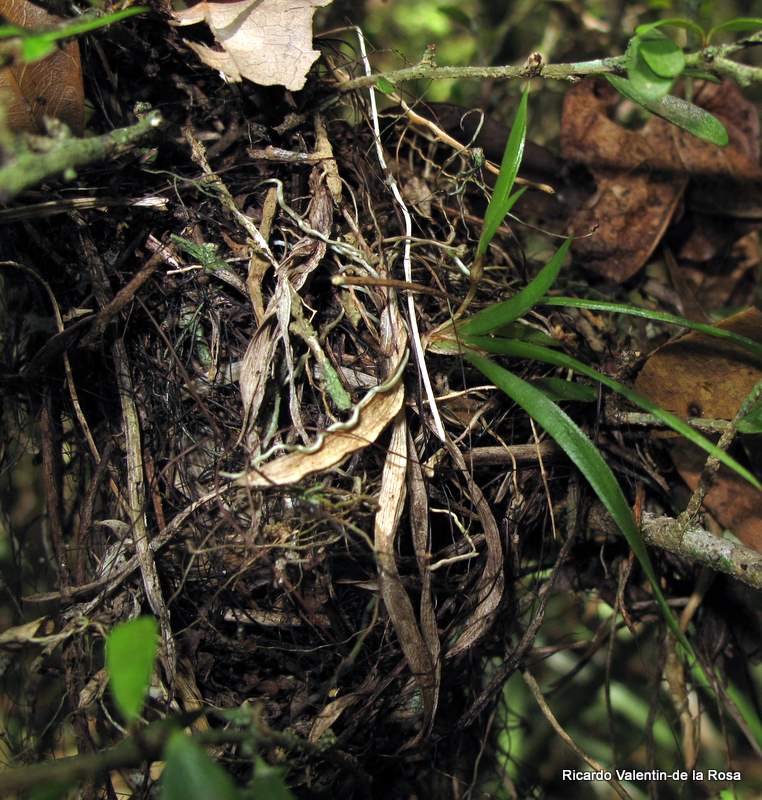
Tolumnia (Oncidium) variegata, birds weaving this orchid into their nest
| Tolumnia variegata, one of our most common native orchids |
| A nest of an unidentified species of bird |
Subscribe to:
Posts (Atom)