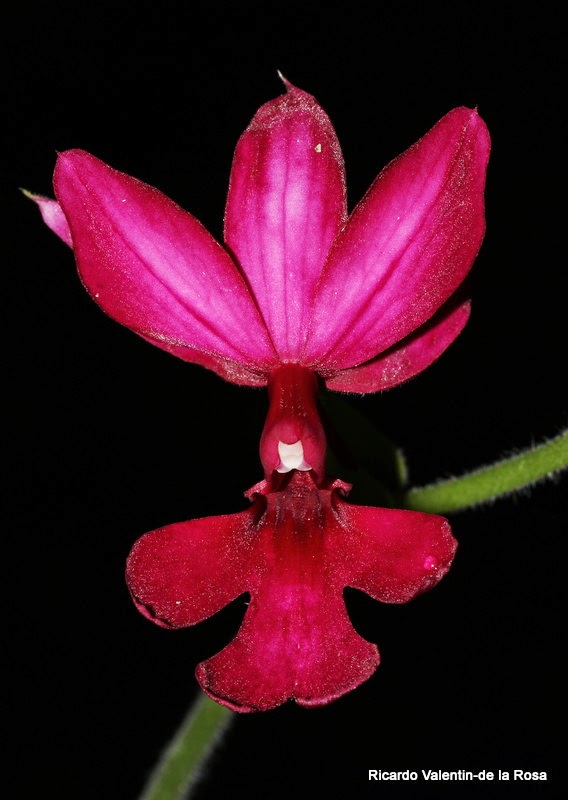
Showing posts with label terrestrial. Show all posts

Tuesday, August 29, 2023

Neobenthamia gracilis culture


I lost many orchids in the aftermath of Hurricanes Irma and Maria.   Most of them were in pots.  So, I decided to plant most of my orchids in baskets to avoid a repeat of that disaster.  Not all plants do well in baskets.   One plant that thrives in a pot is Neobenthamia gracilis.  I decided to experiment how it would do in a basket.   Neobenthamia defies our concept of what an orchid should look like.  A well grown plant looks like an untidy patch of grass.  

I planted a few keikis in a custom-made basket and filled the basket with pieces of coconut husk and a layer of leaf litter.   The keikis grew slowly.   The plant grew and produced new canes at a slow pace.  It eventually produced adult canes that bloomed.  The inflorescences are smaller than those of plants that I had in the past potted in a mix of bark and leaf litter.   The keikis took five years to reach blooming size.   I think that the plant would have taken less time if I had given the basket a top dressing of organic fertilizer.   Although the plant has not done as well as I would have liked, I will keep it in the basket, as a back up in case I lose the other plants.

The root system in the basket is large and its in an excellent condition.  When the plant starts producing keikis I will plant them in pots.  I will keep the mother plant in the basket, just in case.  


Monday, November 21, 2016

Calanthe rubens Ridl. 1890


I used to grow many plants of Calanthe rubens.  They would put a beautiful show in early winter.  However eventually I gave all my plants away.  Mainly because I acquired larger, showier hybrids that would bloom for a longer time.  However I still remember them fondly there were they first Calanthe I ever cultivated and they would bloom very well with little care.

Saturday, September 24, 2016

Cranichis tenuis Reichenbach f. 1865, found some dew covered flowers today.


Today I visited a population of Cranichis tenuis in the Maricao forest.  I was surprised to find only seven plants, when last year were dozens.  The place where they grow is not often visited by people so human influence is not suspect.  I visited the place early in the morning and found these flowers covered with dew.  I like how the flowers look.

Thursday, June 30, 2016

Unknown Sobralia species in my garden


I brought this Sobralia a few years ago as a small, two cane plant.  It has been growing slowly but steadily since then.  It now has several canes which I expect will bloom in the coming months.  It is growing at an altitude of about 1,000 feet above see levels in the mountains of Puerto Rico.  I find this plant easy to care for and it has not given me any problems.  I only water it during the dry season, the rest of the year the local rainfall is enough to cover its needs.  The flowers last only a single day.  If the day is particularly hot and dry this will make the flowers wilt sooner.  The flowers are fragrant.  I keep the plant close to main door of the house so that I don't miss the flowers when I leave the house in the morning.

Saturday, April 23, 2016

Paphiopedilum Genevieve Booth (Mount Toro x rothschildianum)


I brought this plant as a seedling some years ago.  It has grown well in my climatic conditions and pest doesn't bother it.  This is its first blooming, 

Saturday, April 2, 2016

Paphiopedilum Susan Booth x Paph. Prince Edward of York, an elegant hybrid


I saw this tropical ladyslipper in the 2016 Puerto Rico orchid society show.  This hybrid plant is large when adult and the flowers are big and elegant.  The petals are long and held in a nice stance to the sides of the plants.  Few people cultivate this type of multiflora Paphiopedilum in Puerto Rico even though the plants are very easy to grow in our climate.  However the plants can be expensive and slow to reach blooming size.

Paphiopedilum Michael Koopowitz (phillippinense x sanderianum) the first blooming of my plant


I brought this plant a few years ago and hardly expected that it would bloom in a relatively small plant.  The plant has two leaf fans, a mature, the one that bloomed and one that is still growing.  Compared with the parents the plant bloomed relatively small.  It produced three flowers.  The longest petals measured 13 inches long.  The flowers lasted well, but I cut them after two weeks to allow the plant to spend its energy growing.  I expect this plant to increase significantly in size in the future and to produce even larger inflorescences.  So far this orchid has presented no challenges in its culture.  I keep it with my collection of multiflora Paphiopedium, under the shade of saran cloth.  It is growing in bark in a six inch pot.  It gets watered twice a week and fertilized once or twice a month.

Sunday, October 18, 2015

Cranichis tenuis Reichenbach f. 1865, the population I found in the landslide last year has become larger


Last year I found a few plants of this species growing in nooks and crannies among the rocks of a decades old landslide.  In this year blooming season I found many more plants than last year.  It seems the conditions at the landslide site has become favorable for the growth of this orchid.  

Friday, May 15, 2015

What orchid seed actually looks like; The seeds of Oeceoclades maculata being released from a seed pod in the Rio Abajo forest, Puerto Rico


Most orchid growers are unfamiliar with the appearance of the seeds of orchids.  From time to time one sees questions in forums of the Internet of people that have brought "monkey orchid seeds" and are unable to tell if they got actual orchid seeds or some other types of seed.   Orchid seeds are quite small, almost dust like, so if any that has brought the "monkey orchid seeds" gets anything resembling a normal seed, it surely isn't an orchid seed.

I was hiking through the Rio Abajo forest and stumbled upon a group of Oeceoclades maculata with open seed capsules.  I decided to gently shake the stems that held the seed capsules so that they would release the seeds.  In the photos you can see how tiny the seeds are and how the wind quickly wafts them away.

Monday, May 11, 2015

Paphiopedilum Song of Love (Paph lowii x Paph. liemianum) this is a first bloom seedling


This is a first bloom of a plant I brought from Carter and Holmes some time ago.  Paphiopedilum are not really that popular in Puerto Rico among the average orchid grower, but they are not rare in the larger local orchid collections.  I find most Paphiopedium very easy to grow in the coastal region of Puerto Rico.   

Saturday, May 9, 2015

Habenaria amalfitana F.Lehm. & Kraenzl. 1893 in the elfin forest in El Yunque


I was hiking in the upper reaches of El Yunque national forest, in Puerto Rico in May 4.  The forest was very dry, and the orchids with flowers were few and far between.  I was tired and frustrated when I returned to the parking lot where I had left my car.  I sat on the ground and when I looked around I noticed that on a place where there had been a tiny landslide there were some curious plants.

When I looked closer, I could see about ten plants of this species in various stages of growth, from young seedling to plants bearing seed capsules.  The plants are inconspicuous and very easy to miss,  If the spot where they were growing had been covered with more plants I would have missed them entirely.  In Puerto Rico this orchid is only known from the Luquillo mountains.

Wednesday, February 25, 2015

Cyclopogon cranichoides (Griseb.) Schltr. a terrestrial orchid with very dark leaves in the Rio Abajo forest in Puerto Rico


I have passed through the part of the Rio Abajo forest where this orchid grows literally thousands of times.   I had never noticed than an orchid was growing in the place where this orchid lives.  The main reason is that is is a muddy shallow ditch that is normally covered with dead leaves unless a particularly strong rain shower washes them away.  The color of the leaves of this orchid is a good mimicry of the color of the dead and decaying leaves that cover the area most of the time.

I probably would have never stopped to look at the spot if I had not noticed the inflorescence.  The color of the leaves hide them from sight but apparently some animal found them tasty and took out a few bites from them.  The flowers are nodding and tiny so getting a good photo was a bit of a challenge.  This is the only plant of this species I have been able to find in this location.  Nearby there are plants of Erythrodes, Ponthieva, Cranichis and Oeceoclades orchids growing on the ground.

Tuesday, February 10, 2015

Cyclopogon elatus (Sw.) Schltr. 1919, a native orchid in a shaded ravine in the Rio Abajo forest


Today I visited a shaded ravine deep inside the Rio Abajo forest, near the center of the island of Puerto Rico.  This plant was growing near a tiny creek that flowed between the haystack hills.  I almost missed seeing it due to its small stature and dull colored flowers.  But because it was early morning, sun rays were coming at an angle and one of them hit the inflorescence and made it stand out from the rest of the vegetation.  The area has very tall trees which means the forest floor is quite gloomy.  There is a population of manaca palms, Calyptronoma rivalis in the place.  The palms are still young, they were planted there by the Puerto Rico Department of Natural Resources.  The place had many interesting plants but I was there only briefly and barely had time to see a small patch of the ravine.  The place is quite safe from visitors as it can only be reached after an strenuous walk through rugged terrain.

Thursday, January 29, 2015

Epidendrum ackermanii Hágsater 2004, in Maricao, the inflorescence of a plant growing under the shade of a Clusia rosea

Most flowers of this species are a pale lilac color, this inflorescence had unusually deep colored flowers.  I saw this plant in the Maricao forest in an area where a rockslide had obliterated all plants in its path.  This orchid is growing under the shade of a Clusia rosea tree.


This is the most common color of these orchids.


Calanthe Vintage Wine 'Mendenhall' x Calanthe Rozel 'Red Velvet, first blooming

This is the first blooming of this hybrid for me.  The flowers are a lovely shade of red.  For some reason the plants have not grown as well as I had hoped.  However I plan to move them to a sunnier spot and see what happens.

Add caption

Prescottia oligantha [Sw.] Lindley 1840, in the Maricao Forest


Prescottia oligantha is a tiny terrestrial orchid that is native of Puerto Rico.  Previously I had only seen a single plant.  In January 27, 2015 I found a small colony of about half a dozen plants near the Torre de Piedra.  The plants are easy to miss.  I found them because I had a good search image of what I was looking for.   It is not a rare plant however very few people notice them due to the small size of the plant and tiny flowers. 

Tuesday, January 20, 2015

Two types of Arundina graminifolia [D Don] Hochr. 1910

Tall type
Tall type
dwarf type
dwarf type
tall type

In Puerto Rico you can commonly find on sale two types of Arundina gramminifolia.  One is a tall plant whose stems can easily reach six feet tall or more under good care.  The other is a much smaller plant that rarely seems to reach over three feet tall.  The tall type is a wonderful garden plant as the tall canes produce inflorescences that can stay in bloom for weeks or months.  If given particularly good care, the tall plant can form large clumps with many inflorescences blooming simultaneously.    The sheer size of the tall form means that it is too big for people with limited space on which to grow its orchids.  The dwarf form takes much less space and blooms at a much smaller size.  I have seen plants under two feet tall blooming.  It used to be that the tall form was the only one available but on recent years the dwarf form has become more common.  

The flowers of the two types can be easily told apart.   The flower of the dwarf form is smaller that the flowers of the tall type, although small plants of the tall type can produce smallish flowers.  The form and colors of the lip of the two types are different.  The lip of the tall form is larger and longer in relation to the rest of the flower.  The lip of the dwarf form had more purple lines in the yellow patch of the lip.   In the photos you can see the difference in the lips.

I only have experience cultivating the tall form, which is a tolerant plant that even people that know little about orchids can cultivate successfully.  The dwarf form seems to be equally hardy.   Both plants grow and bloom better when grown in full sun.  The plants I have that are in shadier spots don't bloom as well as those in full sun.

Sunday, January 18, 2015

Stenosarcos Vanguard 'Fireball'


I brought this plant about a decade ago.  It grows well with the same care one gives a houseplant.   The leaves are green with a white pattern.  This orchid is terrestrial I usually repot it roughly every two years, after it has finished blooming.  I take care not to harm the flesht roots.

Tuesday, January 13, 2015

Calanthe (Vintage Wine 'Mendenhall' x Rozel 'Red Velvet) frist bloom


First bloom to open in my garden of this Calanthe hybrid.  I like the color.  The plants are very easy to cultivate but few people in Puerto Rico culture them.