Friday, July 3, 2015

Bulbophyllum Grace Thoms (Bulb. echinolabium x Bulb. paluense)


I brought this plant about three years ago as a three bulb division.    Initially, the plant didn’t had much by the way of roots so growth was slow.   After the first new growth produced roots the plant grew better, with larger growths.   However it didn’t bloom until the plant had accumulated several large and plump pseudobulbs.  

The inflorescences are wiry and I didn’t notice them at first.   The inflorescences in my plant open their flowers sequentially, having just one flower open at a time.  The flowers are large and striking, you can easily see the echinolabium parent influence in them.

This plant is cultivated in a relatively small pot, about five inches wide, in bark with some Styrofoam peanuts in the bottom of the pot to aid drainage.  The plant gets watered twice a week when it is in full growth and it has not rained in the previous few days.  When it is not in its growth phase it can go one or two weeks without watering with no sign of distress.  But when it is producing pseudobulbs I don’t allow it to go bone dry.

The plant get full sun for about two hours early in the morning and then sunlight filtered through the canopy of tall trees.    During part of the year the sun comes up in a gap between two large trees this means that the plants get more hours of direct sunlight early in the morning.  They have shown no ill effects due to the increased light exposure.  
 

I have not been able to detect any fragrance from the flowers.  However the flowers are attracting the local flies, so it is probably producing at least some fragrance, probably with a distinct fecal smell.   I found one fly stuck to the fluid in the stigmatic cavity.  I released it and it fled with alacrity.  Other flies were seen in the vicinity but so far only one has become trapped.

Thursday, June 11, 2015

Vanilla planifolia Jacks. ex Andrews 1808, "in situ", in the Rio Abajo forest, Puerto Rico


I found this orchid some years ago during a hike in the Rio Abajo forest.   The orchid was growing over several living trees, on stumps and on some places crawling over the fallen branches and the leaf litter.   In this small spot of the forest the stems of this orchid were all over the place.  However my enthusiasm over finding this plant was tempered by the fact that I could not find any evidence that the stems that were under eye height, and therefore accessible to being photographed, had ever bloomed.  Some of the stems were fifty or more feet up in the trees and I surmised that it was there, where the plant was exposed to the greatest sunlight, that the flowers were produced.

I visited the plants every year on what I suspected was its blooming season, but I could not locate any evidence that it had bloomed.   Then about two weeks ago, I noticed that some of the stems were producing inflorescences, luckily a few were low enough that I could take photos of the flowers.
 
The flowers last a single day, I have noticed that the inflorescences have one flower open at a time.  The inflorescences attract ants, you can see them around the bases of the flower buds.   The inflorescences are not uniformly distributed through the stems.  Almost all of the inflorescences I found were on the stems that were getting the most sun.  None of the stems that were growing on the deep shade had flowers and neither did the undersized stems that were crawling on the ground.   
                                                                                                   

This orchid is used to produce commercial vanilla, it is native of Mexico.    This orchid seems to be doing quite well on its own.  I have only found a single seedling, it growing at the base of a huge teak tree.  Unfortunately, the small plant didn’t survive when snails attacked it.    All the other plants I have seen have been either large adults or pieces that have fallen from the canopy and are starting to produce roots and climbing growths.

Saturday, June 6, 2015

Yamadara Queen Adelia


Seen at the Mayaguez Orchid Festival on May 2015.

Anacheilium cochleatum Hoffmannsegg 1842, an alba form


Seen at the Mayaguez orchid festival May 2015.

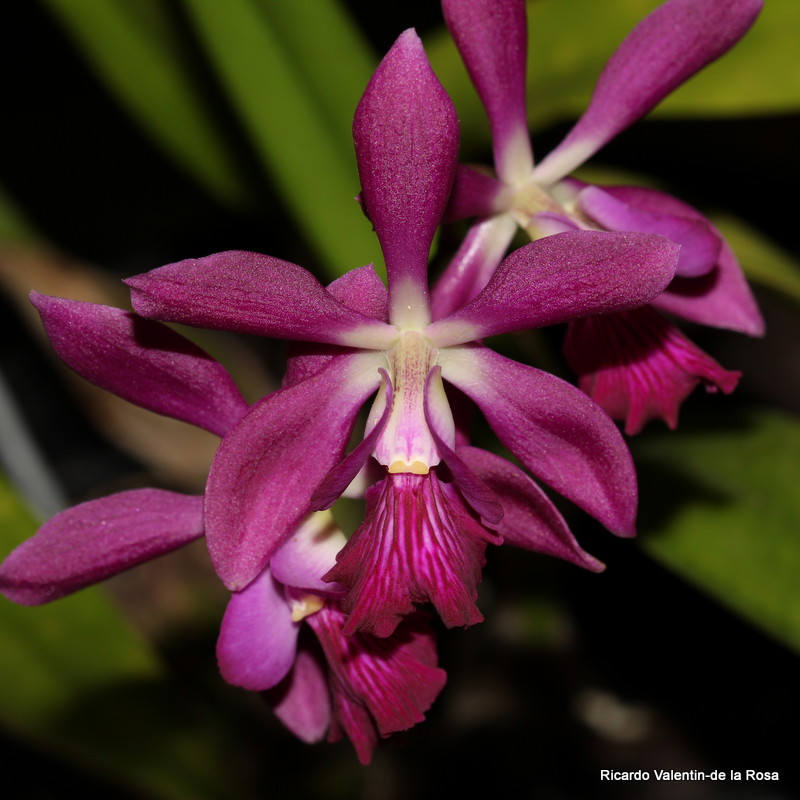
Catyclia Middleburg x Encyclia bractescens, second year blooming


This is the second year this orchid has bloomed for me.  The plant has produced more flowers and of a slightly larger size than last year.  This orchid is still young and has a lot of potential.  It will be interesting to see if these particular clones have inherited the capacity of the Enc. bractescens parent to produce many flowers.

Dendrobium parishii Rchb.f 1863, close up of the flowers


This is one of my smallest Dendrobium species.  The cane grows just a few inches in spite of all my efforts to try to see if it will produce larger canes.  I grow it exactly like my Dendrobium anosmum, it also receives the same light conditions.  It blooms every year with a few flowers on the tip of the canes.  I suspect that my local conditions are a bit too warm for this species and this translates into less vigorous growing.