Showing posts with label pink. Show all posts
Tuesday, December 27, 2016
Bletia patula Graham 1836, a vigorous plant with cerulean flowers
This plant is a variant of the normally pink flowered species. It was found in a vacant lot that was going to be cleaned along with plants of the typical form. It has proven to be a floriferous and vigorous grower. This species is not difficult to grow as long as you replicate the way they grow in the wild. They grow in places where, when it rains, the water percolates quickly and the ground doesn't stay soping wet.
Thursday, December 8, 2016
Sunday, November 13, 2016
Paphiopedilum (Paph. moquetteanum x Paph. rothschildianum), first bloom seedling
I am in love! The flower is huge, and I love the color. This is the first time this seedling has bloomed. I produced just a single large flower. I expect that in the future it will produce more flowers per inflorescence. In the meantime I am not complaining, I find it lovely. I brought this plant some years ago, as happens with other rothschildianum crosses, it has taken its time reaching blooming size.
Labels:
hybrid,
moquetteanum,
orchid,
orchidee,
orquidea,
Paphiopedilum,
pink,
rothschildianum,
white,
орхидея,
蘭花
Wednesday, October 5, 2016
Sunday, October 2, 2016
Basiphyllea corallicola (Small) Ames, one of our native orchids of Puerto Rico
I found this orchid in the Maricao forest. I have walked many times by the place where this clump of plants is growing and never noticed them. They are practically invisible without their inflorescences. This plant is rarely photographed. I always thought that Basiphyllea flowers remained almost completely closed, but it seems there is a population in Maricao where flowers open wide. Unfortunately when I found this clump, a few buds remained and only a single, damaged flower was opened wide.
Labels:
Basiphyllea,
corallicola,
native,
orchid,
orchidee,
orqchid,
orquidea,
pink,
Puerto Rico,
species,
white,
wild,
орхидея,
蘭花
Thursday, June 30, 2016
Unknown Sobralia species in my garden
I brought this Sobralia a few years ago as a small, two cane plant. It has been growing slowly but steadily since then. It now has several canes which I expect will bloom in the coming months. It is growing at an altitude of about 1,000 feet above see levels in the mountains of Puerto Rico. I find this plant easy to care for and it has not given me any problems. I only water it during the dry season, the rest of the year the local rainfall is enough to cover its needs. The flowers last only a single day. If the day is particularly hot and dry this will make the flowers wilt sooner. The flowers are fragrant. I keep the plant close to main door of the house so that I don't miss the flowers when I leave the house in the morning.
Sunday, May 8, 2016
Bulbophyllum Lovely Elizabeth, this clone would produce large pink inflorescences, sadly I lost it. From losing this plant I learned the wisdom of always having more than just one division of your most prized plants.
This clone was beautiful and a vigorous grower. Sadly I lost it because it was one of my firsts Bulbophyllum and I was still learning how to keep them well in the long term. I have brought other clones of this hybrid but they all have been smaller and redder, favoring the rothschildianum parent.
Thursday, April 28, 2016
Dendrobium trantuanii Perner & Dang 2003
I brought this orchid about a year and a half ago. Compared with my other Dendrobium this plant has been a slow, deliberate grower. The cane that produced this flower is small, a bit less than six inches long. The flower has a nice color, I suspect this is due to the fact that the plant get full sun for several hours a day.
Labels:
Debdrobium,
lilac,
orchid,
orchidee,
orquidea,
pink,
purple,
species,
trantuanii,
white
Wednesday, April 27, 2016
Ancistrochilus rothschildianus O'Brien 1907
I saw this plant at the 2016 Puerto Rico Orchid society show at the Jardin Botanico de Rio Piedras. I have cultivated this plant in the past and I found it easy to grow and bloom in the central part of Puerto Rico at an altitude of 1000 feet over sea level. It needed frequent fertilization to produce the husky pseudobulbs that bloom. After the pseudobulbs matured I stopped fertilizing it. I gave it a rest period during the local dry season. Became a mass of bulbs but then I lost it to rot during a time when it rained daily for weeks.
Labels:
Ancistrichilus,
orchid,
orchidee,
orquidea,
pink,
purple,
rothschildianum,
species
Tuesday, April 26, 2016
Maxillaria sanguinea Rolfe 1895
I saw this orchid at the 2016 show of the Puerto Rico Orchid society. This plant produced a clump of many growths all growing close together. It is commonly seen and shows and occasionally one sees a specimen plant. The flowers are smaller than those of its relative Maxillaria tenuifolia.
Sunday, April 24, 2016
Dendrobium smilliae F. Muell. 1867
I brought this plant last year. This is its first blooming. It grows well under my local climatic conditions and it has not presented any unusual challenges. I lost plants of this species that I tried to grow previously because it doesn't do well in media that stays wet too long. In my garden it prefers relatively coarse bark with plenty of air spaces between the bark pieces. Grows best with frequent, weekly, fertilization when it is producing its canes. It receives no fertilizer when it is not growing.
Friday, April 22, 2016
Epicattleya Veitchii, a very old hybrid, was registered in 1890, this is a pink form, it is a cross of Epidendrum radicans and Cattleya coccinea
This plant was for sale in the 2016 Puerto Rico Orchid society show. It is a very old hybrid, registered in 1890. This is a different plant from the red flowered type.
Labels:
Epicattleya,
Epidendrum,
hybrid,
old,
orchid,
orchidee,
orquidea,
pink,
red,
sophronitis,
Veitchii
Monday, April 18, 2016
Dendrobium polyanthum aka Dendrobium primulinum var. Laos, the flowers of two different clones.
About a decade ago there was a large importation of plants of Dendrobium polyanthum to the island of Puerto Rico, in fact they also seem to have been sold in the United States. Some ot these plants have survived and bloomed. The top photo is a flower from a plant that I grew from a keiki. The flower has a large yellow area in the labellum. The bottom flower is from a plant that I brought as an adult, the area of yellow is smaller than in the flower on top but the labellum is larger. The plant that produced the flower on top is a slow deliberate grower that is somewhat delicate, the plant that produced the flower on the bottom is a vigorous grower and blooms relatively well.
Labels:
Dendrobium,
laos,
orchid,
orchidee,
orquidea,
pink,
polyanthum,
primulinum,
species,
variety,
whitee,
yellow
Sunday, April 3, 2016
Dendrobium prenticei [F. Mueller]Nichols 1938, usually known as Dendrobium lichenastrum var. prenticei
This small orchid is cultivated by a few people on the island. It is grown mainly by species growers. The flowers are small. This orchid can form a specimen in a fairly small space.
Saturday, April 2, 2016
Tolumnia Pink Panther, brought as a sacrificial victim to the gods of orchid culture, it surprised me by not only surviving but thriving.
In the past due to a poor understanding of their cultural needs, I sent many a Tolumnias to the great, happy terracota pot in the sky. I became so frustrated at my inability to grow them that for many years refrained from buying them. But last year I decided to try a different way of cultivating them. As a sacrificial victim to the gods of orchid culture, I selected this plant which was on Home Depot on the spot where they put plants that have finished blooming before being sold. I wanted to buy a cheap one so that if it did die It would not be a great loss. I put this plant on a flat plastic dish on top of a very thin layer of moss, all the original roots were left exposed and not buried in the media.
The plant gets full sun from sunrise to about 10 am and the rest of the day it is in light shadow. I fertilize it weekly when it is producing a new fan. The local temperatures are between 75 and 85 most of the year with low down to the sixties for a few weeks in January and February.
The plant has been growing well and finally bloomed this March. Now that I know the way that I can keep them alive I plant to add one or two additional plants to my collection. Hopefully they will do as well as this one. The plant was identified by my friend, Rene Enrique Garcia Lopez.
Monday, September 14, 2015
Sobralia sp.
I brought this plant a few years ago at a local orchid show. I have no idea as of the identification of this plant. It grows well in a mix of compost, sand and red laterite soil. The flowers last a single day.
Thursday, August 6, 2015
Psychilis monensis Sauleda 1988, a pink flower
There are vast populations of this orchid in Mona Island, between Puerto Rico and Hispaniola. There is some variation in the color of the flowers. I found this pink flower deep in the forests of the east part of the island. Most flowers of this species have either greenish or pale cream or yellow flower segments.
Saturday, June 6, 2015
Dendrobium parishii Rchb.f 1863, close up of the flowers
This is one of my smallest Dendrobium species. The cane grows just a few inches in spite of all my efforts to try to see if it will produce larger canes. I grow it exactly like my Dendrobium anosmum, it also receives the same light conditions. It blooms every year with a few flowers on the tip of the canes. I suspect that my local conditions are a bit too warm for this species and this translates into less vigorous growing.
Wednesday, May 27, 2015
Myrmecophyla tibicinis, cultural notes
| In a basket, under the shade of a large avocado tree |
| Growing on a palm trunk in full sun |
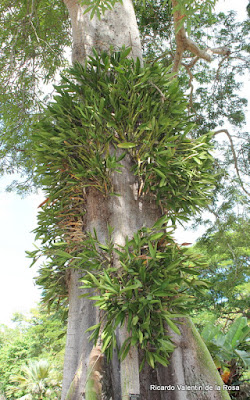
| St. Croix Botanical Gardens |
In areas with warm weather Myrmecophyla tibicinis does very well
when grown in a basket or mounted on a tree.
This orchid can grow in full sun, in fact it needs a certain amount of
full sun exposure or it will not bloom.
Keeping this plant in too much shade is a common error among beginners. However, this plant seem to grow better when
is given a slight bit of shade from the sun when it is at its most intense,
which locally is between the hours of 11 am and 4 pm.
This orchid can produce a huge
specimen plant if well cared for. In one
of the photos above you can see a truly humongous specimen in a Ceiba pentandra tree in the St. Croix
botanical gardens. To me the key to have a large and floriferous
plant, aside from the right level of sun exposure, is giving it the proper
fertilizing when it is producing new pseudobulbs. This plant should be given a high nitrogen
fertilizer when it is growing to help it produce full sized pseudobulbs. Small, undersized pseudobulbs will not bloom.
The plant growing mounted in a
palm trunk, in full sun all day long, produces relatively short
inflorescences. The plant in the basket,
which is growing under an avocado tree with a comparatively open canopy,
produces the typical long inflorescences.
The inflorescences grow until they emerge from the canopy of the avocado
tree, then they produce the flowers.
Friday, May 22, 2015
Subscribe to:
Posts (Atom)


