Saturday, February 7, 2015

Schomburgkia lueddemanniana, it was sold to me with this identification. The Schomburkia genus is defunct so this plant is now a Laelia.


The easiest by far to cultivate and bloom of all the Laelia (formely Schomburgkias) that I have.  It is tolerant of drought, wind and high temperatures.  With a modest amount of fertilizing and watering it has done very well.  However there is one thing it won't tolerate, a potting media that doesn't allow for good ventilation to the roots.  So I have mine potted in media that is coarse and I don't add much of it, just enough to give some weight and stability to the pot.  This is this plant second blooming.

Monday, February 2, 2015

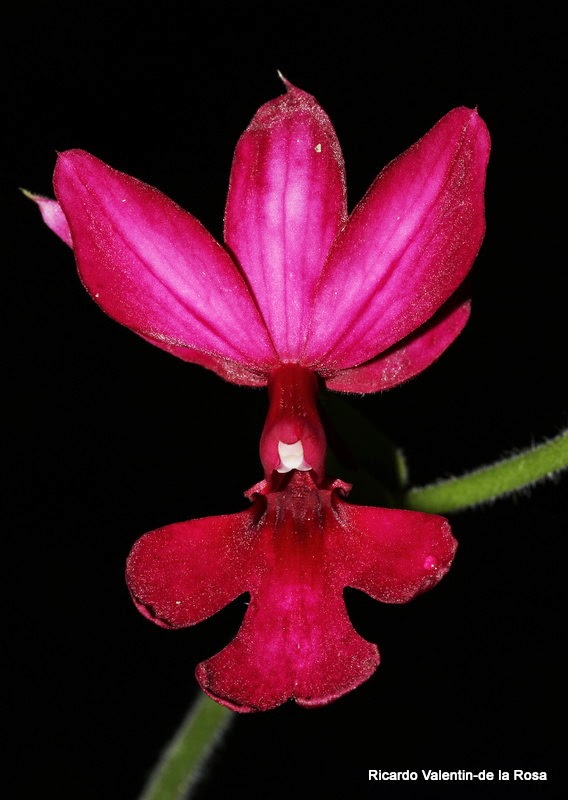
Cranichis muscosa Sw. 1788, in the Rio Abajo forest in Puerto Rico


I found this plant in the roadside during one of my hikes in the Rio Abajo forest, Puerto Rico.  This plant can be found in the roadsides in certain parts of the Yunque forest, in the east of the island, where I had photographed it previously but this is the first time I have seen it in the Rio Abajo forest.   The plant itself is inconspicuous out of the blooming season.

Because the flowers are oriented with the lip uppermost the green marking of the lip are not easily noticeable.  I found only three plants near a patch of Ponthieva racemosa.   The plants were growing in a small stretch of roadside that for some reason has not been overrun by exotic invasive plants.  

Sunday, February 1, 2015

Paphiopedilum Genevieve Booth (Paph. Mount Toro x Paph. rothschildianum)


Adult plants of tropical ladyslippers are not easy or cheap to get in Puerto Rico.  That means that you have to buy small seedlings by mail and then wait until they achieve blooming size.  For some plants you can wait quite a bit for them to reach adult size. This was the first blooming of this plant.  A snail ate a hole in the stem of the inflorescence.  When I moved the plant, the inflorescence broke.  You can imagine how mad I was.   Hopefully it will bloom next year and I will be able to enjoy an inflorescence with all its flowers open.

Thursday, January 29, 2015

Epidendrum ackermanii Hágsater 2004, in Maricao, the inflorescence of a plant growing under the shade of a Clusia rosea

Most flowers of this species are a pale lilac color, this inflorescence had unusually deep colored flowers.  I saw this plant in the Maricao forest in an area where a rockslide had obliterated all plants in its path.  This orchid is growing under the shade of a Clusia rosea tree.


This is the most common color of these orchids.


Calanthe Vintage Wine 'Mendenhall' x Calanthe Rozel 'Red Velvet, first blooming

This is the first blooming of this hybrid for me.  The flowers are a lovely shade of red.  For some reason the plants have not grown as well as I had hoped.  However I plan to move them to a sunnier spot and see what happens.

Add caption

Erythrodes sp. possibly hirtella, growing in the Maricao forest.


This is a relatively common, but fairly inconspicuous species.  The tiny tubular flowers are what horticulturists dismiss as "unshowy".  It is the only species of native orchid that has germinated in my orchid pots.  The plants of this species in my orchid pots are larger, with lustruous green leaves and produce many more flowers than the same species growing in the wild.  I attribute this to the abundance of nutrients in my orchid pots due to regular fertilizing.