Showing posts with label miniature. Show all posts

Wednesday, October 30, 2024

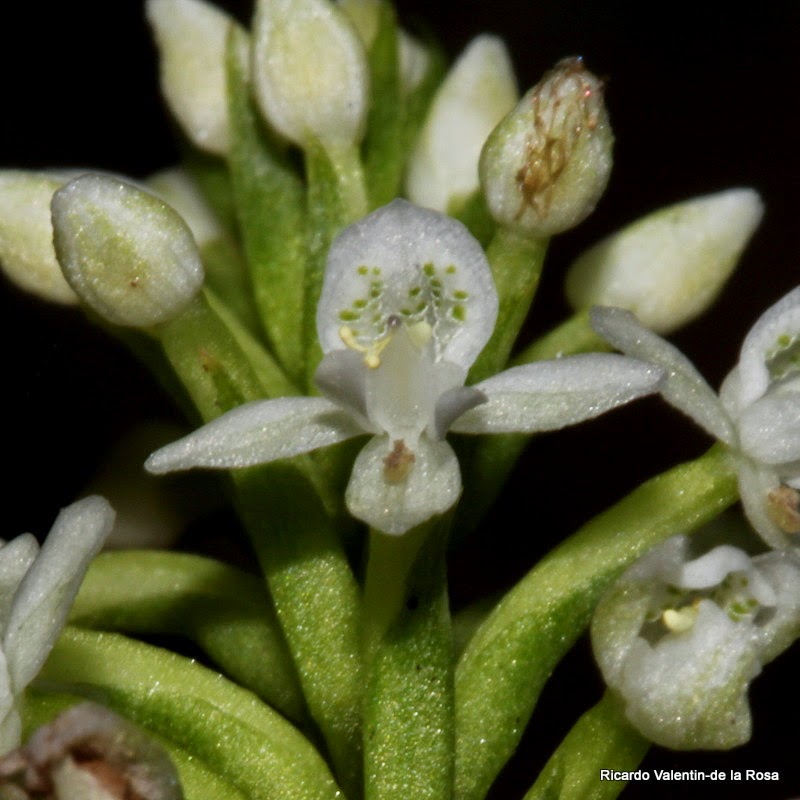
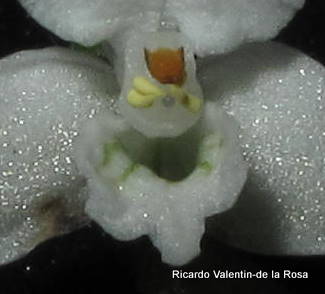
Stelis perpusilliflora Cogn. in I.Urban 1909 in El Yunque National Forest


 This orchid was photographed in El Yunque National forest.  The flowers are tiny and remain cupped when they open.  The inflorescence is horizontal with the flowers pointing downwards or to the side.  I had to bend the inflorescence upwards to get a view of the inside of the flowers.

Monday, October 3, 2016

Ornithophora radicans (Rchb. f.) Garay & Pabst 1951, a miniature that produces many flowers


I photographed this miniature at the Mayaguez orchid society show in September.   This plant is popular in Puerto Rico and it is common to see plants on display at the various orchid shows.  Even small plants produce many flowers.  The flowers are quite small and pose a challenge to get a good photo.  

Sunday, April 3, 2016

Dendrobium prenticei [F. Mueller]Nichols 1938, usually known as Dendrobium lichenastrum var. prenticei


This small orchid is cultivated by a few people on the island.  It is grown mainly by species growers.  The flowers are small.  This orchid can form a specimen in a fairly small space.

Wednesday, February 25, 2015

Cyclopogon cranichoides (Griseb.) Schltr. a terrestrial orchid with very dark leaves in the Rio Abajo forest in Puerto Rico


I have passed through the part of the Rio Abajo forest where this orchid grows literally thousands of times.   I had never noticed than an orchid was growing in the place where this orchid lives.  The main reason is that is is a muddy shallow ditch that is normally covered with dead leaves unless a particularly strong rain shower washes them away.  The color of the leaves of this orchid is a good mimicry of the color of the dead and decaying leaves that cover the area most of the time.

I probably would have never stopped to look at the spot if I had not noticed the inflorescence.  The color of the leaves hide them from sight but apparently some animal found them tasty and took out a few bites from them.  The flowers are nodding and tiny so getting a good photo was a bit of a challenge.  This is the only plant of this species I have been able to find in this location.  Nearby there are plants of Erythrodes, Ponthieva, Cranichis and Oeceoclades orchids growing on the ground.

Monday, February 2, 2015

Cranichis muscosa Sw. 1788, in the Rio Abajo forest in Puerto Rico


I found this plant in the roadside during one of my hikes in the Rio Abajo forest, Puerto Rico.  This plant can be found in the roadsides in certain parts of the Yunque forest, in the east of the island, where I had photographed it previously but this is the first time I have seen it in the Rio Abajo forest.   The plant itself is inconspicuous out of the blooming season.

Because the flowers are oriented with the lip uppermost the green marking of the lip are not easily noticeable.  I found only three plants near a patch of Ponthieva racemosa.   The plants were growing in a small stretch of roadside that for some reason has not been overrun by exotic invasive plants.  

Thursday, January 29, 2015

Prescottia oligantha [Sw.] Lindley 1840, in the Maricao Forest


Prescottia oligantha is a tiny terrestrial orchid that is native of Puerto Rico.  Previously I had only seen a single plant.  In January 27, 2015 I found a small colony of about half a dozen plants near the Torre de Piedra.  The plants are easy to miss.  I found them because I had a good search image of what I was looking for.   It is not a rare plant however very few people notice them due to the small size of the plant and tiny flowers. 

Monday, January 5, 2015

Liparis saundersiana Rchb. f. a terrestrial orchid from Puerto Rico


In many years visiting the Maricao Forest I had never encountered this species.  Then in December of 2014, as I was looking at a plant of Epidendrum anceps, I noticed that there were several plants of this species a few feet away.  I could have easily missed the plants had I not looked at the right place, they are small and inconspicuous, a rosette of a few leaves flush with the leaf litter.    But once I had noticed the plants, I saw them at several places.  The plants must be deciduous since I have examined the places where they are growing many times and would have noticed them if they had been present.

For some reason all the plants I found were growing among fearsomely thorny plants and reaching them to take a photo was not that easy.  The largest group of plants was nested among a clump of Pitcairnia bromeliads.  A few plants here and there were under some thorny vines.  As I stepped in to take a photo a large thorn stabbed me on the foot through the shoe.  It was very painful.  The sacrifices one makes to get a photo!


All the plants I saw were producing seed pods and seemed in good health.  The plants are quite safe in their habitat as it is unlikely anyone will collect them and they live in a protected area.     Next year when I visit them I will wear thorn resistant clothes and footwear!

Sunday, December 8, 2013

Stelis perpusilliflora Cogn. a rare orchid from the Luquillo mountains, Puerto Rico


When I found this orchid I was quite curious about it since I could not identify it on sight.  Unfortunately, I didn't had with me the equipment to make a really good photo of the diminute flowers of this small orchid.  Nevertheless I am satified I was able to get photos of this as it is the first time I have seen Stelis plants growing in the wild in Puerto Rico.  The plant is small and its tiny green flowers are inconspicuous, so it is easy to miss.  I found it by accident as I was looking for Lepanthes orchids near a small creek where they grow particularly well due to the year round high humidity.

Eria hyacinthoides with 2190 flowers on seventythree inflorescences, March 2012


This impressively flowered plant was seen in the Puerto Rico Orchid Society show in March 2012.  Unfortunately, the inflorescences were nested inside the leaves which obscured the massive amount of flowers this plant had.

Thursday, November 21, 2013

Lepanthes rupestris, Stimson 1970, "in situ" growing on very slippery boulders by a mountain stream


These tiny orchids grow on boulders on the side of mountain streams in the high reaches of Sierra de Luquillo.  The plants are small and easily missed.  The flowers are so small most people are oblivious to their presence.  The boulders where these orchids grow are hideously slippery, moving among them demands supreme care and a constante state of alertness.  Any slip can result in a painful fall at best and broken bones at worst.  Given that these orchids are inconspicuous and in a habitat inimical to human presence, the result is that they are fairly common even in places that humans frequent.  

Taking good macro photos of them is not easy since there is no flat surface anywhere to put a tripod.  Also you have to be careful to keep a good balance among the boulders at the same time that you are taking the photos, something that is not easy if you are handling a 100 mm lens, trying to figure out what is the best exposure and hanging for dear life from the rocks themselves to avoid falling.

On top of all that you need to be alert for flash floods caused by rain far away upstream.  These have killed many a distracted bather in these mountain streams.  Happily the day I visited this particular stream, the place was not as soping wet as usual and I could move among the boulders with relative safety.


Monday, September 23, 2013

Epidendrum fimbriatum Kunth 1816, a tiny gem from high altitude wet forests


I saw this plant in the orchid house of the Botanical Garden of Quito, Ecuador.    This plant except that it is found in Peru.¹  It is also found in Venezuela, Ecuador, Colombia and Bolivia.   The flowers were at the tip of a long inflorescence that seemed to have been blooming for a long time.  It was being cultivated on a raised bed of gravel.


¹Zelenko, H., Bermudez, P. 2009.  Orchid species of Peru

Sunday, September 15, 2013

Dendrobium harveyanum Rchb f. 1883, after seven years it is still doing well


(I wrote an article about this species in 2011, here I revisit some of my old observations and add a few new ones)

This orchid comes from Burma, Thailand, Vietnam, and the Yunnan province in China.  In spite of its large area of distribution it is rare in the wild.¹   Since its discovery in 1883, this plant was always rare, and for a long time it was totally lost to cultivation.²   Plants of this species were discovered in northern Thailand and then reentered cultivation.²   Unfortunately, even after it was rediscovered, this plant remained generally unavailable for many years, one could only enjoy its beauty in the occasional photo in a book or an orchid magazine.

When I first saw the flowers this orchid in a book, I was immediately captivated by their unique characteristics.  That was in 1990, back then I could find no source of these orchids in the United States.  I know this sound quaint in the age of the Internet, but back then you had to peruse through orchid magazines, select those vendors that might have the orchid, write a letter asking for a checklist, and then wait for weeks or months to see if you would get an answer.

In 2006 I finally found a source and was able to buy three plants.  Unsure how they would adapt to the local conditions, I mounted one on a branch and potted the other two in wire baskets.  The plant in the branch did poorly and even thought it bloomed, it did so weakly and eventually died.  It died even after I had removed it from the branch and planted it in a basket like the other two plants.
The two plants in the baskets did well and two years later bloomed.  They have bloomed unfailingly every year, sometimes several times in the year, since that time.  The two plants have responded in slightly different ways to basket culture.  One of the plants has grown slowly and is still well within the confines of the basket, the other one was a vigorous grower and grew to the edges of the basket and has continued growing on its sides.  I have never repotted these plants as I suspect that damage to their root system would severely set them back.  As for their culture, I followed the advice to grow them like I grow my Dendrobium farmeri.³

As you can see, all plants responded in a different way to cultivation under my conditions.  One peculiarity is that the most vigorous plant produces keikis from time to time every time a cane loses its base to rot.  The other two never produced keikis.  These plants are unbothered by most pests in my area.  A single pest is capable of damaging them severely is snails.  When a new cane is growing snails have been known to attack the tender leaves.  This has resulted in the plants being set back and weakened.  The result was poor blooming in the cane that sustained the damage.  On rare occasions, canes that are growing have developed rot in the growing tip and died.  It is unclear what has caused this.

Considering how rare this plant has been in cultivation, it was a bit surprising that it has proven to grow well with little special treatment.  It can withstand the local dry season with ease, with no watering, even when a whole month goes without raining.   Outside of its growing season I give it no fertilizing.

The two plants produce inflorescences at any time between late April and July.  Different canes of the same plant can bloom all together or at different times in the same year.  My plants have produced inflorescences with as little as two flowers and as many as thirteen.  I thought the flowers were slightly fragrant until one occasion when I brought a plant in the house.  In late morning I found that the flowers had become powerfully fragrant, much more fragrant than I had ever noticed.   Next time this orchid blooms I shall see if this was a onetime event or whether it always happens but I had never noticed.  Flowers can vary slightly in color and size of the lip but I have not checked if this a characteristic that varies between the different plant or the different bloomings.

One thing I have noted is that my plants have remained relatively small, with canes that rarely grow over six inches tall.   I have seen photos in the Internet of plants that seem to have canes taller than seven inches, but this has not been my experience.  Only once has my plant produced a cane larger than seven inches, a cane that was produced in the 2013 growing season and that topped its growth at eight inches (20 centimeters).  The size of the mature canes of this plant has been cited as being between 6 and 9 inches (17 and 23 cm)¹ and five and eight (15 and 20 cm).³

Given the relatively small adult size of this plant, it often is overlooked when visitors come to my garden and are greeted by Grammatophyllum and Vandachnis that literally tower over all other plants.  But when they are in bloom, the unique, canary yellow flowers of this orchid are truly eye catching.   In my experience this is a plant that is well worth growing. 
 
¹Baker, Margaret L. 1996. Orchid Species Culture.  Dendrobium.  Margaret L. Baker and Charles O. Baker.
²Menzies, David. 1991. Orchids.

³Schelpe, S., Steward, J.  1990 Dendrobium an introduction to the species in cultivation.

Friday, September 6, 2013

Bulbophyllum angustifolium (Blume) Lindley (1830), a miniature botanical curiosity that is quite floriferous


In this photo you can see the long internodes between pseudobulbs

I got this tiny plant as a gift from a friend.  It is a twig epiphyte of the mountainous areas of Thailand, Malaya and Java¹.  This is a plant that is smaller than most commercially available Bulbophyllum, its pseudobulbs less than an inch tall, they are thin and the leaf is much larger than the pseudobulb.  The pseudobulbs are widely spaced along a rambling stem.

I didn’t put this plant in its own mount or pot.  My friend’s plant was an untidy tangle of stems going in every direction around and under a slated basket.  I decided to put the orchid on the top of a basket where a plant of Bulbophyllum Elizabeth Ann was growing so that it could ramble to its heart’s content.  Potting this plant would have is an exercise in futility as, due the long internodes the new growths surely would  end up out of the pot unless a grossly inpractical and oversized pot was used.  The plant grew well and eventually started growing out of the basket.  I kept twisting the stems back to the sides of the basket, because otherwise they grew out into the air.  My plant bloomed profusely with many inflorescences at the same time.

Sadly, I lost this plant.  I lost in a particularly embarrassing way.  Since the plant was growing and blooming well I assumed that it didn’t need much attention, but, as happened to me with other Bulbophyllum, eventually the pseudobulbs started growing away from the basket and into the air.  The result of this was that the stems were hanging from the basket, held back only by the older growths.  When the roots on the older growths died and decomposed, the pieces of the plant with the newest pseudobulbs would fall to the ground where they would lie unnoticed among the leaf litter only to be swept away when I passed the leaf blower.  That is a hazard with this plant, because all the parts of the plant are small and comparatively thin, it is easy to miss it if a piece falls from the mount.

One day I checked the basket and discovered that all the stems were old or dead and none had an active growing tip.   My advice on this plant is to mount it on a plaque that allows it to roam at will but never neglect the task of bending back the new growths that are growing into the air so that they are back in contact with the mount.    This plant grew well under my environmental conditions which are pretty humid during the rainy season.  The inflorescence of this orchid is short and the flowers are small.  The flowers are white with yellow tips.  Although this plant is small it can produce a nice showing when in full bloom, particularly if it has many pseudobulbs.  It is not common among local growers.

¹ Siegerist, Emily S.  2001.  Bulbophyllum and their allies: a grower’s guide


Wednesday, July 31, 2013

Domingoa haematochila (Rchb. f.) Carabia 1943, photo from the 2013 visit


In 2012 I visited Mona Island and was able to take photos of Domingoa haematochila plants near the Sardinera camping area.  Unfortunately the plants there were small and in poor shape.  Also my camera died on my second day on the island and I had to use a camera loaned to me by a friend.  I knew there were far larger and healthier plants in the interior of the island, but getting there is a challenging and dangerous endeavour, even for a trained biologist.  Happily I was allowed to tag along a group of botanist that planned to go deep into the island interior.  The botanist set a punishing fast walking pace in their hike because they wanted to get as far into the island as possible before the temperatures became dangerous.  How high did the temperature climb?  By 1:00 pm the bare limestone was at a toasty 136F/58C, our boots were themselves at 100F/38C.  The hair at the top of the head of one of the botanist was at 103F/40C.  It was some strenous walking and I spent most of the time drenched in sweat, but I managed to get some good photographs of large plants with flowers in good condition (with my new camera Yeah!).

The conditions in the limestone plateau of Mona Island are incredibly harsh for human beings but some orchids have evolved the capacity to grow and even thrive under them.  However there are spots here and there on the island where the ecosystem provides for microclimates that are less extreme, it is in these spots that Domingoa grows best.  However you can find plant of Domingoa in places in the island where conditions are difficult and don't allow for large plants.

This plant is very rare in cultivation locally.  Mostly due to the fact that local growers prefer large flowered orchids but also due to the fact that most growers here are unfamiliar with native orchids.  Given that this plant grows in a habitat the is inimical to human life, it doesn't at present faces any threat to its survival.


Friday, January 28, 2011

Pleurothallis aristata, a highly beautiful but pretty small native orchid of Puerto Rico

A head on view of a flower

The fingertip in the photo can give a sense of scale to judge the size of the flower


Plants of this species growing in a dead branch that had fallen from a tree but was held up in the air because it had become tangled in a mass of vines

I have found Pleurothallis aristata in the upper reaches of the Luquillo Sierra.  Although it is considered uncommon I have not confronted much difficulty finding it.  I have seen it from time to time growing in trees and twigs alongside some roads.  The thing is that I have not found it for long in any particular place.  For a time many plants could be found growing on the trunks of the tree ferns in the higest of the visitor’s areas of the Caribbean National Forest of El Yunque but the last time I was there they all had disappeared.  I found a good cluster of plants on a tangle of fallen branches but these are doomed to die in the long run as the twigs decay in the eternal heat and moisture of the rainforest.  But I am sure I will find it again elsewhere if I keep a sharp eye out for it.  This plant has a vast geographical distribution which includes Hispaniola, Puerto Rico, the Windward Islands and Central and South America. 
The flowers of this plant are quite good looking but their tiny size and the fact that the flowers are displayed facing downward practically guarantees that in its natural habitat it will remain unnoticed except for a very few orchidists that are exceedingly fond of miniatures.  This plant makes small clumps that usually have a few inflorescences with open flowers or seed pods.  It is said to bloom from spring into summer.
I have not seen this plant in cultivation locally and very few orchidists in PR seem to be aware or interested in this plant.  The only photo of a flower similar to those I have seen in the wild in PR was from a plant growing in a collection in Paris, France.  Photos from other sites, such as orchidspecies.com, show flowers with somewhat different patterns that the ones I have seen in PR.
I suspect that with proper care this plant would be able to grow satisfactorily in the warmer coastal areas of Puerto Rico if someone desired to grow it.  But at the moment there seems to be absolutely no interest in this plant from the local horticultural community.

Tuesday, January 4, 2011

Ponthieva ventricosa, the smooth shadow witch, a Caribbean endemic

Ponthieva ventricosa, in situ
Side view of the flower in its natural position

The pollinia (yellow masses) joined by  the stipe which end in a vicid disk (grey) that will attach to the insect,  The column is  just behind the pollinia and you can see the opening of the gynandrum.
A flower against a black background

The lip showing green stripes, in this flower the pollinia can be seen in top view

Ponthieva ventricosa is a small orchid that is endemic of the Greater Antilles.  Its distribution is apparently confined to the “mogotes” region of Puerto Rico.  A few years ago I found a small colony growing in a bank of a road.  This orchid blooms from December to February but for some unknown reason only a few of the plants bloom.  Almost all the plants show some degree of damage on their leaves but it is unclear what is causing the damage.  All the plants I have found have been growing on the side of nearly vertical surfaces along with a few ferns.  I wondered why these orchids were not displaced from their site by more aggressively growing plants but I think I got the answer during the dry season.
At one point in the dry season the bank was nearly bone dry and even the orchids which have underground water storage organs withered noticeably.  For part of the year these plants discard their leaves and withdraw underground where their rhizomes survive in latency until their next growth season.  So my guess is that these orchids survive in these banks because most other local herbs have trouble coping with the wide seasonal swings in the availability of moisture at these locations.
The inflorescences are long and practically every flower produces a seed pod.   Ackermann speculates in his book on orchids of Puerto Rico and the Virgin Islands that this plant may self-pollinate.   The white flowers are presented in the inflorescence with the lip uppermost.
I have been visiting it over the years to photograph this orchid’s flowers.  Unfortunately the small white flowers are difficult to photograph due to their location, small size and the shady nature of their habitat.   Their location on the roadside bank makes the use of a tripod difficult.  The light conditions at the area change continuously due to a combination of tall trees around the area and the open canopy over the road.   Because they are small the focus has to be sharp but the smallest wind disturbance blurs the picture.  The whiteness of the flower means that using a flash to compensate for the lack of light can wash out all detail of the flowers.  So far I am not satisfied with any of the photos I have taken but fortunately the plants are still thriving in their habitat and can be visited with little trouble.
This plant has no horticultural use that I know of and it is not in cultivation as far as I can tell.  Ackermann classifies it as an uncommon native orchid.

Wednesday, December 29, 2010

Ponthieva racemosa, the shadow witch, an orchid native of Puerto Rico

Ponthieva racemosa

Inflorescence, top view

A fly with pollinia stuck to its mouth parts


Pontieva racemosa goes by the common name “the shadow witch”, I don’t know the origin of the name but I am sure it is due to its preference for growing in shaded locations.  It has a patchy distribution in the Rio Abajo forest where it can be locally abundant.  When this plant is not in bloom there is little to betray that it is an orchid.   You can sometimes see it in roadside banks among the weeds as a low growing rosette of leaves growing in the shadow under the trees.  Locally it blooms in the winter and all the plants in a location bloom together.  The flowers are green and small.  It is not in cultivation and I have never seen it exhibited in any of our local orchid shows.

A group of Ponthieva racemosa