Showing posts with label phalaenopsis. Show all posts

Tuesday, July 4, 2017

Bulbophyllum (echinolabium x phalaenopsis)


I brought this plant a few years ago from Carter and Holmes.  It has been growing slowly, at least when compared with my other Bulbophyllum.  The flower is richly colored and the stink it produces is faint when compared with the sheer revolting and powerful smell that issues from the parent species.  I will repot it when it finishes blooming to a basket to see if this helps the plant grow larger.

Wednesday, April 5, 2017

Saturday, February 25, 2017

Phalaenopsis cornu-cervi [Breda] Blume & Rchb.f. 1860, red flowered form


The flowers are very nice but it is hard to get a good photo of them because they are so waxy the flash bounces from the petals as if from a mirror produced areas where all details and color are erased.


Tuesday, April 26, 2016

Phalaenopsis Ks Ever Green


This orchid was shown in the 2016 Puerto Rico orchid society show in the Jardin Botanico de Rio Piedras.

Tuesday, April 19, 2016

Phalaenopsis Ox Happy Girl x Phalaenopsis Paraiso Tropical


This interesting peloric orchid was brought to the April 10 meeting of the AOS judges in Ponce, Puerto Rico.

Wednesday, May 27, 2015

Phalaenopsis cornu-cervi [Breda] Blume & Rchb.f. 1860, a red colored peloric form


Phalaenopsis stuartiana var. nobilis


The real color of the flower of this orchid is the color of the flower in the top photo.  The other photos were taken with flash and the flowers took a yellow color that is not true to life.

Tuesday, March 31, 2015

Phalaenopsis Jiuhbao Fairy, in the 2015 Puerto Rico orchid society show


I saw this Phalaenopsis at the 2015 Puerto Rico orchid society show.  I liked the patterns on the flowers and the color, but what really impressed me was that the flowers were fairly large and the shape was wonderful.

Monday, March 30, 2015

Phalaenopsis the Pride of Ben Yu, at the 2015 Puerto Rico Orchid Society show


A beautiful Phalaenopsis hybrid, seen at the 2015 Puerto Rico Orchid Society show.

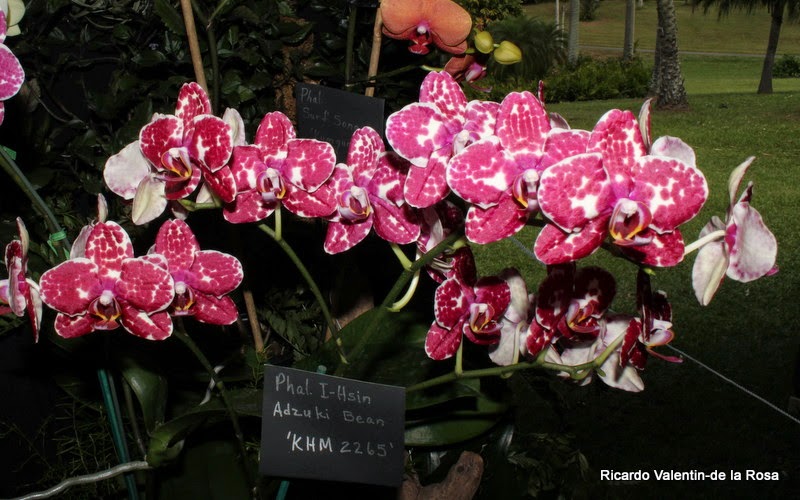
Phalaenopsis I-Hsin Adzuki Bean 'KHM 2265'


I saw this Phalaenopsis hybrid in a card table in the 2015 Puerto Rico orchid society show at el Jardin Botanico de Rio Piedras.  A beautiful and impressive plant.

Sunday, March 23, 2014

Phalaenopsis Memoria Julio Rios Pagan 'Janice' HCC/AOS


Seen at the March 2014 meeting of the Mayaguez orchid society.

Sunday, January 5, 2014

An abandoned orchid collection, observations on how some of the orchids have fared when neglected for a few years.

I must confess that there are few things that I find more poignant than an abandoned orchid collection.  Why orchids are abandoned?  Sometimes the owner basically losses interest in caring for the plants (I know, I know, it strains credulity, but it happens).  Other times, the hobbyist dies and the descendants, stop caring for the plants but won’t sell them because of their sentimental value.    In yet other instances, perhaps the saddest cases, the grower cannot care for them any longer and they simply lay forgotten.

A friend, who has never grown orchids, asked me for help in dealing with some orchids that had been given to him by an elderly relative.    The orchids had not received any care for three or four years I and was intrigued by the opportunity to see how orchids survive when they are left to their own devices.     When I hike in local forests, sometimes I find the vestiges of human habitation.  Most of the time all that remains is the stone stairs that were traditionally set at the front door of the house, but on occasion, you can also find a few houseplants still growing where they were planted.    In all my hikes I have found orchids only a single time.  In the highest parts of El Yunque rainforest, in some tree ferns in front of the remains of an abandoned house there were a Phalaenopsis and two Cattleyas.  None were doing well mainly due to being planted in spots that were too shady for them.  I didn’t remove the plants, the next time I returned someone had cut the tree ferns, probably to take the plants.

The orchids that were given to my friend were kept under the shade of a banyan that even though quite large did allow a modest amount of light to reach the orchids.  The plants were on plastic and metal baskets hanging from a short supporting structure made out of long metal tubes.  Because nobody had walked in the area for a long time, an understory of bushes and low plants had developed under the orchids and sometimes over the orchids, reducing the light reaching the plants even more.  Most of the orchids had the deep green color of plants growing under low light.  Of a collection that originally probably numbered close to forty plants, most were alive.  I started checking them plant by plant.

A Cymbidium, either aloifolium or findlaysonianum, had shattered its plastic basket with its roots and was hanging by a single piece of wire threaded through the center of its root ball.   This orchid was stunted and there was no indication it had bloomed in many years.     Even though it is stunted the Cymbidium  condition is good enough that a few years of the right care could help it produce full sized pseudobulbs that would bloom.

The Dendrobium moschatum was in excellent shape. It was in a basket that was completely filled with its roots.  It had four to five feet long canes that had the remains of recent inflorescences.  The area around the Den. moschatum was littered with older decayed canes and keikis (baby plants produced on the canes and inflorescences of many orchids) it had dropped to the ground.  The only thing this plant needed was to move it (very carefully to avoid sunburn) to a sunnier spot.  The keikis of this plant were gathered to be potted individually.

The base of the stems of Dendrobium fimbriatum var. occulatum had rotted away and its basket lay empty.   However, around it, and on other pots, and on the ground, there were the sections of canes that were still alive and had keikis on them.   We gathered the keikis to put them in a basket.

The Dendrobium nobile had also mostly died, but piece of old canes with keikis on them were hanging from the decaying remains of dead canes that were still attached to the basket.  There were a few large keikis that would respond fairly fast to care, but also many smaller ones whose survival, due to they being so tiny, was problematic unless they received particularly good care.

A good sized plant of Eria javanica was growing well but there were no remains of inflorescences from previous years.   Given the condition of the plant, all that is needed to get is blooming  is moving it to a sunnier spot and giving it good care in the next growing season.

In a single basket there were planted,  Cattleya skinneri, Schomburgkia tibicinis and an unidentifiable Miltonia hybrid.  The Catt. skinneri was a mass of dwarf pseudobulbs that apparently had managed at some time to produce inflorescences of two to three flowers.  All the Catt. skinneri pseudobulbs were growing in the side of the basket.  The Schomburgkia tibicinis had been put inside the basket,  the plant had produced a number pseudobulbs that had met the side of the basket when they were developing and therefore had become twisted and misshapen, only a single bulb had the normal shape for this species.  The Schomburgkia was partly buried in a mass of wet decaying tree fern, a startling sight since one would think that situation would had caused the pseudobulbs of this species to succumb to rot in a short time.   The Miltonia hybrid was growing on top of the material and was easily removed.    Most of the plastic basket was cut away but about a third of it was so enmeshed on the roots of the orchids that could not be removed without severe harm to the plants.  It was decided to let the plants together for the time being and to remove them at a later time when the plants condition were improved and they could handle the trauma to the roots better.  The plants were moved to start to acclimatize them to sunnier conditions.

A Cattleya bowingiana seemed to be in a fairly good shape but the fact that whoever had potted many of the orchids had a thing for burying the bases of the pseudobulbs made it difficult to ascertain the condition of the vegetative buds at the base of the pseudobulbs.    Since digging in the material might have damaged the roots of a weakened plant it was decided to wait and see if new growth would pop up from the media.

Two large bifoliate Cattleya hybrids were in very good shape, but had not bloomed recently.  Both had escaped the confines of the baskets and were growing on the sides with stems outside the baskets but their roots in the media.  All these plants needed to bloom was good light and a single growing season with the right amount of fertilizer and water.

A very small Phalaenopsis was found hanging in the air by two long roots from a piece of tree fern that was on top of one of the hybrid bifoliate Cattleyas.  Intriguingly, even though this plant only had two leaves, the largest of which is all of three inches long, it has an inflorescence developing.  The Phalaenopsis was removed from the tree fern piece to be planted in pot.

A Prosthechea cochleata was in perfect condition and would surely bloom if given more sun.  A Dendrobium anosmum, dwarfed and in poor condition was obviously on its last legs.    There was a number of small unifoliate Cattleyas with no id which had seen better times.    There were also some Oncidium plants that were likely Onc. Sphacelatum.  A few plants that were obviously derived from Brazilian Miltonias were found, but since none had flowers, it was impossible to have an idea of what exactly they were. 

We decided to work first with those who were in the poorer conditions and those that were in such good shape that they would have been blooming but for want of adequate light.  The ones in bad shape were repotted and moved to a shade house.  The ones that were in the best condition were started in the slow process of acclimating them to their optimal level of light exposure.


In this particular case neglect was not the main cause of death of the orchids since the climate in the area where they are located, the mountainous interior of the island of Puerto Rico, is favorable to their survival.  The main threat to the plants were the competition from ferns that invaded their pots and vines that would shade them to such an extent as to cause their deaths from lack of light.  Rooting media on the pots didn’t appear to have caused any deaths.  Insect pests were not found to be a significant problem as only two plants were infested with brown scale and only one large plant of a Cattleya hybrid had a single colony of whitefly.  Although small amounts of damage could be found in almost all plant stems and their leaves, the plant collection as had endured neglect remarkably well.  

Sunday, December 1, 2013

Phalaenopsis Center Stage 'Pine Ridge Cockleshell' AM/AOS, a peloric Phalaenopsis


A truly unique Phalenopsis.  This peloric Phalaenopsis shows what happens when you get unexpected symetry in a normally zygomorphic flower.  The plant that won the award from the AOS was exhibited by Irma Saldana.  It is notewhorty because it is said to be one of the most estable peloric Phalaenopsis.  Seeing one in full bloom is a delight, to quote Irma Saldana, "it looks as it is made of honey colored lace".

Thursday, November 28, 2013

Phalaenopsis Fusheng's Sweet Paradise 'Golden Leopard'


The color combination of the Phalaenopsis hybrid is very eye catching.  It used to be that flowers with these colors were small, this is not the case of this flower.  It may not be the size of a classical white Phalenopsis, but it is clear the hybridizers are well on their way to achieve this bold color combinations on large sized flowers.

Thanks to Irma Saldana, which provided the identification of this orchid.

Tuesday, October 2, 2012

A peculiar Phalaenopsis: Phal. Center Stage 'Pine Ridge Cockleshell' AM/AOS, a rare stable peloric form


This is a very peculiar flower.  This orchid petals are unique in what only can be described as a Roscharchian way.  Unfortunately a photo can't approach the experience of looking at an inflorescence of these orchids in the flesh.   But it has been some years since I last saw a plant of this cross.  I wonder if it has gone out of fashion and has been superseded by new and even more unusual hybrids.  This plant won an AM/AOS when exhibited in St. Croix as a cut inflorescence by Irma Selles.

Wednesday, January 12, 2011

Dendrobium anosmum and their relatives, warning signs of cultural trouble


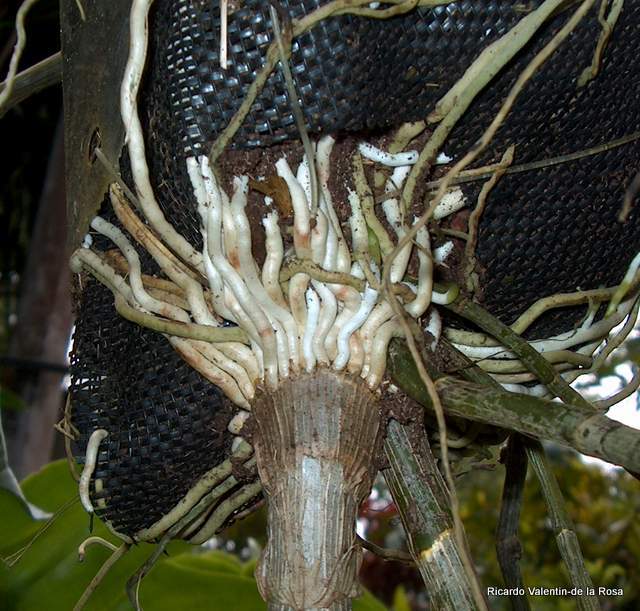
Vigorous and healthy root growth, note that the cane producing the roots is twice as thick as the previous growth

New roots are white older ones are grey green, absence of root growth is a clear signal of trouble


Fungal and bacterial infections can strike with astonishing speed and virulence, this is all that remained of a specimen plant of Dendrobium formosum var. giganteum.  If the gravity of the situation had been recognized on time at least some pices would have been saved for propagation

This Dendrobium nobile has been growing for many years in an avocado tree under hot tropical conditions.  It has never bloomed although in all aspects it is mature plant fully capable of blooming.

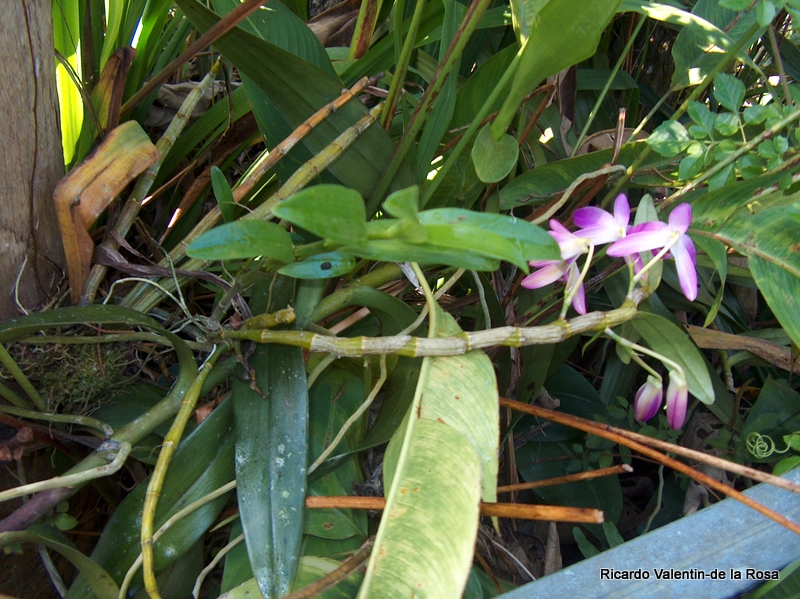
Dendrobium nobile blooming in a shady and cool location.

A Dendrobium phalaenopsis derived hybrid which lost all its roots due to inappropiate potting, all the old roots are dead but some new roots are showing their tips near the base of the canes.

The buds at the base of this canes are dead so the plant is producing new growths from buds higher up in the cane.

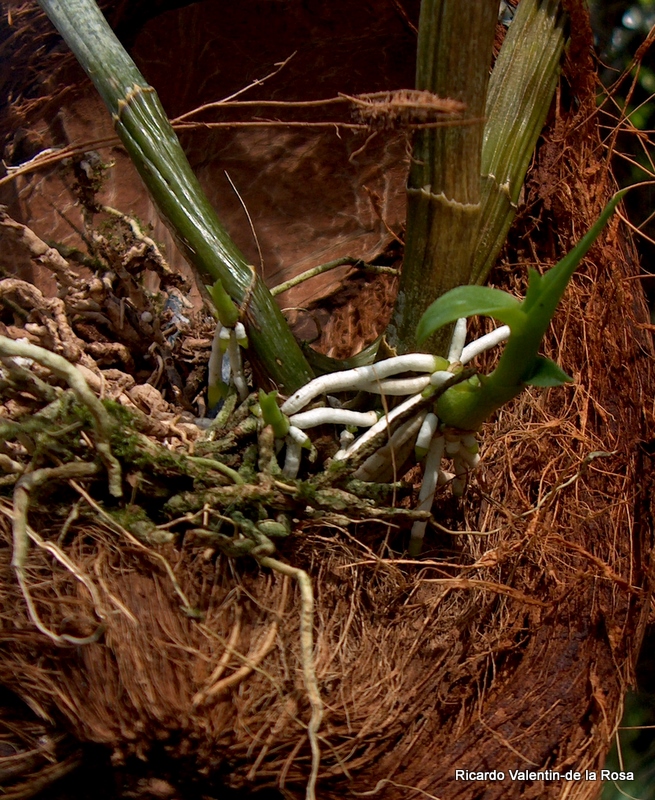
The base of these canes of Den. primulinum was damaged by sunburn and died.     The canes were bent so that the keikis produced by them can attach themselves to the basket.  Notice the many keikis and their abundant root growth.

Den. phalaenopsis hybrid grown with its roots exposed.  Note the abundant flower production and the fully leafed new cane.  It is normal for older canes to lose their leaves after the first year.


Under good care some keikis will bloom even when they are not affixed to anything


When they are growing at their preferred temperature and lighting range, well cared pendent dendrobiums grow vigorously, without any particular trouble and bloom reasonably well. But when they are grown under conditions that are unsuitable for them several things happen that serve as a warning signs that the plant is not doing well. I will detail some that I have learned from the bitterest experience. This is a work in progress and I will try to add information as time permits.

I. When your plant needs a colder rest period to bloom than you can provide.

If a plant needs a colder rest period to bloom but otherwise the conditions are to its liking you will get an endless production of handsome canes, which will be plump and healthy but will never bloom or even get in bud. Because circumstances prevent them from blooming these plants channel their energy into growth and can produce quite large plants. One Den. chrysanthum I have eventually produced a ten feet long cane. This particular plant has never produced even a single bud under the local climatical conditions. Dendrobium nobile will not usually bloom in coastal Puerto Rico but will bloom nicely if moved to locations about a 1,000 feet high in the mountain areas and in certain colder inland areas. There are plants here and there that bloom under conditions that are not in their usual preferred range but usually they do so erratically or poorly.

II. When the temperature is not in the preferred range for growth.

The first signs of trouble in this case is usually a lack of root growth. Unfortunately some pendent dendrobiums can survive for many years growing weakly and with root systems that barely sustain whatever meagre growth they manage. It can happen that the plants perk up and do produce good growth during brief times when conditions are to their liking, but as soon as temperatures drift out of their preferred range the plants weaken again. I brought a Den. falconeri that managed to survive ten years by growing acceptably during the brief weeks that local temperatures dipped and then sulking the rest of the year. Strenuous efforts to sustain this plant only lengthened the agony. Eventually the plant dissolved into a mass of tiny canes and diminutive keikis that were too weak to survive the summers heat. Keiki production on a a same year growth is also a very bad warning sign. It usually means that the plant inability to produce roots has made it transfer its energy to keiki production.

III. When it is not getting enough sunlight

If your plant is not getting enough sunlight to bloom properly you will probably get a few blooms right on the tip of the cane. A plant that might produce dozens of blooms might only produce two or three. The canes themselves might get to be abnormally long and thin. The leaves will have a deep green color.

IV. When roots are not entering the potting mix, or holding the mount.

This probably mean the mix is unsuitable for the plant because it has some characteristic that is inhibiting or killing root growth. A friend of mine accidentally killed many of his orchids by mounting them on the wood of a plant whose wood is permeated by a substance this plant secretes to kill other plants that  might compete with it for food or sunlight.  

V. A growth coming from a cane other than last years cane, if last year cane doesn't grow.

It probably means that the base of its newer cane is dead and the plant is trying to keep alive by producing growths elsewhere. In some plants, (this is an specially insidious occurrence in pendent dendrobiums) a cane that has shed its leaves can continue attached to a dead base without any obvious signs of distress for months before decay reveals that the base is dead.

VI.When a cane suddenly stops growing in the middle of producing a new leaf.

Usually means that something has severed the connection between the growing tip and the base of the plant. I have seen this happens when an insect gnaws the middle of a cane and makes a cavity but leaves it mostly attached to the base on the sides of the cane. This can cause the death of the whole cane, not just the tip.  On some ocassions this can signal a bacterial or fungal infection of a stealthy nature that only becomes obvious when the cane starts to decay rapidly at a time when it should have been growing.

VII. Blackened and sunken areas between the base of the plant and the lower part of the cane.

Can mean sunburn to this area, can result on the death of the plant but the survival of some of the canes.

VIII. Profuse keiki production on plants that normally produce them sparingly.

A sign of root loss, or of loss of the buds at the base of the plant.

IX. A weaker cane than the previous year's cane.

Plant is not getting what it needs to grow well, common in newly repoted plants that have suffered severe root loss and plant adjusting to new environments.

All this information is courtesy of the need to unwind after an unexpedtedly streesful day at work.