Showing posts with label anosmum. Show all posts

Thursday, September 7, 2023

Dendrobium culture: Observations on the color of the mature canes in some Dendrobium species when exposed to strong light


Many Dendrobium need high light to bloom at their best, but the way they respond to it varies depending on the species.  My Den. nobile blooms with larger flowers with richer color when the canes are getting so much sun that they take a yellowish tint.   On the other hand, the Dendrobium primulinum from Laos produces larger flowers when the canes are exposed to full sun and turn purple.    Den anosmum doesn’t change color too much even when exposed to full sun, perhaps the canes are just a bit lighter green color.  I haven’t noticed a color change in the canes of Den devonianum, but the flowers of my plant which is exposed to full sun for hours in the morning show very pale color in the sepals and petals, so pale that it can make one think the flowers are not of devonianum unless one looks closely.  My newly acquired plant of Dendrobium ceraula shows a deep purple tint on the side of the cane that receives the sun and green on the side that is under the shade of the leaves.  In my experience Dendrobium cucullatum becomes yellowish and stunted if exposed to too much sun.   

Wednesday, September 6, 2023

Dendrobium culture: A shade house for Dendrobium anosmum


Dendrobium anosmum needs exposure to full sunlight to bloom well.   But too much sun burns the plants.   I build this wooden shade house so that I could grow my plants in a place where they got the right balance of sun/shade.   The shade house was oriented so its longest axis was perpendicular to the sunrise in the spring/autumn equinox.   It was eight feet tall so that the long canes of the Dendrobiums could hang down without touching the ground.  It was 10 feet long and four feet wide.  To shield the orchids from the harsh midday sunlight a camo fabric was used.   In places I also used black shade fabric.  Notice the camo fabric has a multitude of holes.  This made a pattern of sunlight and shadow that moved across the plants during the hottest parts of the day.   The desired effect was to achieve something similar to the way sunlight is naturally filtered by the leaves in the forest.

 But the key thing of the shade house was its open sides.  To the east of the shade house there were few trees, so the Dendrobium and other plants would get full strength sunlight from about 8 am to 11 am.   The west side of the shade house faced the closed canopy of the forest, so after midday, the plants were in the shade.   This mimics what happens in the natural habitat, where a plant that is growing in the side of a tree can get plenty of sunlight during part of the day and its on the shade after that.

 I used to have many of plants of Den anosmum.  So many plants that when the shade house was full, I could grow plants that needed lower light levels under the Dendrobium.    I hung the Den anosmum in the east side of the shade house and in the center of the structure, these were the areas that received the most intense sunlight for the longest time.   Under the Dendrobium, in the ground I grew Phaius, Calanthe, Phaiocalanthe, Cymbidium, Paphiopedilum, Vanda and Angraecum.   The shade was narrow to maximize the plants exposure to light while protecting them from the midday sun. 

 During the rainy season, in the afternoon the sky would get cloudy and it would rain, this would reduce the intensity of light in the afternoon.    But in the dry season there would be very sunny days, uninterrupted by any clouds, and this threatened the plants with sunburn, even those that were in their resting phase.  To avoid this, I would put a few old dry palm fronds on the roof of the shade house.  This reduced the level of light to tolerable levels.

When the Dendrobium were ready to bloom, they were moved to the terrace.  You can see the result in the photo below.

The wooden shade house was destroyed by a tropical storm.  It was rebuilt, much stronger, now made of two inch metal pipes.  This one lasted until Hurricane Maria dropped the top of a Teak tree on it.


Friday, August 25, 2023

Dendrobium anosmum var.huttonii, 2023 growing season, plant in wire basket


The best performing of all my Den anosmum huttonii plants is potted in a home-made wire basket.  The wire basket is five inches deep and four inches wide.  It looks small for an orchid that is several feet long, but it is the best option for me since this plant is growing outdoors and gets soaked almost every day during summer and fall which is the time of the rainy season.  The plant has been growing since February and still have four months to go to finish its growing season.   The plant has some keikis that I have kept on the plant so they will be larger and stronger when they are removed next year after the plant blooms.  During the peak of the rainy season, it rains so much that the media can become coated in patches with white fungus.  In a pot this would be really, really bad for the plant since the fungus accelerates the decay of the media and interferes with the capacity of the roots to absorb water.   But in the basket, the roots still have access to moisture and oxygen in spite of the fungus.  With the onset of the dry season the fungus dies out.   Normally this type of fungus is kept in check by the daily cycle of drying that the media experiences every day.  But during the rainiest days of the year, the media can remain wet for weeks or months even in the baskets. 

This orchid is growing so well I plan to move all my other var. huttonii to baskets.   Because some of my plants are grown in the north coast of Puerto Rico which is drier and windier than my current location, I plan to grow them in plastic pots with a small water reservoir.  I will try this because in the coast the winds dries the media in the baskets much faster than in the mountains.


Friday, February 3, 2023

Dendrobium anosmum var huttonii

I have cultivated this particular clone of Dendrobium anosmum var. huttonii for many years. It has several peculiar traits that make it distinct from other anosmum plants. But first let’s mention which trait defines var. huttonii as a distinct variety of Dendrobium anosmum. The defining trait of var. Huttonii is a pure white flower with purple color on the lip. If a plant has any color, no matter how pale, outside the lip, it is not Huttonii. There are many, many named varieties of anosmum, but only two have been scientifically described, var. dearei, the alba form and var. huttoni. The other variants, and there are probably dozens or even hundreds of them, get their names from commercial growers or from informal descriptions in popular literature. To mention just a few, anosmum from the Philippines sometimes are called superbum, also there is var. delacourii, var. velutina (both very hairy flowers with flowers that look squashed), “touch of class” and the “thai” type. Also, there are many hybrids of anosmum and parishii, cucullatum, primulinum and rhodopterygium that are sometimes sold as anosmum. Hybrids sometimes sold as anosmum are Nestor, Supernestor, and Little Sweetscent. There are several traits that are characteristic of this huttoni clone. For example, my plants start producing flower buds and showing basal growths in the middle of January. A six to seven weeks before the type form of the species does the same in my locality. The clone I have is less vigorous than the type form of the species. It takes dedicated care to coax this plant to produce canes more than two feet long, and none of my plants have produced canes larger than three feet. It is common for anosmum to produce plantlets near the tip of old canes that have lost their roots. Huttonii produces plantlets near the tip of canes, but it also produces them, at the middle of the cane. Huttonii plantlets separated from the mother plant will tend to remain small unless they get fertilized regularly during the growing season with a fertilizer that has a high nitrogen number. In December, I reduce considerably the water my plants get and they start shedding their leaves. By the end of January most of my plants are entirely leafless. My huttoni bloom from leafless canes. Normally, anosmum plants produce their flowers along the length of the cane. If the only few flowers are produced they tend to cluster at the tip of the stem. In huttonii, the flowers can appear near the tip of the cane but also at random spots near the middle. Sometimes small plants will bloom if they have several canes. I have seen plants with canes that are less than eight inches long produce a single flower at the tip of the cane. The huttonii clone has never been as floriferous as the type form which can produce dozens of flowers if well cared for. I am happy if any of the canes produce eight flowers simultaneously. Sometimes a cane will only produce two to four flowers. And here is the most bizarre thing about this clone, sometimes a cane that bloomed early in the year will bloom again, weeks or months after it first flowered. No other anosmum variety I have has shown this peculiar trait. The flowers are highly fragrant. When this plant shows the buds of the flowers and the new growth, I return to a normal watering and fertilizing schedule. I cultivate my plants in baskets because during the rainy season it can rain heavily, every day for months. This, and the heat and the insects tend to turn most organic potting media into slush in a bothersome short time if the media stays saturated all the time. Baskets allow for fast drainage and at bit of drying in between rain events. This also means that the media can get very dry during the dry season and will need several good soakings before it starts retaining water. These plants are heavy feeders and will not grow to a good size unless regularly fertilized. At the beginning of the growing season, I remove the plantlets from the older canes. Sometimes I cut a sizeable section of the cane around the plantlets to them a better head start. The critical part is the time period when the plantlet is sending into the media the roots of its first cane produced after separation. If anything happens to the roots, this will be a considerable set back to the growth and will endanger the survival of the plantlet. A plantlet that is well cared for can start blooming as soon as two years after being separated from the mother plant. There is more information on the culture of Dendrobium anosmum elsewhere in this blog.

Monday, January 21, 2019

Dendrobium anosmum var. huttoni


In the difficult weeks and months after the hurricane, I lost hundreds of plants to the changed conditions of illumination, humidity and rainfall.  This is one of the survivors of hurricane Maria.  Last year it was in poor shape and it didn't bloom.  The 2018 canes were small for the plant but they were large enough to produce four flowers.  I expect that as it recuperates from the damage it suffered after the hurricane it will go back to blooming well.  It is highly fragrant and even with only four flowers it perfumes the area around it.

Thursday, February 19, 2015

Dendrobium anosmum var. huttonii, an update on my plant


For the last seven years my plant of this species grew vigorously and bloomed well.  Unfortunately, I moved it to a shadier, wetter spot than what it was used to because I wanted to put some other plants there.  As a result the base of the plant stayed sopping wet for weeks during the rainy season and it died.  Fortunately the plant has four large keikis that will be repotted to individual baskets as soon as they finish blooming.  Although the mother plant base died, the keikis are so large, all of them bloomed.
Here is a link to how I cultivate this plant.

http://ricardogupi.blogspot.com/2008/10/dendrobium-anosmum-var-huttoni-culture.html

Tuesday, May 6, 2014

Dendrobium Nestor, (Den, anosmum x Den, parishii)
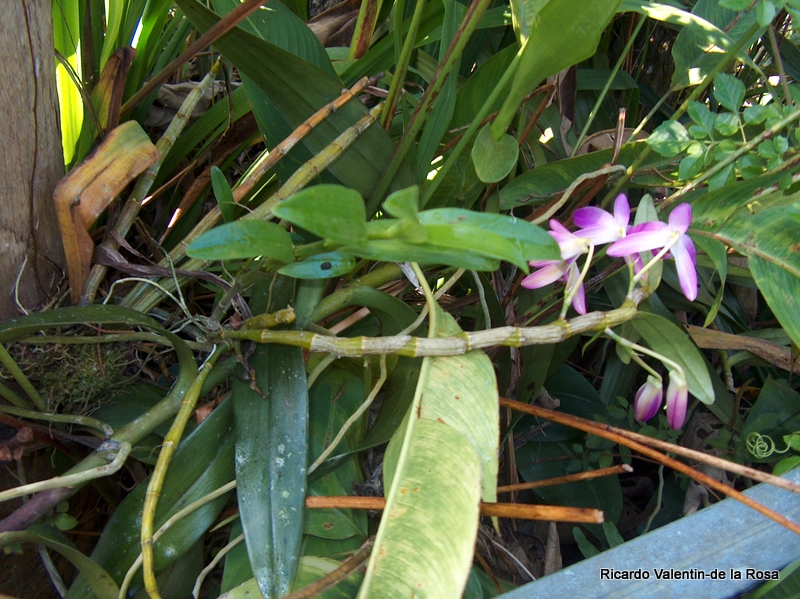

I got this plant about twenty years ago.  Back then Den. Nestor was something of a rarity.  This plant has an interesting combination of traits of its parents.  The soft color is similar to the most common forms of Den. anosmum.  The lip is very hairy, a characteristic of the lip of Den. parishii.  Den. Nestor has been remade many times with different parents.  The forms that seem to be most popular nowadays are deeply colored and have a shape that is reminiscent of the Den. anosmum parent.  I have seen plants of Den. Nestor being sold as Den. anosmum.  If the plants are inmature it is not that easy to tell apart the hybrid from the species.  However you can tell adult plants of anosmum from the hybrid due to thecomparatively larges size and flowers of anosmum.

Dendrobium anosmum

Dendrobium parishii

Thursday, November 29, 2012

Dendrobium keiki, What causes them to appear?


Dendrobium harveyanum keiki producing a second cane, because it has substantial
roots it can be removed with little fear that it wiil die.

Keikis from unbloomed stem of Dendrobium Yellow Chinsai, probably caused
by too much nitrogen in the fertilized applied late in the growing season

Dendrobium anosmum keikis, these are tiny and have little green tissue to support
independent growth removing keikis this size is not adviced.

Dendrobium anosmum keiki, this plant has a good size for a keiki and a significant growht of roots.   It can be removed with confidence that it has enough reserves to start growing idenpendently

These Dendrobium anosmum keikl have three canes with means they are over due for removal
from the cane, the original cane has decayed completely.

Dendrobium primulinum keiki, although on the small side for a keike the fact that it has two canes
will help this plant adapt to independent living without too much trouble.

Dendrobium fimbriatum oculatum keiki.  This keiki is quite large and can be treated
right away like an adult plant onece it is removed from the cane.

One characteristic of some Dendrobium species is that they have the capacity to produce plantlets from the meristematic tissue that lies in the form of small buds along the sides of the canes of the adult plants.  Most of the year these buds lie dormant, but if they are activated by hormonal changes in the plant they can turn into floral stems or into little plantlets.  In the hobby these little plants are known as keiki, this is the Hawaiian word for baby.  I will use the term keiki to refer to this form of propagation on the rest of this article.  Keikis are plantlets produced vegetatively by the mother plant, it is an asexual type of reproduction which means that the little plants will be exact copies of the mother.
 The frequency of keiki production varies wildly in the Dendrobium genus.  Some species will never, or only very rarely produce them, I have yet to see a keiki in a plant of Dendrobium farmeri or Den. secundum.  In other cases some plants will produce keiki and others of the same species will not.  This is my experience with Den. harveyanum, one plant has produced several keiki while another has never produced them.   Some species will almost always produce one to a few keiki from older canes, an example of these are Den. anosmum, Den. cucullatum and Den. primulinum.  In the extreme of keiki production Den. crumenatum and Den. kingianum produce them frequently and sometimes abundantly. 
There are several circumstances that can stimulate the production of keiki.  A relatively common occurrence is the production of keiki instead of flowers.   Normally canes will not produce keiki in their first year, before they have bloomed.  If a mature cane produces keiki instead of flowers when its blooming season comes around, this means something has disrupted the sequence of metabolic processes that produce the hormonal changes that turn the resting vegetative buds into floral buds.  In Dendrobium descended from Den. nobile and related species, if the plant is given a fertilizer with a high nitrogen content during the latter part of the growing season or the resting plant experiences too high temperatures, this can “short circuit” the blooming response and then it can either not bloom or it can produce keiki where blooms would have been expected.    I have seen plants produce keiki all along the cane where flowers should have been.  In rare cases a plant can both produce keiki and some flowers.   A few days ago a friend showed me one of his Den. nobile hybrids where the plant had produced keikis instead of flowers and then some of these keiki had produced a single flower from the tip of their tiny canes.
In many Dendrobium species the sudden production of keiki by a plant on canes young and old is a signal of significant root loss.  I have frequently observed this on Dendrobium species from the Spathulata section and on hybrids descended from Sphatulata/Phalaenanthe section.  These hybrids are produced by the millions and are commonly sold on Walmart, Home Depot and other stores because they travel well and their flower sprays last for weeks in good condition even in hot weather.  The problem with these Dendrobium is that most the people that buy them often now virtually nothing about their growing needs.   When these orchids are repotted they are frequently put in dense bark mixes that are kept wet.  If the mix is so dense and soggy that it doesn’t allow oxygen to reach the roots, the roots die.   The one common indication that the roots have died is the complete defoliation of the plant.  That is all canes, young and old shed their leaves due to the loss of the capacity for water uptake.   By the way, it is normal for the older canes of many types of Dendrobium to be leafless, it is abnormal for a cane of the year to lose their leaves, particularly in the evergreen types that are common in the retail market.  If the plant is cared for well, it might start growing in its season and if it has a number of healthy canes it can even produce a reasonably large mature growth that will in time produce a new root system.  But if, the loss of roots has been accompanied with the loss of the lower vegetative buds, the plant can produce keiki from the top of the canes.  I have seen plants that have lost the lower vegetative buds because the owner buried the base of the stem under the potting media and the new growths have succumbed to rot.  By the way, sometimes a Dendrobium will produce a new cane from a bud that is located slightly higher in the stem than previous growths, this is not a keiki, as canes produced this way can develop normally to full size.  This sometimes happens when the buds at the base of the stem are lost.
Keiki produced at the top of the canes varies hugely in quantity and quality depending of the ancestry of the plant.  I have an antelope Dendrobium (of the Spathulata section) called Percy’s Passion.  This plant lost its roots and produced a single very large keiki that is for all purposes a small adult plant.  This keiki has even bloomed with a substantial inflorescence while still attached to its mother’s cane.  In these cases these keiki can be cut from their stem, potted and treated as an adult plant, they don’t need any special considerations.
On the other hand some plants will produce tiny keikis at the very tip of the canes.  These keiki are typically one to two inches long and depending on the parent species, can have a substantial quantity of roots or almost none.  Keikis that are smaller than two inches are a special case. They are much more fragile than those that are over two inches and might not survive being detached from the cane.  If they have few roots they will need care that addresses their particular needs and it may be more than the average grower might want to provide, also they will take a long time to reach maturity.  In my experience that hardiness and vigor of these tiny keiki vary depending on the species.  Keiki of anosmum, cucullatum, crumenatum and primulinum larger than two inches long, are quite hardy and survive very well if given appropriate care and an environment with high air humidity.  I have not been so lucky with small keikis of the Phalaenanthe section and of the “antelope” Dendrobium of the Sphatulata section.    In my experience keiki from these groups take more time to grow larger, produce roots more slowly and succumb to rot more readily.  Admittedly this is probably due to the particular environment in which I keep the keiki in my orchid growing area, some people elsewhere might have a different results.
I have observed that older canes sometimes produce keiki even in the absence of any of the issues that I have detailed previously.  My guess as to what causes this is that keiki production in older canes is probably related to the loss of the roots that are connected to that particular cane.  In these cases the plant still has a healthy root system in his younger canes and all the canes receive moisture from those roots, so this keiki production is not related to any distress from the part of the plant.  I don’t cut out these keikis until they have at least two canes and a significant number of roots. 
If a cane losses its vascular connection with the rest of the plant it can start producing keiki.  This may happen if part of the stem rots or is damaged.  If the base of the stem is buried in the media the death of the base of the stem might not be evident to the casual observer.  Also even though the cane connection to the vascular system is severed there still might be a substantial amount of dead but not decayed tissue holding the cane together with the rest of the plant.  When this happens to my pendent Dendrobium I may cut the cane in the part that has decayed and plant the keiki, still with the cane attached, in another container or mount.  This often makes a huge difference in the speed in which the keiki reaches adults size, as the piece of cane can provide, if large enough, with enough support to allow the keiki to produce a substantially larger new cane in its next growth phase.
Many growers propagate their Dendrobium using the capacity of these plants to produce keiki.   They cut the older canes into three to four node sections and lay them in sand that is kept moist.  I have seen this method producing satisfactory results with canes from “soft cane” Dendrobiums such as anosmum, cucullatum and with many of the types of the Dendrobium that are available at department stores and that are lumped in the literature under the denomination “evergreen”.


Tuesday, November 13, 2012

Soft cane Dendrobium, end of growing season flowers


Dendrobium Bohemian Rhapsody, end of growing season flower

Dendrobium Bohemian Rhapsody, normal flower

Dendrobium anosmum, dark colored variant

Dendrobium anosmum var. huttoni
When the growing season ends for soft cane Dendrobium, the canes stop growing and produce a terminal leaf that is smaller than previous leaves.  But sometimes, instead of a terminal leaf, the plant produces one or more flower buds.  I have seen this happen in Den. anosmum. Den. pieradii, Den. loddigessii and Den. Bohemian Rhapsody.  These end of season flowers can be larger, differently shaped and brighter colored than flowers produced during the normal blooming season.  I don't know why this happens.  Some people, particularly those that have plants that have never bloomed, can take these flowers as a normal blooming event, but it isn't.  The flowers can sometimes be significantly different from typically shaped flowers, with a prominent raised area in the middle of the lip and pointy sepals. This variation can cause confusion as to the identity of the plant, on the part of growers whose plants otherwise have never produced flowers.  At times the flowers can be deformed or crowded in a bunch at the tip of the cane.  I don't find the appareance of these flowers a cause of concern as those of my plants that produce these flowers from time to time, bloom well when their blooming season comes around.

Wednesday, March 30, 2011

A small pendent Dendrobium hybrid, Dendrobium Adastra x Den. parishii


Dendrobium Adastra x parishii
Dendrobium Adastra
Dendrobium anosmum
Dendrobium cucullatum
Dendrobium parishii
I brought this small Dendrobium hybrid at a huge Spring orchid show in 2009 that was held at Plaza Las Americas, the largest Mall in the Caribbean.  One interesting feature of these shows is that every year a few new and interesting plants are brought in, sold in quantity, and then never seen again for sale.   Because this has happened a number of times I am always on the lookout for orchids that I know are rarely exported.  This little Dendrobium is one of those rare and exciting finds.
This little plant combines the genome of three of the most outstanding species of Dendrobium of the section Dendrobium.  This orchid is the result of the cross of Den. Adastra (anosmum x cucullatum) and Den. parishii.   It is interesting to note the flower of this hybrid doesn’t resemble too closely any of the parents and has a unique charm all of its own.  One surprising characteristic of this plant is its small size.  The canes of my plant are between 12 and 15 inches long, pretty small considering than a local anosmum can easily produce five foot canes and I have some clones of cucullatum reach more than six feet long with ease.  It appears that the influence of the parishii parent has resulted in a reduced cane length in this hybrid.  But I must confess the size of this plant might have also been influenced by the way I culture it. 
One vexing problem I have had with parishii derived hybrids is their vulnerability to cane rot under my local conditions, something that also plagues my parishii plants.  However not all my parishii hybrids are equally affected, those that are in baskets with excellent drainage fare the best, those in pots fare poorly.  Because I didn’t want to lose this plant to rot I put it in a tiny basket with just enough moss to give the roots something to hold but not enough that it would stay sopping wet for hours.  As a result the root ball of this plant is comparatively puny for its size.  But since after three years under my care it has now shown itself to be quite hardy I plan to move it to a larger basket where it will be able to develop a larger root ball.  Unfortunately it has shown no inclination to produce two canes at the same time as anosmum sometimes does and its quite stingy producing keikis having produced just two so puny that I will wait until they have two canes to remove them.
As far as culture goes I grow them like I grow my anosmum except that this one is kept in a shadier location until I have more plants and can test them for resistance to several hours of full sun exposure.  Indications on growing anosmum are located elsewhere in this blog, a link can be found at the bottom of this blog page.   Compared with Adastra, anosmum and cucullatum this orchid is a relatively slow grower.  The canes sometime have slight sidewise twists, an odd feature that none of the parental species show under my care.
The flowers of this hybrid have a better shape and presentation than the flowers of any of its parents and the pink color is outstanding.  But sadly they are not scented and they are produced in limited numbers.  The relative small flower count might be due the way I grow it so the flower number will probably increase significantly if I expose it to more sun but that will be tested in the future.   Personally I would love to see a flower with the shape and color of this one but with a size comparable to the flowers of anosmum which can be four inches wide.  I sometimes wonder what would come out if someone would cross this plant with Dendrobium primulinum var. giganteum which has an enormous lip with a spectacular orange coloring in the center.  Alas it is a fantasy at this moment but, you can always dream!

Thursday, February 17, 2011

Dendrobium anosmum and its relatives, the rest period as a tool to promote abundant blooming


Dendrobium primulinum stems at the tail end of the growing season

The same plant as above after two months of no water or fertilizer and exposure
to bright light.
Dendrobium Adrastra blooming from leaveless canes

A properly rested plant of Den, anosmum with more than forty buds in a single cane.  Note the blooms are produced all along the lenght of the stem and not just near the tip
A relatively young Den. primulinum plant, note that stems are plump and still have the remains of a few leaves.  See below the plant in full bloom.


Giving your Dendrobium a rest period can be the difference between an impressive and abundant floral display and one that produces just a few blooms.  Species of Dendrobium of the group that includes  anosmun, primulinum, cucullatum, nobile and parishii among others flower best when given a rest period that mimics the seasonal conditions that are the trigger for blooming in their native haunts.
What is the nature of the seasonal rest period in this particular group of orchids?  These Dendrobium live in the south east of Asia and in parts of India.  In these regions they are subjected to the monsoon weather system.  In the summer there is abundant rains that fuel the growth of their long pendent canes.  But as winter approaches the rain diminishes considerably and eventually ceases for some months.  The constant cloudiness of the monsoon season is then substituted by clear sunny skies.   As the rain ceases the trees lose their leaves and the Dendrobium are exposed to high levels of sunlight.  Finally as the dry season starts the Dendrobium lose their leaves and enter the dry season as a bundle of stems that not in the least resemble their lush rainy season appearance.
Generally, but not in every geographical region, the dry season is also a season of lower temperatures.  The combination of high light conditions, drought and low temperatures is said to prime the buds of the stem of many Dendrobium for flowering. That means that the seasonal change is the cue that makes the vegetative buds that are all along the stems turn into flower buds.   When orchidists talk about giving their plants a rest period they are referring to the set of circumstances in the natural habitat of the Dendrobium that I have outlined in the preceding paragraphs.
Personally I stop all fertilizing and watering in November.  This means that the media of some of my plants will become bone dry and stay that way sometimes for several weeks.  All my pendent Dendrobium tolerate these lengthy dry spells with little complain, probably because even thought they are not getting any water the environmental humidity is high enough to prevent severe shriveling of the canes.  However I do have to confess that if I see a plant becoming excessively wrinkled from desiccation I do water it lightly.
 Although these conditions might seem severe and some of these pendent Dendrobium will flower quite well without experiencing the most severe rigors of the rest season other species will not produce flowers if not given a distinct rest period.  The best example of an orchid of this group that grows very well and yet blooms poor in the tropics is Dendrobium nobile.  If maintained under constant warm conditions, fertilized all year and kept under shady conditions most nobile will bloom poorly and may not bloom at all.  
Some orchidist just can’t resist the urge to water and give fertilizer to their plants year round. These orchidists generally have a tough time getting blooms out of them.  I have seen massive nobile specimens that have never produced a single flower.  I once brought a large plant for the ridiculous amount of $15.00 because the garden store owner had become tired of waiting for it to bloom and felt the plant was taking too much space and not bringing any profit.   I gave this plant a proper rest period and the plant responded by producing 150 large and fragrant flowers in about twenty canes.  All those canes that had accumulated without blooming for years produced flowers all at the same time.
I know some people keep watering their plants even in the rest period and that some of those plants bloom from canes that have kept their leaves.  But so far I have not seen a plant that has kept its leaves bloom as abundantly as one that has lost all its leaves due to the stress of the rest period.

Friday, February 11, 2011

Dendrobium Adastra a hybrid of anosmum and cucullatum


I brought this plant many years ago in a Puerto Rico Orchid Society show at el Coliseito Pedrin Zorrilla.  When I brought the plant it didn’t have an ID but given its distinct flowers it was easy to identify it using the sources available over the Internet.  This orchid is a hybrid of Dendrobium anosmum and Dendrobium cucullatum (pierardii).  I have seen a number of plants of this hybrid and there is a certain degree of variation on flower size, the color has been the same in all the flowers.  The plants I have seen fall into two broad types, the ones that favor the flower size of the anosmum parent and the ones that are on the cucullatum parent side of the spectrum.  The plants that have flowers that are more similar in size to anosmum tend to produce less flowers that the ones that favor cucullatum, which has smaller flowers.  I personally like the type that produces the smaller flowers.  None of the plants I have seen have had any fragrance that I could detect. 
This plant is a vigorous grower under my local climatic conditions and the care it receives is the same that my anosmum plants are given http://ricardogupi.blogspot.com/2008/10/dendrobium-anosmum-when-cultured-so.html.
To my surprise I have found that my clone of this plant is less tolerant of exposure to full sun than the clones I have of the parental species.  Plants grown with an exposure to a few hours of morning sun are smaller and weaker that those that are under shadier conditions.  It is unclear whether this is a result of an endemic susceptibility of this hybrid or a particularity of my clone.
My plant produces flowers that are brightly colored when they open but that become lighter in color as they age.  As a result the plants are at their most beautiful in the first few days after the flowers open.  My clone of this hybrid produces canes that are shorter than those of most anosmum and cucullatum clones I have even though it is grown under the same conditions that they are.   Since some of my cucullatum and anosmum plants can produce six feet long canes I can only surmise the plants that were used as parents for this hybrid were of a smaller stature. This plant produces keikis fairly frequently in older canes and the keikis grow well with routine care.  Sometimes the base of the older canes succumbs to rot but the rest of the cane stays alive.  When this happens I put the cane in a shady and humid area and very often the cane will produce one or more keikis.


Wednesday, January 12, 2011

Dendrobium anosmum and their relatives, warning signs of cultural trouble


Vigorous and healthy root growth, note that the cane producing the roots is twice as thick as the previous growth

New roots are white older ones are grey green, absence of root growth is a clear signal of trouble


Fungal and bacterial infections can strike with astonishing speed and virulence, this is all that remained of a specimen plant of Dendrobium formosum var. giganteum.  If the gravity of the situation had been recognized on time at least some pices would have been saved for propagation

This Dendrobium nobile has been growing for many years in an avocado tree under hot tropical conditions.  It has never bloomed although in all aspects it is mature plant fully capable of blooming.

Dendrobium nobile blooming in a shady and cool location.

A Dendrobium phalaenopsis derived hybrid which lost all its roots due to inappropiate potting, all the old roots are dead but some new roots are showing their tips near the base of the canes.

The buds at the base of this canes are dead so the plant is producing new growths from buds higher up in the cane.

The base of these canes of Den. primulinum was damaged by sunburn and died.     The canes were bent so that the keikis produced by them can attach themselves to the basket.  Notice the many keikis and their abundant root growth.

Den. phalaenopsis hybrid grown with its roots exposed.  Note the abundant flower production and the fully leafed new cane.  It is normal for older canes to lose their leaves after the first year.


Under good care some keikis will bloom even when they are not affixed to anything


When they are growing at their preferred temperature and lighting range, well cared pendent dendrobiums grow vigorously, without any particular trouble and bloom reasonably well. But when they are grown under conditions that are unsuitable for them several things happen that serve as a warning signs that the plant is not doing well. I will detail some that I have learned from the bitterest experience. This is a work in progress and I will try to add information as time permits.

I. When your plant needs a colder rest period to bloom than you can provide.

If a plant needs a colder rest period to bloom but otherwise the conditions are to its liking you will get an endless production of handsome canes, which will be plump and healthy but will never bloom or even get in bud. Because circumstances prevent them from blooming these plants channel their energy into growth and can produce quite large plants. One Den. chrysanthum I have eventually produced a ten feet long cane. This particular plant has never produced even a single bud under the local climatical conditions. Dendrobium nobile will not usually bloom in coastal Puerto Rico but will bloom nicely if moved to locations about a 1,000 feet high in the mountain areas and in certain colder inland areas. There are plants here and there that bloom under conditions that are not in their usual preferred range but usually they do so erratically or poorly.

II. When the temperature is not in the preferred range for growth.

The first signs of trouble in this case is usually a lack of root growth. Unfortunately some pendent dendrobiums can survive for many years growing weakly and with root systems that barely sustain whatever meagre growth they manage. It can happen that the plants perk up and do produce good growth during brief times when conditions are to their liking, but as soon as temperatures drift out of their preferred range the plants weaken again. I brought a Den. falconeri that managed to survive ten years by growing acceptably during the brief weeks that local temperatures dipped and then sulking the rest of the year. Strenuous efforts to sustain this plant only lengthened the agony. Eventually the plant dissolved into a mass of tiny canes and diminutive keikis that were too weak to survive the summers heat. Keiki production on a a same year growth is also a very bad warning sign. It usually means that the plant inability to produce roots has made it transfer its energy to keiki production.

III. When it is not getting enough sunlight

If your plant is not getting enough sunlight to bloom properly you will probably get a few blooms right on the tip of the cane. A plant that might produce dozens of blooms might only produce two or three. The canes themselves might get to be abnormally long and thin. The leaves will have a deep green color.

IV. When roots are not entering the potting mix, or holding the mount.

This probably mean the mix is unsuitable for the plant because it has some characteristic that is inhibiting or killing root growth. A friend of mine accidentally killed many of his orchids by mounting them on the wood of a plant whose wood is permeated by a substance this plant secretes to kill other plants that  might compete with it for food or sunlight.  

V. A growth coming from a cane other than last years cane, if last year cane doesn't grow.

It probably means that the base of its newer cane is dead and the plant is trying to keep alive by producing growths elsewhere. In some plants, (this is an specially insidious occurrence in pendent dendrobiums) a cane that has shed its leaves can continue attached to a dead base without any obvious signs of distress for months before decay reveals that the base is dead.

VI.When a cane suddenly stops growing in the middle of producing a new leaf.

Usually means that something has severed the connection between the growing tip and the base of the plant. I have seen this happens when an insect gnaws the middle of a cane and makes a cavity but leaves it mostly attached to the base on the sides of the cane. This can cause the death of the whole cane, not just the tip.  On some ocassions this can signal a bacterial or fungal infection of a stealthy nature that only becomes obvious when the cane starts to decay rapidly at a time when it should have been growing.

VII. Blackened and sunken areas between the base of the plant and the lower part of the cane.

Can mean sunburn to this area, can result on the death of the plant but the survival of some of the canes.

VIII. Profuse keiki production on plants that normally produce them sparingly.

A sign of root loss, or of loss of the buds at the base of the plant.

IX. A weaker cane than the previous year's cane.

Plant is not getting what it needs to grow well, common in newly repoted plants that have suffered severe root loss and plant adjusting to new environments.

All this information is courtesy of the need to unwind after an unexpedtedly streesful day at work.