Wednesday, April 20, 2011

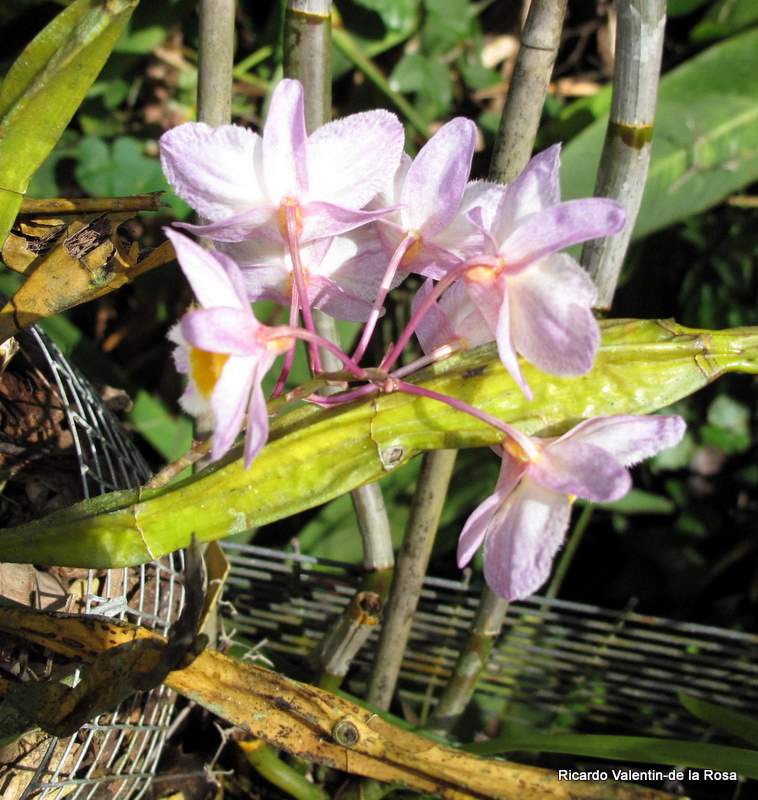
Dendrobium Bohemian Rhapsody, Den loddigesii x Den cucullatum

A beautiful form with heart shaped lip

A smaller clone with poorer flowers and an oddly shaped lip

This Dendrobium is a hybrid of the species loddigesii and cucullatum.   In my experience Dendrobium loddigesii will grow well under warm conditions but will bloom poorly or not at all.   Dendrobium cucullatum will grow and bloom well under my conditions.  This hybrid has been a disappointment for me, it grows relatively well but blooms with few flowers.  This plant is capable of producing a good display of pink flowers.  I have seen a plant grown by Ed Merkle that produces a breathtakingly beautiful display of pink flowers.
My suspicion is that my conditions are just too warm for this plant to perform at its best.  I cared for this plant in ways that elicit abundant flowering from its pendent Dendrobium relatives with little to show for the effort.   Surprisingly the flowers of my two plants are very different.  One has big flowers with wide petals and sepals and a wonderful heart shaped lip.  The other one has narrow petals and sepals and a strange trumpet shaped lip.  Why these two plants of the same hybrid are so different is a mystery to me as primary hybrids tend to be quite similar, perhaps different forms of the species were used to make the two of them.  Since they bloom weakly I keep them mainly as curiosities.  Perhaps growers that can supply the proper seasonally cooler temperatures will probably be able to enjoy really good blooming from this orchid.

Dendrobium parishii a small orchid from the deciduous forest of Asia


This plant is relatively well bloomed for a local plant

A more typical few flowered blooming, note the hairy lip that is characteristic of this species

A hybrid between lodiggesii and anosmum, this one has a particularly wide lip and a delicate color.  Small and deeply colored forms of this hybrid, Den. Nestor, are sometimes confused with parishii


This species is native of a wide band of Asia, it can be found from the Assam region of India to China, Thailand, Myanmar, Laos and Vietnam.  It grows grows in deciduous forest that undergo seasonal variations that dictate a wet and cloudy summer and a dry and sunny winter.  This variations in water availability and light intensity are said to promote better blooming when some effort is made to replicate them in captivity.  The flowers have a powerful, pleasing fragrance.
This Dendrobium seems to grow poorly locally.  Most of the plants I have seen on display are literal dwarves when compared with similar plants grown in more temperate climates.  In my own experience this is a plant that is difficult to keep and can be prone to rot if put in a growing media with poor aireation.  None of my plants have produced canes that have reached more than five or six inches.  However when grown in well drained media or in a plaque of cork or fern the plant can be problem free.  It has also grown relatively well in very small pots that have good drainage.  One of my best plants was grown on a two inch pot for several years with little complaint.
The canes can be straight or arching, I have had plants that have grown both ways.  It responds well to daily watering and heavy fertilization during its growing season.   However it can be perceived as a frustratingly slow grower for those of us accustomed to plants such as anosmum and cucullatum which can grow a five to seven feet cane in a single season.
This plant is very common in horticulture and even the most cursory Internet search can reveal several growers that have it for sale at very affordable prices.  Locally I have seen this plant only on the collections of the more experienced hobbyists.  It is not clear if the relative rarity of this species locally is because the more experienced hobbyists are the only ones that are interested in it or whether they are the only ones that can keep it alive for an extended period of time.

Saturday, April 9, 2011

A rare hybrid of Dendrobium farmeri and Dendrobium densiflorum

The flowers of the hybrid look like those of Den. farmeri var. albiflorum but the structure of the lip and the distribution of color are slightly different

The plant packed for transportation to a local orchid society meeting where it won the "plant of the month" award.

To the left, Dendrobium farmeri var. albiflorum, to the right the hybrid of farmeri and densiflorum
Several inflorescenses together show the dense arrangement of flower that this plant has inherited from the densiflorum parent

This hybrid is more floriferous than either parent but can be erratic on its blooming patterns with several inflorescences opening together of one or two at a time over several months.

This rare Dendrobium farmieri x densiflorum hybrid combines the dense and long inflorescence of densiflorum with the white-yellow flowers of farmeri.   When I got this plant, years ago, as tiny seedlings I found that it grew well albeit a bit slowly.  In time it started blooming and producing large and dense inflorescences.  Unfortunately I lost one of my plants to rot after a repotting.  This seems to be a big problem locally with these plants and other related to farmeri and densiflorum, they grow very well but damage to the root and the stems during repotting can result in the rotting of the stems.  As a result now I am potting these plants in baskets and avoiding repotting them as long as possible.
Unlike densiflorum and farmeri which bloom once or at most twice in a season this hybrid usually blooms once with several inflorescences at the same time and the rest of the year it can produce inflorescences at irregular intervals.  It can be cultivated in an identical manner as farmeri or densiflorum but seems to be less dependent in seasonal cues to bloom.  I tried to grow this plant into a specimen but the loss of older canes to rot made this impossible.  I would love to find source for this hybrid to replace the plant I lost but so far it seems that nobody has made it again. 
The flowers of this hybrid are very much like farmeri with little to betray the densiflorum ancestry.  You have to look at the flowers closely to see the way they differ from farmeri.  The differences are mainly in the lip, the orange-yellow color of the lip extends almost to the tip of the lip, the upper side lobes of the lip don’t close over the column and the lip is more elongated.  The canes of the plant however are larger than those of farmeri and have a clear resemblance to the canes of densiflorum.  As far as I now this plant is quite rare in cultivation, I have yet to see one exhibited in a local show.  Hopefully someone will make this hybrid again as it has much to recommend it.

Thursday, April 7, 2011

Dendrobium thyrsiflorum, a rare blooming in Puerto Rico


The color combination of completely yellow to orange lip and white floral segments is a salient characteristic of Dendrobium thyrsiflorum
It is very rare to see locally plants with full sized inflorescences.  Plants in the wild and those cultivated in temperate climates can produce even larger inflorescences

This flower shows the round lip of a fully opened flower

Dendrobium thysiflorum is an orchid that is found in the northern areas of India and the Himalayas, China, Thailand and Vietnam.  In Puerto Rico it can grow happily and vigorously.  But it blooms rarely and most of the time with relatively short inflorescences that are a pale shadow of the ones this plant produces in the wild and under cultivation in more temperate climates.  I have often wondered why this plant won't bloom well locally.  I thought that it might be due to the lack of the proper rest period of low temperatures or too enthusiastic fertilizing and watering in its rest season.  But after examining this plant I am starting to suspect that although temperature and rest period may have something to do with the lack of blooming it may be that most local plants are too small to bloom properly.  The blooming plant was significantly larger than most plants I have seen under cultivation locally with canes close to two feet tall.  In more temperate areas  Dendrobium thyrsiflorum can grow into humoungous specimen plants that produce dozens of inflorescences at the same time.  I have never seen a specimen plant in Puerto Rico but after seen this one, there is hope that someone can crack the problem of blooming this plant well in our island.  This plant can be cutlivated the same as Dendrobium farmeri but it is a much taller orchid.  I grow my own plant of this orchid in a net pot.  I have lived there for many years but now I see that it has the potential to grow much larger as my plant is barely nine inches tall.  I plant to give it heavy fertilizing during its growth phase to see if I can coax it to produce larger canes.

Dendrobium farmeri, a flower with a touch of lavender in the petals


This photo, taken with flash, gives the lip a deeper orange color than what it is in life

This plant bloomed unexpectedly from a very old cane, and from an axillary bud that had been dormant for years.  This plant almost perished from rot and the new canes, are tiny, too small to produce inflorescences so this blooming was a pleasant surprise

This photo which was taken using sunlight gives the lip a color more true to life than the first photo.  Most farmeri blooms are pink to pale pink but this variant has a slightly deeper shade of lavender in the border of the floral segments.

Dendrobium farmeri is one of my favorite Dendrobium.  It is easy to grow (there is information about its care elsewhere in this blog) and can be very floriferous.  There are many variants in the market that go from pure white to lavender.  Variants with a deeper lavender color are rare in Puerto Rico.  I compared the flowers of this plant with the flowers of the pink forms I have and the color of the petals is essencially the same.  The difference lies in the size of the flowers and in the lavender color in the tip of the lip.  In this plant the flowers stay small and the color is spread over a smaller area in my pink forms the petals are significantly larger and lavender is fainter giving the plant an overall pink shade.  This plant suffered from rot a few years ago and almost died.  The plant was reduced to a few dehydrated canes.  I put the canes in a shady humid spot where they remained for almost two years without neither dying or growing.  But last year one of the canes produced a tiny side growth from a dormant bud.  I was overjoyed and gave the plant a lot of TLC.  Unfortunately it seems that this plant will take a lot of time to recuperate to its former size.  On the bright side I got this unexpected blooming with was a wonderful surprise from a plant that almost didn;t make it.


Friday, April 1, 2011

Crash Boat Beach y Peñas Blancas area, Aguadilla, underwater photos from the early eighties


A coralline comunity near the beach in Peñas Blancas called by surfers "wishing well".  There was an impressive quantity of marine organisms growing in some underwater limestone outcrops full of caves.  Mark Verdiun, his siblings and me used to visit this place all the time.  It was fun to explore the area to see what we would find, there was always something new to see.  Large stony corals were rare here.

Two spotted drums (thanks Pucho for the ID), very young ones, swimming near the base of one of the pillars in the Crash Boat beach.  Notice the trash on the seafloor.

Add captin
One of the pillars of the Crash Boat piers.  You can see the pillars have lots of fishing wire entangled around the sea life clinging to them.

The longspined black urchin Diadema antillarum used to be present in the coralline areas in huge numbers as you can see in some spots the sea floor was carpeted with them.  In 1983 there was a tremedous die off in which around 97% of all of this urchins perished.  Some say that the decline of some Caribbean reefs was tied to the loss of this important member of the reef community.

A box fish, Crash Boat

Coralline community, Peñas Blancas, see the blue chromis in the left center of the photo

My friend Jose Nieto snorkeling between the pillars of the Crash Boat piers