Showing posts with label farmeri. Show all posts

Wednesday, November 23, 2016

Dendrobium (farmeri x densiflorum)


Sadly I lost this beautiful and floriferous plant.  But if I ever see this cross again for sale, I will buy it in a second!!

Friday, February 28, 2014

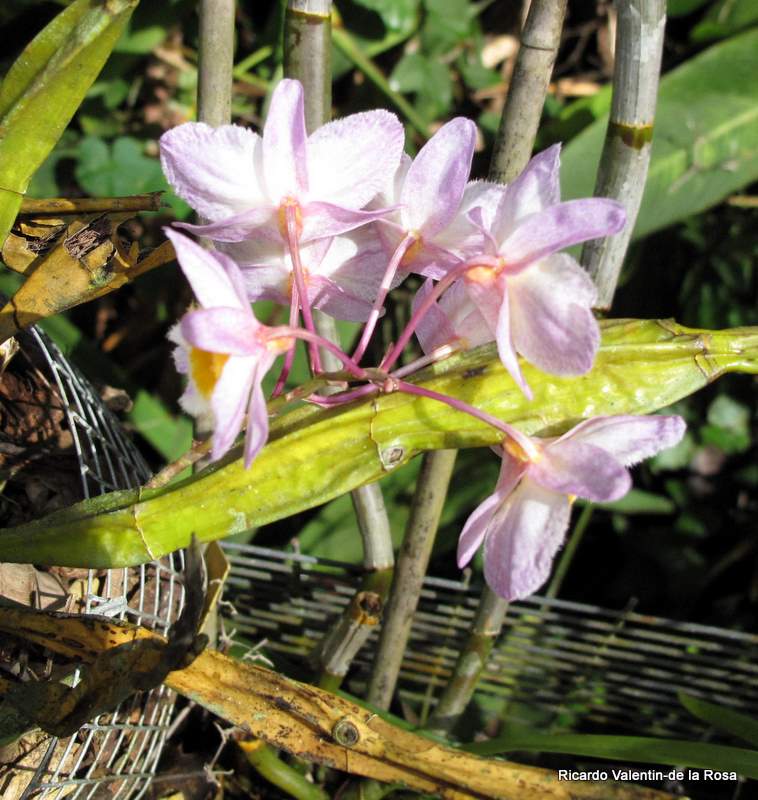
Dendrobium farmeri, my favorite color form


The lilac color of the borders of the petals and sepals of this Dendrobium farmeri make the flower look pink when looked from a distance.  The flower also has a touch of color in the tip of the lip, which in this particular flower is curved back.  Sadly the top sepal edges curl back instead of being flat, as it is in some other color forms.

Saturday, February 22, 2014

Dendrobium farmeri, a white flower with a touch of color in the floral parts.


This particular clone of Dendrobium farmeri is mostly white with some color in the sepals and petals.  Unfortunately the plant is a weaker grower than my other Dendrobium farmeri.  Its pseudobulbs are smaller than regular farmeri and its inflorescences have fewer flowers.  I give it the same care I give all my other farmeri plants.

Monday, September 30, 2013

Dendrobium farmeri, a significant blooming six months after its blooming season.


My plants of Dendrobium farmeri blooming season is in March and April.   Their blooming pattern is fairly predictable, the plants produce a number of inflorescences in March, and then about a month later, they produce a second blooming.   Not all plants bloom that way, in my area Dendrobium farmeri albiflorum produces a single flush of inflorescences and that’s it for the year. 

Sometimes the plants that produce pink tinged flowers produce single inflorescences long after the blooming season has passed.  These inflorescences are produced erratically and don’t seem to conform to any blooming schedule.  But in 2013 my largest plant produced four inflorescences in September, the largest blooming event ever outside its normal blooming season.  This is not the only plant to bloom six months after its normal blooming season, a large Coelogyne parishii also produced a few inflorescences in September.  


What really sets these blooming events apart from the ones that occur in Spring is the fact that all the inflorescences came from latent buds low on the stems of older pseudobulbs.  In the normal blooming season the inflorescences come from the highest bud in the previous year growths.  This means the inflorescence is produced just under the leaves of the stem.  The autumn inflorescences in my plants were all produced from buds halfway down on the stems of old pseudobulbs.

Saturday, April 9, 2011

A rare hybrid of Dendrobium farmeri and Dendrobium densiflorum

The flowers of the hybrid look like those of Den. farmeri var. albiflorum but the structure of the lip and the distribution of color are slightly different

The plant packed for transportation to a local orchid society meeting where it won the "plant of the month" award.

To the left, Dendrobium farmeri var. albiflorum, to the right the hybrid of farmeri and densiflorum
Several inflorescenses together show the dense arrangement of flower that this plant has inherited from the densiflorum parent

This hybrid is more floriferous than either parent but can be erratic on its blooming patterns with several inflorescences opening together of one or two at a time over several months.

This rare Dendrobium farmieri x densiflorum hybrid combines the dense and long inflorescence of densiflorum with the white-yellow flowers of farmeri.   When I got this plant, years ago, as tiny seedlings I found that it grew well albeit a bit slowly.  In time it started blooming and producing large and dense inflorescences.  Unfortunately I lost one of my plants to rot after a repotting.  This seems to be a big problem locally with these plants and other related to farmeri and densiflorum, they grow very well but damage to the root and the stems during repotting can result in the rotting of the stems.  As a result now I am potting these plants in baskets and avoiding repotting them as long as possible.
Unlike densiflorum and farmeri which bloom once or at most twice in a season this hybrid usually blooms once with several inflorescences at the same time and the rest of the year it can produce inflorescences at irregular intervals.  It can be cultivated in an identical manner as farmeri or densiflorum but seems to be less dependent in seasonal cues to bloom.  I tried to grow this plant into a specimen but the loss of older canes to rot made this impossible.  I would love to find source for this hybrid to replace the plant I lost but so far it seems that nobody has made it again. 
The flowers of this hybrid are very much like farmeri with little to betray the densiflorum ancestry.  You have to look at the flowers closely to see the way they differ from farmeri.  The differences are mainly in the lip, the orange-yellow color of the lip extends almost to the tip of the lip, the upper side lobes of the lip don’t close over the column and the lip is more elongated.  The canes of the plant however are larger than those of farmeri and have a clear resemblance to the canes of densiflorum.  As far as I now this plant is quite rare in cultivation, I have yet to see one exhibited in a local show.  Hopefully someone will make this hybrid again as it has much to recommend it.

Thursday, April 7, 2011

Dendrobium farmeri, a flower with a touch of lavender in the petals


This photo, taken with flash, gives the lip a deeper orange color than what it is in life

This plant bloomed unexpectedly from a very old cane, and from an axillary bud that had been dormant for years.  This plant almost perished from rot and the new canes, are tiny, too small to produce inflorescences so this blooming was a pleasant surprise

This photo which was taken using sunlight gives the lip a color more true to life than the first photo.  Most farmeri blooms are pink to pale pink but this variant has a slightly deeper shade of lavender in the border of the floral segments.

Dendrobium farmeri is one of my favorite Dendrobium.  It is easy to grow (there is information about its care elsewhere in this blog) and can be very floriferous.  There are many variants in the market that go from pure white to lavender.  Variants with a deeper lavender color are rare in Puerto Rico.  I compared the flowers of this plant with the flowers of the pink forms I have and the color of the petals is essencially the same.  The difference lies in the size of the flowers and in the lavender color in the tip of the lip.  In this plant the flowers stay small and the color is spread over a smaller area in my pink forms the petals are significantly larger and lavender is fainter giving the plant an overall pink shade.  This plant suffered from rot a few years ago and almost died.  The plant was reduced to a few dehydrated canes.  I put the canes in a shady humid spot where they remained for almost two years without neither dying or growing.  But last year one of the canes produced a tiny side growth from a dormant bud.  I was overjoyed and gave the plant a lot of TLC.  Unfortunately it seems that this plant will take a lot of time to recuperate to its former size.  On the bright side I got this unexpected blooming with was a wonderful surprise from a plant that almost didn;t make it.


Monday, March 28, 2011

Dendrobium farmeri, a small Dendrobium that can produce an impressive show


The white form of the species, albiflorum
The most common form in the wild

A very light pastel pink form

A highly colored type with smaller slightly cupped flowers

A pink form, the orange lip is due to the fact that they were photographed with flash
Two slightly different forms side by side, note the long slits for aireation on the pots

The albiflorum form next to a pink one

A plant almost totally covered with flowers

This deeply colored form even has a purple dot in the lip
Dendrobium farmeri is an orchid that has a geographical distribution that goes from the eastern Himalayas to Malaysia.  This means that plants of this species can grow in environmental conditions that range from fairly cool to sweltering hot.  But this doesn’t mean that all plants of this species will grow under any condition that you can expose them.   There are local populations of this species that have adapted to certain regimes and will not bloom in the environmental conditions don’t match their seasonal needs.  Visitors to their natural habitat remark that the plants are often seen growing in trees near river courses.  I have had the experience of growing several different plants of Den, farmer, I will detail my experiences in the following paragraphs.

A few years ago a friend gave me as a gift a very peculiar farmeri plant.  It had a long and thin stem that about halfway of the way up the stem would fatten to a ridiculously disproportionate girth.  It was the tallest farmeri that I ever seen with canes 30cm long.  My friend gave me the plant because it would not bloom for him (he lives in the coastal lowlands of Puerto Rico), at that time the canes were about 15 cm tall.  What made them grow to 30 cm was the heavy application of water and fertilizer during its active growth phase.  After two years under my cultural regime the plant produced the two largest inflorescences that I have ever seeing in a farmeri plant.  I have wondered this plant was palpebrae but it lip didn’t show the fringe that palpebrae flowers are said to have.  This plant sadly died unexpectedly of a stem rot that had never previously attacked any farmeri plant in my collection and has never attacked one since this one died.  This plant was cultivated in a plastic basket that it eventually filled with roots, the only potting material were several large pieces of bark.  The flowers of this orchid were pure white with a bright yellow coloration in the lip.   This orchid was a large sized representative of the albiflorum variety.  All my other plants are smaller than this one and don’t show the shape of the stem this plant had.  I suspect this plant came from and mountainous region and needed a sharp drop in temperature to stimulate blooming.

I have several smaller (less that 20 cm tall) slender types will bloom equally well in the mountains as in the coasts of Puerto Rico.  In the early nineties there was a huge importation of Den. farmeri, the plants were sold at the Puerto Rico Orchid society show in San Juan.  When these plants bloomed they all turned out to be the white variant of the species Den. farmeri albiflorum.  For many years var. albiflorum was the only one that was seen in orchid exhibits in the island.  During the course of the nineties I saw exhibited some impressive specimens and I personally had a plant that would produce more than a dozen inflorescences at the same time.  Unfortunately many plants of this importation showed cupped, nodding flowers, this detracted from the beauty of the blooms.  It is not clear whether this cupping of the flowers is due to genetic or cultural causes.   

A few years ago there was another importation, this one consisted almost entirely of the pink form of the species.  I saw one plant in bloom and was so smitten with it that spent $60 dollars. That is right I spent almost five times the value of a seedling of this type of orchid in a single plant.   But I loved the purplish color of the flowers and was quite happy with my purchase.  In due time the flowers fell (the flowers of this plant last from a week to ten days, less time if weather is really hot).  In about two week the plant bloomed again and to my surprise the flowers were different!   In this blooming the flowers were pink, larger and fuller than in the firsts bloom.  A few weeks later the plant produced a single inflorescence which was again different from the previous two.   In this case the flowers had a very delicate pastel pink color.   After careful examination of the plant I had to conclude that I actually had three plants growing very close together in a single pot.

With extreme care I disentangled the three different clones and potted them separately.  Two of them have been growing well with no problems, the third one almost died.  Why?  Because under my conditions farmeri seems to be extremely vulnerable to rot after it has been repotted.  The plants can live for a long time, a decade or more filling and growing over their old pot in great health.  But every time I have divided and repotted the plants I have lost many of the pieces.

My saddest experience was when I took out of its pot a specimen plant of the variety albiflorum that had been in the same basket of about ten years.  I took the plant out of the basket divided it in several pieces and potted each piece separately.  After a few days they started dying, at the end only a tiny two cane piece survived.  This piece has been growing painfully slowly but at least is alive and has started producing small but pleasing inflorescences.  So what is my advice on potting this plant?  Put it into a basket that will allow the plant to grow for years without the need to repot.  Use the hardest most decay resistant media you can find, don’t use cheap bark and for Peter’s sake don’t even consider the super cheap landscaping bark for this orchid. 

The most vexing problem I have had to deal with this species is the proclivity of some clones to produce new canes lower in the stem than the original cane.  As a result of this habit the new canes end up growing through the media and sometimes into the media before growing upwards.  These types may be better grown in slat baskets or mounted on tree fern slabs.

For most of the year I don’t fertilize this orchid, I only fertilize when the plant is producing new growths.  When this plant is growing the canes grow comparatively fast so you need to give it fertilizer frequently.  When my plants I growing I give them diluted fertilizer at every watering.  I use whatever fertilizer I have on had, be it 20-20-20 or any other combination, I have never seen any difference in growth as long as I fertilize the plant regularly.

My plants bloom in February, March and April.  The albiflorum type produces a single flush of inflorescences that open all at the same time.  The pink flowered types bloom once a year when they have few canes, but once they grow large they bloom twice, once in February and again in March or April.  My main problem has been that the flowers are wildly attractive to thrips which will attack them in great numbers even when they have been rendered toxic by the application of pesticides.  To avoid having the flowers damaged with these hateful pesky pests I move the plants indoor for the duration of the blooming period.  As the plants mature and gain size they can produce very impressive flowerings.

These plants need bright light to bloom well.  I grow my plants in a terrace where they get full morning sun for two to three hours and then sunlight filtered through the trees the rest of the day.  Too much shade results in poor blooming or even no blooming at all.
When my plants are growing I water them almost daily to sustain the rapid growth of the canes.  During the summer my plants get a daily soaking from the thunderstorms that form over the mountains every day.  The plants take the wetness with little complaint.  When the dry season starts in December I stop watering the plants and allow them to dry, but not so much the canes shrivel and twist, if the canes start to get too wrinkled I water the plant lightly.
This plant is an excellent addition for an orchid collection if you can fulfill its relatively modest needs.

Wednesday, December 1, 2010

Fragrant Dendrobium, ideal for a perfumed tropical garden


Dendrobium anosmum, all plant of this species I have grown are capable of producing the strong sweet fragrance characteristic of this species, the scientific name, anomum, which means without fragrance, must have been given by an anosmic individual!  This species when well bloomed can produce a powerful fragrance that can be clearly smell from many feet away.
 I have grown Dendrobium orchids for many years and it is one of my favorite orchid genera. Of the Dendrobium, the ones I like best are the fragrant species and hybrids. In the following article I will share details on the species and varieties I have grown, on their fragrances and on the particular quirks that the various species have exhibited under my culture.


Many years ago, in a book whose title I can’t remember, I read about a circular garden that was divided in six parts. Each part of the garden was devoted to a different sense. The garden had five wedges, where all the wedges converged in the center there was another circle, this one devoted to the sixth sense, intuition, and planted with only with golden flowers. This garden captured my imagination, but unfortunately I could not make one. My work as a wildlife biologist has meant that I have lived either in urban areas near universities or deep in protected forests, in these places this type of garden was impossible. But in these settings orchids allowed me to enjoy delightful fragrances, lovely colors and interesting shapes without the need of large spaces, digging, or modifying the landscape in any significant way. Orchids had also the virtue of portability, when I moved, (something that has happened several times during my career), I just took them with me with little problem.


Of all the orchids I have, the Dendrobium represent the best combination of ease of culture, resistance to pests and consistent flowering. This didn’t happen by chance, I did my homework and tried to acquire those species that were best suited for my climatic conditions. Getting the information on the cultural needs of the particular Dendrobium you want to grow is very important as some species need a certain degree of seasonal variation of temperature and moisture to stimulate the buds in the cane to change from the vegetative to flowering mode. Pest resistance is important to me as I don’t want to have to continually use pesticides just to keep my plants in good condition. I do use pesticides but on spot applications and not as preventive measures. In respect to consistent flowering, taking care to give the plants the proper culture they need goes a long way toward achieving regular flowering even on plants that are sometimes labeled as difficult. I suspect that some of the difficulties faced by growers getting their plants to bloom may have to do with growers trying to grow them under conditions that are not really suited to that particular species.

I grow my orchids outside, in a terrace and in a shade house. I live near the central mountain range of Puerto Rico at an altitude of 1000 feet (350 mts), near the center of the Rio Abajo State Forest, where I work. The local temperatures range from 60F (16C) at night at the peak of winter to 90F at daytime in the height of summer, daily temperature variation is about 10 to 15 degrees. There are just two seasons, a dry and a wet one. Humidity fluctuates most of the year between 70 and 80% but varies from 40% during the day at the peak of the dry season to close to 100% at night during the rainy season. The plants are watered weekly during if it doesn’t rain. The plants are regularly watered during the dry season with the exception of those that need a seasonal dry spell. The plants receive fertilizer only when they are growing. Some effort was made to find the optimal sun exposure for each species. It was found that most bloom much better with several hours of exposure to full sunlight in the morning.

Dendrobium anosmum alba, small flowered, small lipped clone

Dendrobium anosmun var. huttoni

The most common type of Den. anosmum is also the most floriferous, it is capable of producing more than sixty flowers on a single cane

Den. anomum variety from Thailand, the flower is suspiciously similar to Den. Nestor but the canes are unique and not similar at all to those of Nestor

Den. Nestor clone, favoring the anosmum parent, but note the fuzzy lip that betrays the parishii ancestry, at time sold as anosmum, all Nestor I have grown have the sweet fragrance associated with anosmum
A Den. Nestor that favors the parishii parent

A Den. Nestor that is quite distinct from most other forms hybrid

A very small lipped form of Den. Nestor with very thick textured flowers

In the front, Den. farmeri var. albiflorum, an outstading clone of this type, in the background a typically colored form. The fragrance is faint but clearly felt when there are many flowers

A flower of Den. farmeri albiflorum

Den. farmeri, a faint fragrance
Dendrobium harveyanum, formerly an extremerly difficult to find species, a slight honey fragrance

Den. crumenatum, powerfully fragrant at certain times of the day
Den. parishii, delightfully frangrant with a sweet note

Den. chrysotoxum, a sweet slight honey fragrance

Den. fimbriatum var. oculatum, a sour citrical fragrance

Den. nobile, a slight sweet fragrance

Dendrobium moschatum it has complex fragrance delightful to some, unpleasant to others

Dendrobium spectabile it has a complex fragrance sweet to some, to others like crushed stinkbugs