Showing posts with label crumenatum. Show all posts

Friday, August 9, 2013

Dendrobium gone wild! Dendrobium crumenatum in San Sebastian Puerto Rico


Dendrobium crumenatum, known as the pigeon orchid, is ubiquitous in orchid collections in the island of Puerto Rico.   I suspect the two main the reasons it is so common in collections are, one, it can grow well under Puerto Rico’s climatic conditions and two, it is generous producing plantlets along its flowering stems.   Also, it can stand utter neglect and can survive a wide range of light exposures from full sunlight to deep shade.
The flowers of Den. crumenatum last only one day, but this is compensated by the fact that the plant blooms every time there is a strong shower that lowers the temperature 10 degrees Fahrenheit.    The flowers are strongly fragrant and a big plant can have dozens of flowers at the same time.    As a result of this orchid capacity to survive, and even thrive, with minimal or no care, many people simply tie a plant to a tree and essentially forget about it.   If the location is favorable Den. crumenatum can grow into a huge plant with many canes.
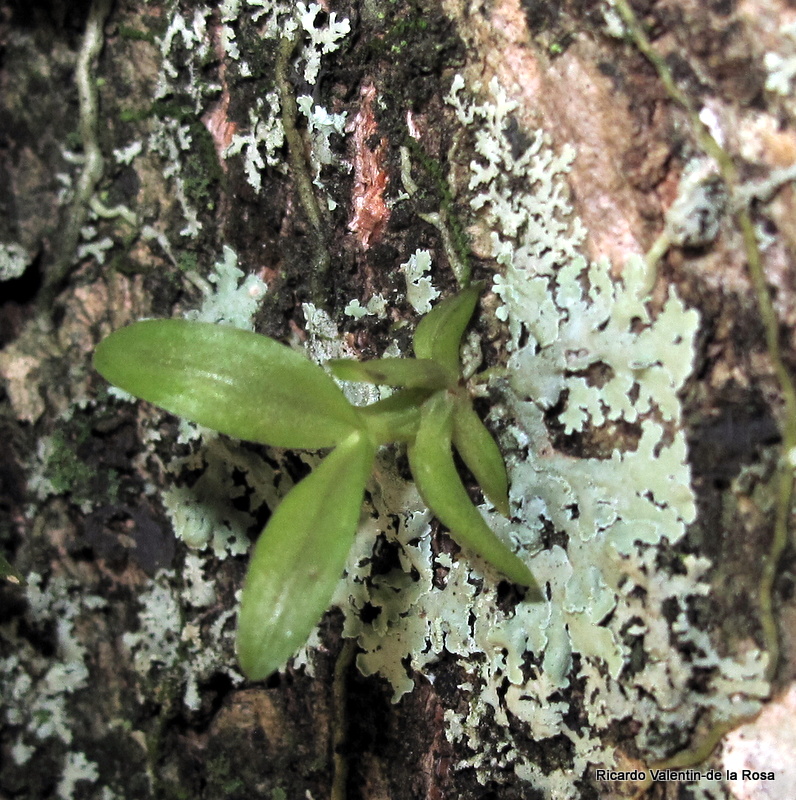
In 1984, I visited the garden of Dr. Juan A. Rivero, he had many types of orchids, growing both on trees and in pots.  I noted that there was a seedling Den. crumenatum in the trunk of a tree.  Dr. Rivero told me that the plants would set seed and that some plantlets had appeared spontaneously on the trees.  The next time I saw seedlings growing feral was in January 2012.  In January 2012, I visited the city of San Sebastian to participate in the Festival de la Novilla.   This festival is named because a young cow is adorned with ribbons and paraded through the streets of the city.  Needless to say lots of drinking and merrymaking happens, but I digress. As I was walking along a city street I saw a large plant full of blooms inside a fenced garden.    I stopped to take some photos and then I noticed that in one of the trees that lined the street there were seedlings of this Dendrobium.
The seedlings were growing on the trunk, from a little bit below eye level to high in the branches.  It counted a dozen seedlings on the tree.  Some were close to blooming size and others were only a few inches long.  The tree where the seedlings were growing was about twenty feet away from the site of the specimen plant, which I suspect was the parent.
As I explored the area, I noticed there were a number of orchids on the nearby trees, with the exception of the tree with the seedlings, all were in the gardens and clearly put there by humans.   There was a large plant of Dendrobium cucullatum, a clump of Dendrobium Jacqueline type, a strap leaf Vanda and many Arachnis plants, probably from their look Arach. Maggie Oei.  
Given that the seedlings of Den. crumenatum are becoming established with no human help, and that locals clearly love to see orchids on their trees, I would think it will stand little difficulty colonizing the area.   I checked other trees near the one with seedlings but no other had seedlings on them.  Maybe next year, as I go to the Festival de la Novilla, I will go and see how they are doing.

 If you notice any exotic orchid growing in the wild in Puerto Rico, please contact Prof. Ackerman of the University of Puerto Rico in Rio Piedras.  He is studying invasive orchid species and will appreciate the information.   It is important that the information on the location of the plants be as precise as possible.


Wednesday, December 1, 2010

Fragrant Dendrobium, ideal for a perfumed tropical garden


Dendrobium anosmum, all plant of this species I have grown are capable of producing the strong sweet fragrance characteristic of this species, the scientific name, anomum, which means without fragrance, must have been given by an anosmic individual!  This species when well bloomed can produce a powerful fragrance that can be clearly smell from many feet away.
 I have grown Dendrobium orchids for many years and it is one of my favorite orchid genera. Of the Dendrobium, the ones I like best are the fragrant species and hybrids. In the following article I will share details on the species and varieties I have grown, on their fragrances and on the particular quirks that the various species have exhibited under my culture.


Many years ago, in a book whose title I can’t remember, I read about a circular garden that was divided in six parts. Each part of the garden was devoted to a different sense. The garden had five wedges, where all the wedges converged in the center there was another circle, this one devoted to the sixth sense, intuition, and planted with only with golden flowers. This garden captured my imagination, but unfortunately I could not make one. My work as a wildlife biologist has meant that I have lived either in urban areas near universities or deep in protected forests, in these places this type of garden was impossible. But in these settings orchids allowed me to enjoy delightful fragrances, lovely colors and interesting shapes without the need of large spaces, digging, or modifying the landscape in any significant way. Orchids had also the virtue of portability, when I moved, (something that has happened several times during my career), I just took them with me with little problem.


Of all the orchids I have, the Dendrobium represent the best combination of ease of culture, resistance to pests and consistent flowering. This didn’t happen by chance, I did my homework and tried to acquire those species that were best suited for my climatic conditions. Getting the information on the cultural needs of the particular Dendrobium you want to grow is very important as some species need a certain degree of seasonal variation of temperature and moisture to stimulate the buds in the cane to change from the vegetative to flowering mode. Pest resistance is important to me as I don’t want to have to continually use pesticides just to keep my plants in good condition. I do use pesticides but on spot applications and not as preventive measures. In respect to consistent flowering, taking care to give the plants the proper culture they need goes a long way toward achieving regular flowering even on plants that are sometimes labeled as difficult. I suspect that some of the difficulties faced by growers getting their plants to bloom may have to do with growers trying to grow them under conditions that are not really suited to that particular species.

I grow my orchids outside, in a terrace and in a shade house. I live near the central mountain range of Puerto Rico at an altitude of 1000 feet (350 mts), near the center of the Rio Abajo State Forest, where I work. The local temperatures range from 60F (16C) at night at the peak of winter to 90F at daytime in the height of summer, daily temperature variation is about 10 to 15 degrees. There are just two seasons, a dry and a wet one. Humidity fluctuates most of the year between 70 and 80% but varies from 40% during the day at the peak of the dry season to close to 100% at night during the rainy season. The plants are watered weekly during if it doesn’t rain. The plants are regularly watered during the dry season with the exception of those that need a seasonal dry spell. The plants receive fertilizer only when they are growing. Some effort was made to find the optimal sun exposure for each species. It was found that most bloom much better with several hours of exposure to full sunlight in the morning.

Dendrobium anosmum alba, small flowered, small lipped clone

Dendrobium anosmun var. huttoni

The most common type of Den. anosmum is also the most floriferous, it is capable of producing more than sixty flowers on a single cane

Den. anomum variety from Thailand, the flower is suspiciously similar to Den. Nestor but the canes are unique and not similar at all to those of Nestor

Den. Nestor clone, favoring the anosmum parent, but note the fuzzy lip that betrays the parishii ancestry, at time sold as anosmum, all Nestor I have grown have the sweet fragrance associated with anosmum
A Den. Nestor that favors the parishii parent

A Den. Nestor that is quite distinct from most other forms hybrid

A very small lipped form of Den. Nestor with very thick textured flowers

In the front, Den. farmeri var. albiflorum, an outstading clone of this type, in the background a typically colored form. The fragrance is faint but clearly felt when there are many flowers

A flower of Den. farmeri albiflorum

Den. farmeri, a faint fragrance
Dendrobium harveyanum, formerly an extremerly difficult to find species, a slight honey fragrance

Den. crumenatum, powerfully fragrant at certain times of the day
Den. parishii, delightfully frangrant with a sweet note

Den. chrysotoxum, a sweet slight honey fragrance

Den. fimbriatum var. oculatum, a sour citrical fragrance

Den. nobile, a slight sweet fragrance

Dendrobium moschatum it has complex fragrance delightful to some, unpleasant to others

Dendrobium spectabile it has a complex fragrance sweet to some, to others like crushed stinkbugs