Showing posts with label exotic. Show all posts

Saturday, April 11, 2015

Dendrobium nobile Lindley 1830. Culture: A plant that has bec naturalized on a tree near the town of Corozal, Puerto Rico


Dendrobium nobile is a species that is common in orchid collections in the Island of Puerto Rico.  Unfortunately, few people know or understand the seasonal cycle of this species.  As a result one sees many plants that are quite large and healthy and yet bloom poorly or not at all.  The most common error in cultivating this orchid is keeping it in too much shade.  This plant grows best when cultivated in strong light, it can even stand the full strength of the tropical sun.   However in nature the amount of light exposure this orchid gets varies with the seasons.  During most of the year the plant grows under a leafy canopy, but as the dry season progresses the trees in its native haunts lose their leaves an the plant is exposed to full sun.  Seasonal low temperatures and a dry spell are also elements that happen in this plant habitat that is often not replicated in captivity.

This particular plant is growing ten feet up in a tree in a fork between branches.  The canes are getting a healthy amount of  sunlight because the tree has a fairly open canopy.  The plant experiences a seasonal dip in night temperatures that resembles somewhat what it gets in its native range, although in Corozal, low temperatures normally don't often stray lower that the low sixties.   It is blooming now in what is locally the height of the dry season.

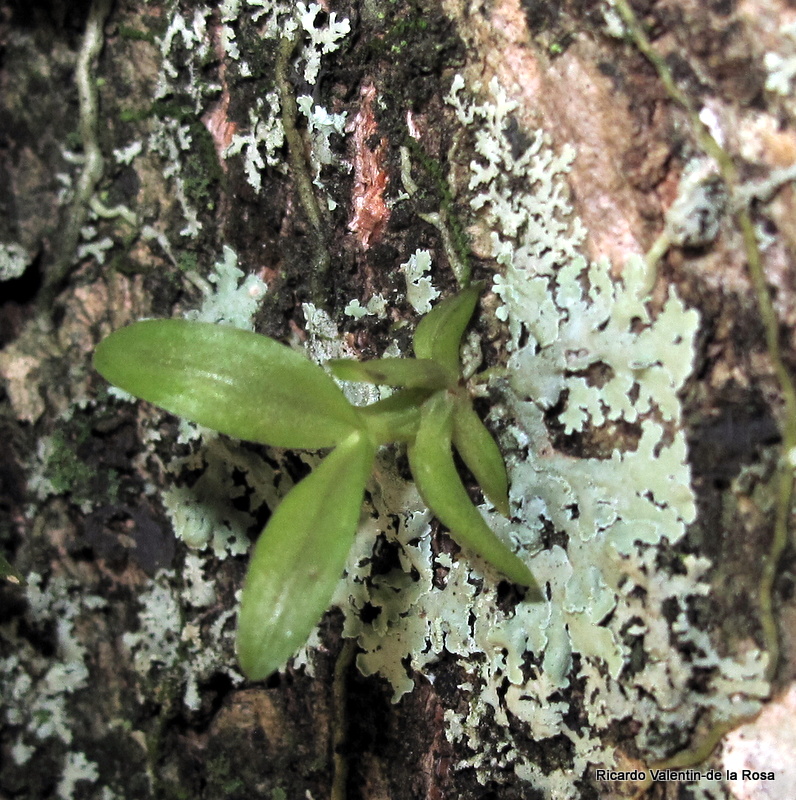
This is clone has nicer flowers than most other plants I have seen locally.  I examined this tree and others that were nearby but I didn't find seedlings.  The plant has no signs of having ever produced a seed pod.  I did find a small seedling under the plant but it was evident it was a vegetative propagation from an old cane.

It is clear the environment in this locality is favorable for the growth of this species.  I have seen even larger specimens of this orchid growing at higher altitudes in Puerto Rico.  Those plants grew well and bloomed abundantly, in contrast with the plants one often sees in the coast.  The common circumstances of the plants I have seen blooming locally is that they were all naturalized to trees in sunny areas and that they were in places that consistently experience temperatures in the range of sixty Fahrenheit or lower during the dry season.

Friday, August 9, 2013

Dendrobium gone wild! Dendrobium crumenatum in San Sebastian Puerto Rico


Dendrobium crumenatum, known as the pigeon orchid, is ubiquitous in orchid collections in the island of Puerto Rico.   I suspect the two main the reasons it is so common in collections are, one, it can grow well under Puerto Rico’s climatic conditions and two, it is generous producing plantlets along its flowering stems.   Also, it can stand utter neglect and can survive a wide range of light exposures from full sunlight to deep shade.
The flowers of Den. crumenatum last only one day, but this is compensated by the fact that the plant blooms every time there is a strong shower that lowers the temperature 10 degrees Fahrenheit.    The flowers are strongly fragrant and a big plant can have dozens of flowers at the same time.    As a result of this orchid capacity to survive, and even thrive, with minimal or no care, many people simply tie a plant to a tree and essentially forget about it.   If the location is favorable Den. crumenatum can grow into a huge plant with many canes.
In 1984, I visited the garden of Dr. Juan A. Rivero, he had many types of orchids, growing both on trees and in pots.  I noted that there was a seedling Den. crumenatum in the trunk of a tree.  Dr. Rivero told me that the plants would set seed and that some plantlets had appeared spontaneously on the trees.  The next time I saw seedlings growing feral was in January 2012.  In January 2012, I visited the city of San Sebastian to participate in the Festival de la Novilla.   This festival is named because a young cow is adorned with ribbons and paraded through the streets of the city.  Needless to say lots of drinking and merrymaking happens, but I digress. As I was walking along a city street I saw a large plant full of blooms inside a fenced garden.    I stopped to take some photos and then I noticed that in one of the trees that lined the street there were seedlings of this Dendrobium.
The seedlings were growing on the trunk, from a little bit below eye level to high in the branches.  It counted a dozen seedlings on the tree.  Some were close to blooming size and others were only a few inches long.  The tree where the seedlings were growing was about twenty feet away from the site of the specimen plant, which I suspect was the parent.
As I explored the area, I noticed there were a number of orchids on the nearby trees, with the exception of the tree with the seedlings, all were in the gardens and clearly put there by humans.   There was a large plant of Dendrobium cucullatum, a clump of Dendrobium Jacqueline type, a strap leaf Vanda and many Arachnis plants, probably from their look Arach. Maggie Oei.  
Given that the seedlings of Den. crumenatum are becoming established with no human help, and that locals clearly love to see orchids on their trees, I would think it will stand little difficulty colonizing the area.   I checked other trees near the one with seedlings but no other had seedlings on them.  Maybe next year, as I go to the Festival de la Novilla, I will go and see how they are doing.

 If you notice any exotic orchid growing in the wild in Puerto Rico, please contact Prof. Ackerman of the University of Puerto Rico in Rio Piedras.  He is studying invasive orchid species and will appreciate the information.   It is important that the information on the location of the plants be as precise as possible.


Friday, May 11, 2012

Amandara Rafael Sobrino, Epidendrum ciliare x Blc. Toshie Aoki


This orchid is a cross between Epidendrum ciliare, an orchid species native of Puerto Rico and Blc. Toshie Aoki a complex Cattleya hybrid.  Its name is Amandara Rafael Sobrino made by Dr. Rafael Sobrino. The flower of this hybrid favors the shape of the Epi. ciliare parent.  The  Blc. Toshie Aoki influence is obscured to such an extent in this hybrid that if one saw this plant with no information about its parentage, one would have hardly guessed that Blc. Toshie Aoki was involved. This plant represents a departure from traditional orchid breeding.  Most hybridists pursue the goal of very flat flowers with wide floral segments and round lips.  They would hardly use a plant with the idiosyncratic fringed and elongated lip of Epi. ciliare when there are so many Cattleya hybrids that carry in their genome a concentration of the choosiest traits in an already advanced form.  For me this plant represents and experiment to see how the traits of the parental species would mesh and present themselves in a flower.  As for what I think of the flower, I can say I like it. But the truth is, to quote the romans, “De coloribus et gustativus non disputandum”.

Thursday, May 10, 2012

Dendrobium gouldii 'Black Koa' a yellow colored "antilope" Dendrobium


A mature flower with fully curled petals.

A newly opened flower.

A few years back I brought a seedling of this plant from Tropical Orchid Farm.  I have always liked “antelope” Dendrobium from the section Sphatulata (also known as Ceratobium) because of their resemblance to the heads of antelopes. This plant is native of Papua New Guinea and the Solomon Islandsm it has a number of differently colored forms.  Unfortunately my first plant proved to be a slow grower and would only produce small squat canes.  Undaunted, I brought another plant from TOF.  The new plant grew vigorously and promptly produced a cane that was at one feet and a half tall, much larger than any of the previous ones.  This cane produced an inflorescence in January and the first flowers opened in March. Now it is the middle of May and most flowers are still in good shape.  The inflorescence had about twenty flowers.
The flowers are yellow with a finely sculpted lip and the upraised twisted petals that are a notable characteristic of the section.  The distal end of the petals is a deep brown color which contrasts well with the color of the rest of the flower.  The flowers last for months in perfection, even when subjected to wind and rain.  My plant is growing in a pot with medium size stones as media as I have lost many a Dendrobium from root rot as a consequence of a waterlogged media.
The cultural advice I can give about this plant is the following.  I grow my best plant in a bright, airy spot.  I have grown my plants both in full sun and under shade cloth and the plant under shade cloth grew better.  Give the plant plenty of fertilizer and water when it is producing new canes.  When they are not growing I don’t fertilize my plants.  Avoid putting this orchid in media that can become so packed and waterlogged that the roots are deprived of oxygen, this will kill the roots.


Friday, March 11, 2011

Arundina graminifolia an exotic orchid that has become naturalized in Puerto Rico

A flower of the most common form
A flower of the dwarf form
A flower of the dwarf form in the middle of a group of canes of this orchid
A side view of the flower of a form that seems to be uncommon in the extreme
Excuse me for the poor photo but it is the only front view I have of this mysterious flower
Arundina graminifolia is an orchid native of Southeast Asia that has become naturalized in Puerto Rico.   It can be found in the wild from Sri Lanka and India on the Indian Ocean to the Caroline Islands and Tahiti on the Pacific Ocean.  It is a vigorous plant that has escaped cultivation in areas outside its natural geographical range for example the Hawaiian Islands and Puerto Rico.  In Puerto Rico it has been reported from moist areas in the east of the island.
I have seen it growing in gardens all over the island sometimes forming huge specimen plants.  The tallest plants I have seen were in cultivation right on the ground in gardens in the foothills of the Luquillo Mountains, some seemed to be close to seven feet tall.  There is a huge specimen plant growing in a garden that sits by the side of the road that goes from Utuado to Adjuntas that is notable due to the large number of flowers it can have at the same time.  The plants are known locally as bamboo orchid due to a fancied similarity between the tall canes of this orchid and the canes of the bamboo plant.
I have seen several variations of this plant growing in captivity.  The most common form of Arundina in Puerto Rico is the tall one that can grow to six feet or more.  This form is nearly ubiquitous in the gardens of orchid growers.  However a dwarf form has become very popular in the last few years and it not rare to see this form growing as a pot plant.  It can also grow into a large clump of stems but since it is just a few feet tall even large clumps can be accommodated in a limited space.  The flowers of the tall type and the smaller type are quite similar, they differ mainly in the way the flower are presented and in some details of structure of the lip.  In its native haunts there are several varieties that formerly were classified as different species, these are now considered variations of a single species. Recently a white flowered form is sometimes being offered for sale at orchid shows but I have yet to see one blooming in a local garden.
Intriguingly there is a fourth type of Arundina in Puerto Rico.  The lip of the flowers of these plants is very different from the two more common types.  I have searched to see if this type of Arundina has been reported elsewhere but so far it has been absent from the books and Internet sources that I have accessed.   As far as I know this mysterious Arundina type is not in wide cultivation and I have seen mature plants of this type only in one private garden.  I was told that this type of plant was found in a population of feral plants in the south east of the island.
This orchid is easy to cultivate in Puerto Rico and responds vigorously to good care.  To cultivate this plant you need a eight or ten inch wide pot to accommodate its rampant growth.  The media should be coarse and heavy to avoid having the pot tip over.  Cow manure is an excellent additive as a top dressing to the media in the pot.  You need to water this plant abundantly as this helps the plant achieve its tallest size.  Large vigorous plants can produce single or branched inflorescences that can produce blooms sequentially for weeks or even for months.  When the inflorescences stop producing flowers they produce small plantlets.
These little plants can be detached when they stop growing.  I put them in water to stimulate the production of roots.  When the small plants have several roots they are transplanted to a pot with a mixture of potting soil and compost that is kept moist until the plants have been able to develop a significant root system.  This plant root system tends to be superficial so when growing the tall type in a pot it is useful to have a stake in the pot to tie the canes.  Young canes don’t need staking to stay upright but canes seen to become weaker with age and prone to tip over. Once the plant produces its second cane it can be treated as an adult plant.  Unlike most orchids this one is easy to grow into a specimen plant in a comparably short time.

Sunday, January 2, 2011

Spathoglottis plicata, a weedy invasive exotic orchid that can go viral on you.


A mature fully expanded flower

A freshly opened flower still in pristine condition

Notice the many seed pods

A small patch of fern prairie in the Rio Abajo forest showing about a dozen plants on bloom

The purple color form

The damage that the flower beetles inflict on the flowers is clearly evident in this photo
 
The first time I saw this species growing in the Karst region of Puerto Rico it was back on 2005, on the sheer wall of a haystack hill, these hills are called locally “mogotes”. At first I thought they were flowers of the fabled alba form of Bletia patula. But on closer inspection the flowers turned out to belong to a plant of Spathoglottis plicata with white flowers that was part of a small colony growing on a ledge just over a tiny water seep.


I wondered if I could ever find a plant of this species on a more accessible spot so I could photograph the flowers, little I suspected the enormous success this plant would enjoy colonizing the areas around the road. In the next few years I started noticing that the plants were popping up all over the place. By 2010 these plants have become absurdly common on the roadsides of the highway 10 to such an extent that continuous collecting by passerby doesn’t seem to make any noticeable dent in their numbers. I have been to some fern prairies where you can see hundreds of blooming plants and an uncounted number of smaller plants.

On first sight this degree of abundance is a bit shocking given what we know about the difficult odds that orchid seeds face in the wild. But when I examined the plants and their inflorescenses the reason for their abundance became clear. All the plants that had inflorescences were laden with seedpods and it seemed as if almost every single flower was either pollinated or had set seed by self-pollination. As a result of the heavy seed production the population on this fern prairie is broadcasting onto the environment a staggering, mind- numbing quantity of number of seeds. The consecuence of the massive number of seeds that the plants produce is that even if only one seed in a million survives to grow into adulthood to reproduce the population will thrive and grow.

One peculiarity I have observed in Rio Abajo is that the white flowered plants are taller and an order of magnitude more common than the purple colored ones. When I have seen them in the same areas, the white plants dominate the sunny centers of the prairie and the purples ones grow in more shaded spots and the areas where the prairie borders on the forest. Native orchids can be found growing in the same areas as the Spathoglottis but in comparatively tiny numbers. The purple and white forms seem not to cross as I have never seen any intergrades even when the plant are growing cheek to jowl.

In the Rio Abajo Forest Spathoglottis distribution seems related to human activity and the disturbance of the soil. I have not found plants of this species in pristine areas inside the forest, away from the roads. However I am still finding plants here and there in spots along the road that enters into the heart of the forest so it is probable that in the near future this species will be able to colonize new areas deep in the forest.

Generally I am against the collecting wild growing plants, unless for scientific or to rescue them from destruction, because this depletes the populations of our native orchids but in this case this is a moot point. This plant is not native and since it is a wildly successful invasive weed it is not likely to be affected in its abundance or capacity to spread by being collected by humans. But there is a different, unexpected reason not to invite this species into your orchid collection. The reason is related to this plant impressive ability to produce seeds.  You should also be aware that collecting plants in state forests is prohibited by law, even if they are obnoxious weeds.

The reason not to bring this plant into your orchid collection is that the seeds of this plant are much more likely to germinate and grow than any other orchid I know. Whether they are more viable than the norm or less fastidious in the choice of their fungal partner or simply because so many of them are produced but the consequences are the name no matter the cause. As a result of the amazing capacity of the seeds of this Spathoglottis you will start finding seedlings in the pots of other orchids, under the benches and on the flower beds in the garden. I am sure most people will be delighted to see a seedling orchid appear in their collection. But this delight disappears quickly when one discovers that seedling Spathoglotis are growing at rocket speed on the pots of that rare, finicky orchid that only grows, and slowly at that, if watered at dawn with water derived from dew drops gathered by hand after midnight from rose petals and that will die if subjected to the slightest disturbance of its roots.

I have had trouble finding flowers of this species in good condition in the wild. Almost every inflorescence hosts one or more flower beetles that damage and disfigure the flowers. The beetle populations seem to wax and wane so at times it is possible to find a few flowers in pristine condition, but most of the times I have visited the areas where this orchid grows virtually all the flowers were damaged to some extent. Isolated plants seem to fare much better in this respect as I have found a few with their flowers in fairly good shape. But the flower damage doesn’t seem to affect in the least the plant’s capacity to set seed and produce plenty of seed pods.

It seems the humidity of the soil or orchid media dictates whether this orchid can colonize a spot. In one of my relative’s garden the Spathoglottis seedling appear only in well watered orchid pots and in regularly watered flower beds. The rest of the garden remains free of their presence even in areas where one would have thought at first sight that they could do well.