Showing posts with label elegans. Show all posts

Sunday, August 27, 2023

Grammatophyllum culture: My experience with plants that have lost their roots


The aftermath of hurricanes Irma and Maria left most people in the island of Puerto Rico scrambling to secure the basic survival needs.  I my case, I was so busy at work, that for many months I could not pay attention to my orchids.   The hurricanes destroyed the forest canopy in my locale.  This produced wildly fluctuating temperature, humidity and light exposure.   Periods of extreme rain alternated with periods of almost no rain.  Many of my orchids could not adapt to the new circumstances and died.   Those that survived often suffered massive root loss.   Among those that lost their roots were my Grammatophyllums of the scriptum and elegans type.  As a result, they became much smaller, some plants divided into small groups of rootless pseudobulbs. 

Normally, Grammatophyllums are tough and resilient, but their tolerance was solely tested after the hurricanes.   To compound the problem the tags of most of them were lost.  So I took the remaining pieces and planted them in a variety of mounts to see in which ones they did better.   I have one advantage most people don’t enjoy, the humidity in my locale normally lies in the range that is good for tropical orchids. 

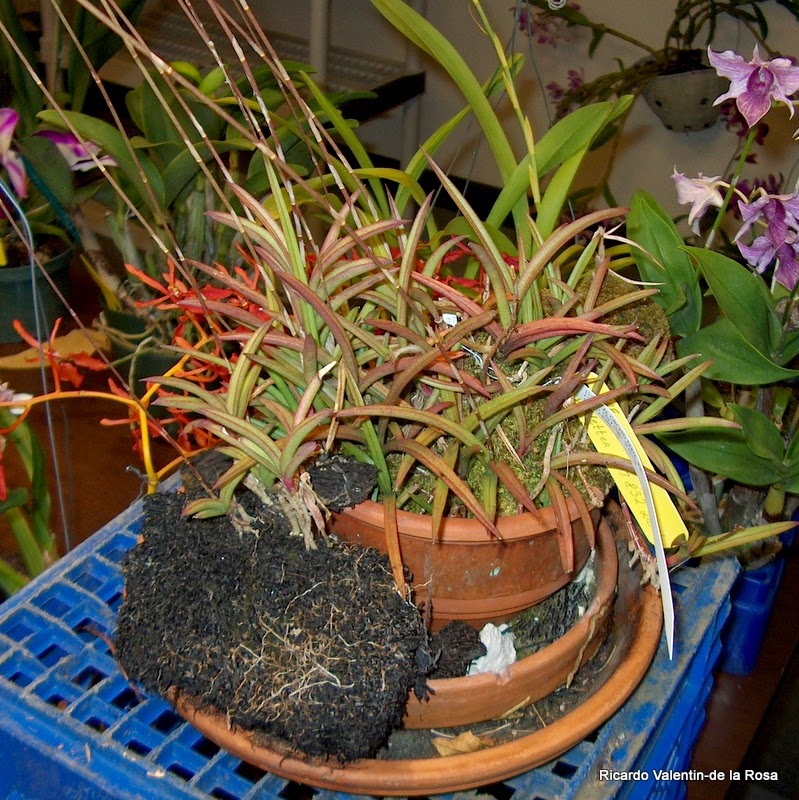
I planted the pieces I had in four different ways.   One was tied to a wire framework, with nothing else to provide attachment or moisture.  Another was put on a small plastic mesh pot filled with bark.  A third one was put on top of a metal wire basket.  Lastly one was tied to the bottom of a wire basket.  Before I go on, I have to explain what is a root basket.   Grammatophyllum often produces a mass of roots with many roots pointing upwards.  The purpose of these roots is to trap leaves and debris that fall on the plant as a source of moisture and nutrients.  A healthy plant often has a large root basket surrounding its pseudobulbs.  Many people affix their plants to tree fern plaques, or grow them in wooden baskets to allow the roots of the root basket to expand at will.  

 After a few years of care this is the results:  The one that was tied to the metal wire mesh has done better, it’s the one that has the most bulbs and the largest root basket.   On second place came the one on top of a metal wire basket, it produced small bulbs until it reached the edge of the basket, then produced the largest pseudobulb of them all.   Unfortunately, I put this one in a planter and it send a mass of roots into the pot next to it.  I had to rip it from the pot and in the process damaged its root basket, I expect it will recuperate quickly.  On third place is the plant growing attached to the bottom of a wire basket.  It has grown slowly, lost some pseudobulbs to rot and it still hasn’t started producing a root basket.  The piece that is growing on top of the plastic mesh pot filled with bark is the slowest growing of them all.  It only has two relatively small pseudobulbs and its yet to start producing its root basket. 

 From these results, I think it is clear that the Grammatophyllum prefer that their roots not be confined and will do better if their roots can grow at will and are exposed to air.  These plants are heavy feeders and need constant fertilization during their growth cycle for their pseudobulb to attain a large size.  High environmental humidity is extremely important in the case of plants that have lost their roots. 


Friday, May 6, 2016

Tetramicra elegans [Hamilton] Cogn. 1910, here I show the flowers of a plant from cultivation, origin unknown and two flowers from plants "in situ" in the Sierra Bermeja, Puerto Rico

Cultivated plant
Cultivated plant
Cultivated plant
"in situ"
"in situ"
Tetramica elegans is an orchid that is native of Puerto Rico and can be found in dry forests in the southwest of the island.  Because it has showy flowers it also cultivated by orchidists.  The photos of the plant in cultivation are from a specimen plant that produced large, many flowered, even branched inflorescences, something I have yet to see in the wild where most of the plants I have found are small and have few flowered inflorescences none of which has been branched.  The flowers of the cultivated plant are fuller, larger and more numerous than those of the wild plants.  I cannot say that this is due to some genetic condition or caused by optimal care for the cultivated plant.  The lip of the cultivated plant seems to have a pure white central stripe, but it does have a faint yellow spot in the middle.  Sadly, the friend that cultivated this plant died some years ago I can't ask him where he got the plant.  The plants from the wild are part of a large population on the Sierra Bermeja hills in Cabo Rojo.

Sunday, April 24, 2016

Grammatophyllum (elegans x scriptum 'hieroglyphica')


There are a number of Grammatophyllum elegans hybrids in the market.  Most differ from each other only on minor details.   I like them all.   

Monday, March 30, 2015

Grammatoheadia Boynton Leopard, blooming in 2015 with a large inflorescence


Some years ago I brought three seedlings of this orchid because I was intrigued by this cross, which is of genera that are pretty different, Grammatophyllum elegans and Bromheadia findlaysoniana.  The plants grew well, but they took their time blooming.  Last year two of the plants bloomed and I found that they hardly showed any of the traits of Bromheadia.   Nevertheless they are quite pretty and I like them.

One of the plants didn’t bloom last year.  I wondered what was wrong with it since it is getting exactly the same care and environmental conditions as the other two ones.  It seems it only needed a little bit more time.  This year this plant bloomed and produced a very large inflorescence in comparison with the size of its pseudobulbs.  It is comparable to the inflorescence of a full grown Gramm. elegans in size, the flowers however are smaller than that of my plant of Gramm. elegans

This year I have the fortune of having both the Grammatoheadia and Grammatophyllum elegans in bloom at the same time so that I will be able to compare the flowers directly and see the similarities and differences between the parent and the hybrid.

Tuesday, January 20, 2015

A rare sight, a Tetramica specimen plant


I saw this Tetramica specimen plant in 2007 at a meeting of the Mayaguez orchid society.  At that time I didn't fully appreciate this achievement.  This Tetramica plants don't look lie the local Tetramica species in their body form, the local species has leaves that are terete.  However the flowers do look like those of Tetramica elegans, a species native of PR.  I have never again seen a specimen plant of this species.  In my experience Tetramica plants are intolerant of media that is too water retentive.  The also are vulnerable to scales, which means that you have to check your plants periodically for these pests.

Monday, April 14, 2014

Grammatoheadia Boynton Leopard a cross of Grammatophyllum elegans and Bromheadia findlaysoniana


Under my climatic conditions, at a 1,000 feet of altitude, near the center of the island of Puerto Rico, this hybrid has proved to be easy to grow.  However it demands good fertilization if the pseudobulbs are to grow to blooming size.  That is the trick with growing and blooming these orchids, when they are in their growth phase they need regular watering and fertilizing coupled with bright light to produce pseudobulbs large enough to bloom.  If neglected they will grow but their pseudobulbs will not reach their full potential and they might not bloom.  This plant gets full sun in the morning from 8:00 am until 11:00 am.  After the pseudobulbs reach their full size I stop fertilizing.  It is a cross between a Grammatophyllum and a Bromheadia, but I see little of the Bromheadia in these flowers.

Thursday, January 27, 2011

Grammatophyllum Tiger Paw, a hybrid of Gramm. elegans and Gramm. fenzlianum


The flower of my plant is unusually full, until recently
 most Tiger Paw sold had spindly flower segments
An inflorescence showing the flower arrangement

A photo using full sunglight, the upper sepal has been reflexed from its natural position

The red toucan key chain serves to give a scale to these inflorescences

The plant stayed in this pot until it was ready to bloom

The mature plant in its new plastic pot.  Note that a relatively small plant is producing three inflorescences


I brought my plant of Grammatophyllum Tiger Paw at a show in Ponce about ten years ago.  The plant was quite tiny with finger sized pseudobulbs but I decide to take a chance on it.  The orchid was planted in a tall plastic pot made from a soda pot bottle.  This plant grew well but relatively slow, the pseudobulbs grew in size but not too much from year to year.  Because it was so small when I purchased it the plant took about five years to reach blooming size, however it has never stopped blooming since that date.  

I find this hybrid is more forgiving of lapses in its care than the elegans parent.  However as in all the Grammatophyllums I have, blooming is mostly determined by how well the plant was cared for when the pseudobulbs were growing.  When I have helped the plant produce large fat pseudobulbs then blooming is all but assured, spindly and skinny pseudobulbs don’t bloom.  My Tiger Paw blooms more reliably than my elegans.

One curious thing my plant has is that its root basket is much smaller than what one would expect given its parents both of which can produce sizeable root masses.  The flowers of my Gramm. Tiger Paw are quite round, this used to be a rare thing in the Tiger Paw hybrids that were available locally but lately plants with nice round flowers are becoming more common. 

An unexpected thing is tha the inflorescences of my plant are smaller that those of either parent that I have seen locally, maybe it's parents were selected from plants with shorter inflorescences.  Its cultural needs are exactly like those of elegans.  This orchid seems much more vulnerable to snail and slug damage in its pseudobulbs than elegans and I have found holes eaten in their pseudobulbs made by snails, something that I have never seen either on elegans or scriptum.

Enormous numbers of this plant, of several varieties of scriptum, and other related Grammatophyllums have been put for sale in the last few years at most orchid shows I have attended in the island.  But apparently their survival locally is poor.  My suspicion is that they are killed when people try to confine their massive root systems to unventilated pots producing inevitable root loss and the death of the plant.

Wednesday, January 26, 2011

Grammatophyllum elegans a delightful representative of this genus that doesn't need a gigantic space to grow and bloom


This is the normal flower of the species

An incomplete flower, the first few flowers to open
 at the base of the inflorescence tend to be this way

An inflorescence that has been allowed to grow in a pendulous manner

A mass of pseudobulbs showing a very modestly sized root basket

A mature plant blooming, the inflorescence has been trained horizontally
 for better display.  Notice the heftly log needed to keep
 the plant upright against the weight of the inflorescence.


Grammatophyllum Tiger Paw a hybrid (elegans x scriptum) 
just after its removal from a plastic pot

The tree fern plaque in which Gramm. elegans grew originally, notice the 
large ferns and begonias and sundry plants growing on the plaque.

I brought this plant as a seedling around 1990, I think I brought it from H&R orchids in Hawaii.  Following the recommendations of other orchid growers and from seeing plants in orchid shows, I planted mine in a slab of tree fern.  The plant thrived and by 1993 it was flowering.  But them the plant started to decline.  At first I was puzzled because there had been no significant change in any parameter relating to the care of the plant and it had not been attacked by any pest.  But then I noticed that the fern plaque was becoming harder and harder to keep clean of ferns, begonias, and other assorted plants that would grow with wanton abandon anytime I became careless in weeding them out.  The reason for the decline became clear when I noticed that the base of the root basket these plants make had died and was decaying.  It turned out that the fern plaque, as it decayed, was holding too much water.  This meant that the root mass of the Grammatophyllum would never dry at the base; this meant death for the active roots and accelerated decay for the dead ones.

In the end, my formerly large plant, became three clusters of sorry looking pseudobulbs with few live roots.  I decided to try something different with this species.  I potted the plants in plastic pots that had a small reservoir of water at the bottom.  The pot was filled with rocks, Styrofoam and bark pieces.  The plants were tied on top of the pots because they had few living roots to anchor them in the media.  With time the little plants sent their roots into the pots and then began producing their characteristic root basket.  I repotted these plants in 1994 and they are still in the original plastic pots.  However, at the same time they are not in the pots at all, what happened was that as the plants grew in size they produced a large root basket and as pseudobulbs grew upward the living roots essentially abandoned the pot and grew into the mass of the root basket composed of the previous year root growth.  Nowadays the plants are still attached to the plastic pots by their massive root mass but the living roots are all independent of the pot.  I have not removed the pots because they are a convenient counterweight when the plants produce their massive inflorescence.

If there is any advice that I consider most important in the care and culture of this plant is that you should strive to keep the root basket that these plants naturally produce around their pseudobulbs in a good state.  This means that you should allow the root basket to dry between waterings to avoid killing the roots.  If the root basket decays  this can cause a severe setback for your plant.  Actually the key is allowing the best possible drainage and plenty of air flow around the root mass as it is not excess water that kills the roots but lack of oxygen.

This plant can produce an impressively large, massive inflorescence that can seem at odds with the size of the plant.  I recommend this orchid to those that don’t have space to grow Grammatophyllum speciosum but can accommodate a smaller plant.  So far Gram. elegans has proved to be relatively easy to care as long as you respect its need to have exposed roots that are not kept wet all the time.

Unlike Gramm. speciosum, Gramm. elegans doesn’t take a decade to grow to blooming size, its blooming seems to be controlled by the size of the last mature pseudobulb.  It has been my experience that large pseudobulbs that are at least four or more inches tall will bloom, smaller ones won’t.  The larger the size of the pseudobulbs of a given plant the more spectacular the inflorescence.  A relatively small plant with pseudobulbs five or six inches tall can produce an inflorescence five or six feet tall with dozens of large flowers.   Inflorescences can grow to such size and weight that they can destabilize the plant so care is needed to fasten the pot of the plant firmly to its basket or base.  Inflorescences can be staked or allowed to grow in a pendulous manner.  I have both trained inflorescences upright and allowed them to hang naturally and I personally prefer the trained ones.  The only significant problem when this plant is blooming is the need to keep the inflorescence safe from snail and slugs which seem capable of sensing the tender tip of the inflorescence from afar.

Media: Any material that resists decay, after the root basket formed, none.

Potting: First on well drained plastic pots, then on a very strong metal basket.

Fertilizing: 20-20-20 every week during the growing season. When it has a root basket of a significant size I put a few pieces of very dry horse manure on top of the root mass at the start of the growing season and keep replacing them as they degrade and are washed away by the rain.  Feeding this plant conscientiously during its growing season is the key for producing the large pseudobulbs that are the key to blooming this species.

Light: Full morning sun, light shade after midday, It gets this regime because it is what is available on the only spot that I had to put this plant.

Temperature: From 95F high during the day in summer to 60F during the night in winter.