Showing posts with label lavender. Show all posts

Tuesday, March 31, 2015

Phalaenopsis Jiuhbao Fairy, in the 2015 Puerto Rico orchid society show


I saw this Phalaenopsis at the 2015 Puerto Rico orchid society show.  I liked the patterns on the flowers and the color, but what really impressed me was that the flowers were fairly large and the shape was wonderful.

Tuesday, January 20, 2015

Two types of Arundina graminifolia [D Don] Hochr. 1910

Tall type
Tall type
dwarf type
dwarf type
tall type

In Puerto Rico you can commonly find on sale two types of Arundina gramminifolia.  One is a tall plant whose stems can easily reach six feet tall or more under good care.  The other is a much smaller plant that rarely seems to reach over three feet tall.  The tall type is a wonderful garden plant as the tall canes produce inflorescences that can stay in bloom for weeks or months.  If given particularly good care, the tall plant can form large clumps with many inflorescences blooming simultaneously.    The sheer size of the tall form means that it is too big for people with limited space on which to grow its orchids.  The dwarf form takes much less space and blooms at a much smaller size.  I have seen plants under two feet tall blooming.  It used to be that the tall form was the only one available but on recent years the dwarf form has become more common.  

The flowers of the two types can be easily told apart.   The flower of the dwarf form is smaller that the flowers of the tall type, although small plants of the tall type can produce smallish flowers.  The form and colors of the lip of the two types are different.  The lip of the tall form is larger and longer in relation to the rest of the flower.  The lip of the dwarf form had more purple lines in the yellow patch of the lip.   In the photos you can see the difference in the lips.

I only have experience cultivating the tall form, which is a tolerant plant that even people that know little about orchids can cultivate successfully.  The dwarf form seems to be equally hardy.   Both plants grow and bloom better when grown in full sun.  The plants I have that are in shadier spots don't bloom as well as those in full sun.

Saturday, January 17, 2015

Laelia marginata also known as Schomburgkia crispa Lindley 1838


I brought this plant as a large seedling a few years ago.  I can’t say I gave it any particular attention.  It was just there in the bench with all the other orchids.   The only thing that I made sure was that the media in which it was growing was composed of good quality bark and that the mix allowed plenty of air to reach the roots.  This is very, very important in these orchids as the roots will rot if the media becomes anoxic which can happen if it becomes waterlogged.  I speak this out of sad experience, I have lost plants because I neglected to repot them timely and the media decomposed and killed all the roots.

This plant is growing in my garden in the north coast of Puerto Rico.   Temperatures in the area can soar into the nineties during the hottest part of the day, nighttime lows are around 75F but at the cusp of summer sometimes they barely go under 80 degrees.  Between the months of May and December it rains regularly, sometimes abundantly but in winter and early spring the weather can be very dry.  The trade winds are good for the plants most of the year but during the dry season they can desiccate the plants pretty fast.

This plant gets fertilized when it is in its growth phase, it gets no fertilized when it is not growing.  It is growing under shade cloth, but one that allows for plenty of light to get through, this is not a plant that loves shade.  So far I have had no problems with pests with this species, although some other Laelias in my garden have had to be treated for scale insects.


So far I have had no problems with this plant except that it grew relatively slowly, but perhaps that is partly my fault for not giving it particular attention when it was in the growth phase of its yearly cycle.   The only complaint that I can make is that it will be a pretty large plant when it reaches full adult size, this is clearly not a plant for the grower with limited space.  On the other hand it will make an impressive garden plant in places where the climate allows for growing this plant outside.

Friday, August 8, 2014

Cattleya trianae Lindley & Rchb.f 1860


I got this Cattleya trianae as a seedling about a decade ago.  The flowers were not quite what I expected, but I found them very nice nevertheless.  Ever the years the plant grew larger and more floriferous.  Unfortunately, during a spell of very wet weather the center of the plant got rot and it lost many pseudobulbs.  It no longer looks like this.  But these photos record the plant at its best.  

Wednesday, June 11, 2014

Dendrobium Love Memory 'Fizz'


This Dendrobium nobile hybrid grew very well in the coastal lowlands of Puerto Rico.   Unfortuantely when the blooming season arrived it was the only adult nobile hybrid not to produce flowers.  Because it appeared that it would not bloom in the coast I took it to the mountains, to an elevation of 1000 feet over sea level.  Because the night temperatures are lower in the mountains than it the coast it appears this provided the needed stimulus to make the plant bloom and in a few weeks flower buds started to develop.  The flowers are holding up well even with the daily downpours that tend to damage less sturdy ones.

Tuesday, May 6, 2014

Dendrobium Nestor, (Den, anosmum x Den, parishii)


I got this plant about twenty years ago.  Back then Den. Nestor was something of a rarity.  This plant has an interesting combination of traits of its parents.  The soft color is similar to the most common forms of Den. anosmum.  The lip is very hairy, a characteristic of the lip of Den. parishii.  Den. Nestor has been remade many times with different parents.  The forms that seem to be most popular nowadays are deeply colored and have a shape that is reminiscent of the Den. anosmum parent.  I have seen plants of Den. Nestor being sold as Den. anosmum.  If the plants are inmature it is not that easy to tell apart the hybrid from the species.  However you can tell adult plants of anosmum from the hybrid due to thecomparatively larges size and flowers of anosmum.

Dendrobium anosmum

Dendrobium parishii

Monday, May 5, 2014

Dendrobium amabile O'Brien 1909, an outstanding member of the Densiflora section of Dendrobium


I acquired this orchid in May 2102.  It came from the Redlands in Florida.  A friend told me he intended to brave the perilous waters of the Bermuda Triangle in order to search for exotic orchids in the mysterious and far off state of Florida.  Initially I was aghast at my friend intentions.  Who would want to travel to a land known for its anthropophagous junkies that love nothing best than to eat, as if it is were the daintiest morsel, the flesh of the face of the unwary?  But my friend mind was firmly set, he would go forth for the sake of the beauty of the orchids.

In due time, and after braving many terrors, my friend returned laden with a bounty of plants, among them was Den. amabile.  To my astonishment the inflorescences survived the trip well and the flowers opened just days after its arrival.  I decided to cultivate this plant next to my Den. farmeri. It has done well there, exposed to the sun during a few hours early in the morning and then to bright shade the rest of the day, as the sunlight it receives is filtered through the high canopy of Teak trees.   I culture this plant exactly as I care for my Den. farmeri, it had done well under this cultural regime.
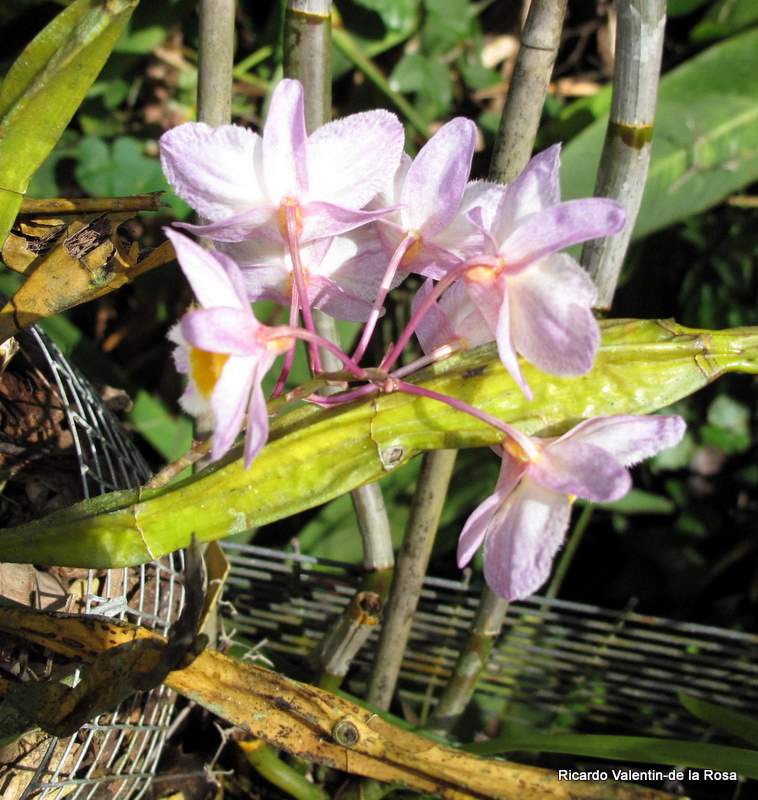

The only oddity I can report is the strange proclivity of the canes to grow sidewise toward the direction of the strongest light.  None of the other Dendrobium growing around it show this.   In plants generally this is a response to inadequate light levels, but this plant gets full sun for a few hours every day.  As a result the canes of this plant are nearly horizontal, with a slight s shape as they curve down from their bases and then curve up near the leafy tip of the cane.

Saturday, February 22, 2014

Dendrobium farmeri, a white flower with a touch of color in the floral parts.


This particular clone of Dendrobium farmeri is mostly white with some color in the sepals and petals.  Unfortunately the plant is a weaker grower than my other Dendrobium farmeri.  Its pseudobulbs are smaller than regular farmeri and its inflorescences have fewer flowers.  I give it the same care I give all my other farmeri plants.

Wednesday, September 25, 2013

Dendrobium aduncum Lindl. 1842, some curious translucid flowers


In January 2010, the flowers of one inflorescence of Dendrobium aduncum became translucid.  I had never noticed this happening before.  The flowers looked oddly beautiful.  I don’t know what caused this or whether it is normal for the flowers to become translucid under certain circumstances. 

Saturday, December 17, 2011

Porroglossum amethystinum a tiny and yet very weird orchid from Ecuador


When I first saw this little orchid I was totally stumped as to what orchid genus it could belong.  My ignorance can be excused on the basis that I had never previously seen an orchid of the genus Porroglossum.  These orchids are known for the particularity that they have a sensitive lip that retracts into the flower when touched.  The movement is triggered by an insect which is forced the lip’s action into contact with the plant pollinia.  There are a few specialists orchid growers in the United States that keep Porroglossum species but I have never seen this one before.  The flowers are lovely but small, the inflorescence is quite long in comparison with the flower size.  Because of the many other orchids with larger flowers in the Cabañas Armonia site I almost missed this one.   I saw this plant in the town of Mindo Ecuador.

Friday, December 16, 2011

Laeliocattleya Drumbeat 'Heritage' HCC/AOS a stunning 'classical Cattleya'


A particularly nice blooming with three large, very symetrical flowers.

 When most people talk about orchids, the one that is in their mind’s eye is the classical large lavender hybrid Cattleya.  This image is so culturally ingrained that even people that have only the slightest knowledge about orchids will instantly recognize the type.   Even in the orchid world, where people will often ignore large flowered hybrids to fuss a coo around a rare tiny flowered species,  Cattleya still hold their ground as a sort of cultural compass . “ Grow it like a Cattleya” is an advice that is so common as to be in the same level as “tastes like chicken”.
Back in the nineties my collection of orchids was composed mostly of species (as it still is) and I had only a few small flowered Cattleya species .  I started looking for a large flowered Cattleya because I wanted the kind of orchid that my mother, who was not particularly interested in “botanical” orchids (the smaller and weirder types which “only a botanist would love”), would enjoy.  After doing some research on lavender Cattleya I decided that the one that seemed the best option was Lc. Drumbeat ‘Heritage’.  This plant has large flowers with an excellent shape and I was sure it would grow well under my climatic conditions.  To me Lc. Drumbeat ‘Heritage’ embodies the best characteristics that people associate with a classical lavender Cattleya.
I brought it from Housermann’s Orchids as a relatively large plant as I didn’t want to wait years for it to bloom.   Having learned, from bitter experience, that potting Cattleya in bark in plastic pots was a recipe for disaster under my local conditions, I potted it in a wire basket I made myself.  The basket was filled with stones and a few of the the hardest pieces of wood I could find.  The key feature of this arrangement was that the plant’s roots would have a very well aireated mix that would drain quickly and would not have, even under the wettest conditions imaginable, pockets where the air would not reach.  This is an important item as Cattleya roots need to breathe and decay quickly under anaerobic conditions.
The orchid grew vigorously right from the start and bloomed very well.  Since then it has bloomed every year for the last thirteen years, an impressive record considering that it has had its up and downs.  Since the leaves can grow quite large, this is not a plant for growers with limited space.  I fertilize this plant only when it is producing new growths, the rest of the year it gets plain water.  It is very important to fertilize appropriately when this plant is growing, the quality of the flowers is mightily influenced by the size of the mature pseudobulb.
But getting a good display of flowers from this plant is a bit tricky as you have to find the right combination of sun, watering and fertilizing that will bring out the best results under your own conditions.  My plant produces the largest flowers when it is under strong light with a fair bit of direct sunlight in the morning.   I have my plant in a spot where it gets the strongest light it can tolerate short of getting sunburned.  This has the unfortunate result that the leaves look yellowish and might have a spot of sunburn of two.  But the resultant flowers are so impressive that few people look at the leaves.
The best combination of size, color and presentation occurs when the plant is under conditions where it produces three flowers.  My plant generally produces three flowers on each new pseudobulb but it has also occasionally produced two and four at a time.  When it produces two flowers at time they are typically of an enormous size, quite a bit larger than normal, but presentation suffers as the flowers tend to be crowded and particularly the very large size of the petals means the flower are pressed closely together and don’t look their best.  Perhaps if I would take the time to gently and carefully separate the blooms so that they are far enough apart so that they can unfold fully without bumping into each other the flowers would much look better.  When it has produced four flowers the flowers are undersized and the fourth flower, at the tip of the inflorescence is much smaller than the others and sometimes misshapen and oddly colored.  The first time this happened I was dismayed and feared that the plant had become virused.  But when the plant bloomed again the next year the flowers were totally normal.
When this plant starts its growing season, I give it a high nitrogen fertilizer diluted according to the instructions on the label.  I pay close attention to the new growth as it is most vulnerable to damage when it is still young.  I water the plant every two to five days when it is in full growth depending on how dry the mix is, because my plants are outside and get drenched every time it rains (which can be every afternoon at the height of summer) sometimes I don’t need to give them supplemental watering for months. 
The most critical time, in my view, is when this orchid is developing its roots.  Root loss has been my bane when dealing with Cattleya, they tolerate wetness, drought and sundry pests, but if they lose their roots bringing them back is an uphill battle and the plant health deteriorates significantly.  So when the roots are developing I am extremely vigilant in regard to snails and slugs and will use, with the proper precautions, the various ways that are in the market to send slugs and snails to the great and happy lettuce leaf in the sky.
Another thing to watch for is the various insects that attack the leaves.  White flies can be persistent but they are very easy to control.  I keep a small spray bottle of rubbing alcohol and whenever I spot a some white flies trying to establish a colony a few spritzes take care of the situation in seconds.  Scale insects are more devious and harder to control, the key here is to eradicate them when they are few in number.  I carefully rub them off the plant taking care not to damage the leaf.  A bit of rubbing alcohol helps finish the deed.  Every month I take some time to check over the plants.  This is a practice that will go far in keeping your plants pest free, or as pest free as you can get if you grow them outside like I do.
I can’t give repotting advice on this plant for the simple reason that I have never repotted it.  It is still growing in the same basket where I planted it sixteen years ago.  It has gone across it and around it several times.  The original organic material in the mix decayed completely many years ago.  The plant is now growing in a mass that is composed of the remains of old roots and the rocks, which are still there but totally covered with mosses and old and new roots.
This orchid has been meristemmed and seedlings are available in many places, at times at surprisingly affordable prices.  One thing about this plant that is seldom commented upon is its fragrance.  It is the typical sweet Cattleya fragrance and I really enjoy it.  I have the impression that the flowers are particularly fragrant in the middle to late morning.  If you are looking for a lavender Cattleya and have ample space available, Lc. Drumbeat is one of the best alternatives. 

In the photos below, first photo:  A two flowered inflorescence, note the particularly large size of the petals, second photo;  A three flowered inflorescence with narrow petals.   Third photo; A four flowered inflorescence (see text) showing the somewhat oddly shaped flower with streaks of color reminiscent of virus symptoms.


Friday, August 5, 2011

Epidendrum atacazoicum, an orchid native of Ecuador


This Epidendrum native of Ecuador produces large many flowered piramidal inflorescences.  The inflorescences are quite showy both due to their sheer size and to the lovely presentation.  This is a large plant, in the plant shot it might look small but this is due to the fact that behind it are the 15 feet tall canes of a large Sobralia orchid.  The specific name of the plant is because there is a volcano en Ecuador named Atacazo.  This plant grows in cool, wet montane forest.  I have not seen photos of this plant being cultivated out of its native range except for this plant which I saw at the Quito Botanical Gardens, in Ecuador.

Thursday, April 7, 2011

Dendrobium farmeri, a flower with a touch of lavender in the petals


This photo, taken with flash, gives the lip a deeper orange color than what it is in life

This plant bloomed unexpectedly from a very old cane, and from an axillary bud that had been dormant for years.  This plant almost perished from rot and the new canes, are tiny, too small to produce inflorescences so this blooming was a pleasant surprise

This photo which was taken using sunlight gives the lip a color more true to life than the first photo.  Most farmeri blooms are pink to pale pink but this variant has a slightly deeper shade of lavender in the border of the floral segments.

Dendrobium farmeri is one of my favorite Dendrobium.  It is easy to grow (there is information about its care elsewhere in this blog) and can be very floriferous.  There are many variants in the market that go from pure white to lavender.  Variants with a deeper lavender color are rare in Puerto Rico.  I compared the flowers of this plant with the flowers of the pink forms I have and the color of the petals is essencially the same.  The difference lies in the size of the flowers and in the lavender color in the tip of the lip.  In this plant the flowers stay small and the color is spread over a smaller area in my pink forms the petals are significantly larger and lavender is fainter giving the plant an overall pink shade.  This plant suffered from rot a few years ago and almost died.  The plant was reduced to a few dehydrated canes.  I put the canes in a shady humid spot where they remained for almost two years without neither dying or growing.  But last year one of the canes produced a tiny side growth from a dormant bud.  I was overjoyed and gave the plant a lot of TLC.  Unfortunately it seems that this plant will take a lot of time to recuperate to its former size.  On the bright side I got this unexpected blooming with was a wonderful surprise from a plant that almost didn;t make it.


Monday, February 7, 2011

Myrmecophyla (Schomburkgkia) grandiflora, an ant orchid from Central America

Head on view of a flower

The top view shows the ruffles of the flower segments
The flowers partly close at night

Note that the inflorescence has sustained some damage from insects feeding just under the scar of the first flower.  You can also see the sequential mode of flower production

A flower over a slab of limestone to show the color of the flower under sunlight
Myrmecophyla grandiflora, has a geographical distribution that ranges from Mexico to Colombia.  It inhabits dry areas where it grows both on trees and on rock.  The pseudobulbs of this species are hollow and it is said that in the wild there are always ant colonies inhabiting them.  It is reported that the pseudobulbs of this plant can reach up to 18 inches long and have two to five short coriaceous leaves on top.
A few years ago I was given a rootless three pseudobulb division.  I planted it in a custom made basket with no media (I was afraid that the plant would be attacked by an insidious disease but more on this below).  I tied the plant to the basket and watered and fertilized it like I do the Cattleya in my collection.  In due time the plant produced a new growth, after that it engaged in the copious production of roots, it repeats this cycle every year one or two times.  The plant did well in the basket but in due time it became clear that it would never reach its full potential with no media from which to draw moisture and fertilizer.  I then added some large, hard chucks of bark to its media, which the plant eventually enveloped with its roots.  However since it had started as a completely rootless division it took several years to achieve enough strength and size to bloom.
My plant produces two growths a year and sometimes tries to bloom from both of them.  Unfortunately the inflorescences of this orchid seem to be attractive in the extreme for some gnawing insects and I have lost a few to them.  Now I routinely give a slight dusting to my plant with some insecticidal dust to prevent any such critter from destroying them.  Given that these plants are hung on the shade house from wires about four feet long and the inflorescences are sometimes four feet long, the critters that eat them seem to be so highly motivated as to travel all this distance to munch on the tender inflorescence tip.  But use any insecticide with extreme care, and follow all instructions to the letter.  I, in particular have to be very careful as my shadehouse if full of fish tanks that could become contaminated with insecticide which would kill my beloved fish.
The flowers open widely in the morning but become floppy during the hottest hours of the day.  I am not sure if this happens everywhere but it is what happens in my garden.  The same thing is done by the flowers of Myrmecophila humboldtii in my garden.  The inflorescence keeps elongating and producing flowers for a few weeks.
I have found this plant to be generally problem free and a vigorous grower that can grow into a hernia inducing specimen plant.  The very long inflorescences can be an annoyance, as the flowers can end up so high up that you practically have to put the plant on the ground to enjoy them.  This plant responds well to constant watering and weekly fertilizer during its growing phase.  My plant produces very closely spaced pseudobulbs which mean I have to watch carefully when the new growth is forming so that it won’t get trapped in the media or the wire of the basket.
My plant is not growing in full sun, I have it under shade cloth, but one that allows a high percentage of the sunshine to pass through.  The sun in my location can be quite harsh on orchids, especially during the dry season, so I almost always give my plants some sort of protection from the sun during the hours surrounding noon and early afternoon.  Other Myrmecophyla that I have grown in full sun during the whole day have responded by becoming stunted.
This orchid seems indifferent to the local level of humidity although during the height of the dry season the pseudobulbs can become furrowed from water loss.  It gets watered once every week year round, along with whatever it gets from local rainfall.
I have always admired this plant but for many years I was hesitant to include it in my collection.  The reason was that I found that in my garden lurked a specially evil and insidious disease to which these plants were particularly vulnerable.  What makes this disease (I am not sure if it’s a fungi or a bacteria) exceedingly vile is that it won’t kill the whole plant, only the buds capable of new growth and a tiny area around them.  As a result of this damage the plant won’t grow or flower, but since everything else is ok, it still looks like it is in great shape.  I discovered this disease when my plants of Myrmecophila exaltata and a plant of Myrmecophila humboldtii would not grow or bloom for several years in a row.  I think I have found the way to stop or limit the damage this disease can inflict on my Myrmecophila.  I observed that all the plants that got this disease were planted in fairly water retentive media that was in contact with the stems on which the pseudobulbs sit.  By planting my orchids in fairly chunky media and keeping the base of the pseudobulbs a fraction of an inch over the media the disease seems to have been controlled.  So far tibicinis has not been molested by this dreadful disease.
Of all the Myrmecophyla orchids formerly known as Schomburgkia this is probably the one that is under the wider cultivation.   There is hardly any serious local orchid grower that doesn’t have at least one plant of this species.  There are also a number of hybrids of various sizes and colors that occasionally make their appearance at orchid shows but they don’t enjoy a fraction of the popularity of the Myrmecophila parent.  I have seen plants of this species of all sizes in the collections of various orchidists which makes me think that there is some variation on the plants available locally.  But all the flowers I have been able to examine were pretty similar regardless of the size of the plant that produced them.
In conclusion,if its minimum requirements of temperature and watering are met, this plant can survive almost every vicissitude that ordinarily sends other orchids to that great pot in the sky.   I have seen them growing equally vigorously in the hands of skilled growers as well as those of rank amateurs.
If you have any question just leave it in the comment section under the article.