Thursday, January 29, 2015

Epidendrum anceps Jacq. 1763, The flowers of 2015 in comparison with those I found in the same place in 2011

January 2015
January 2015
February 2011
February 2011
A few years ago I found a clump of stems of Epidendrum anceps growing in the crest of a hill in the Maricao forest. Since then, I visit these plants once a year to check how they are doing and to photograph the flowers.  In 2011 the clump had an inflorescence with green flowers.  In 2015, only one of the inflorescences had not suffered damage.  It was not clear what had damaged the inflorescences before they had finished their growth.  The only one with flowers had a distinct purple color in the edge of the lip.  Apparently, rather than all the stems being a single plant, the clump is composed of two plants growing very close together.  Hopefully next year I will be able to photograph both colors of flowers side by side.

Prescottia oligantha [Sw.] Lindley 1840, in the Maricao Forest


Prescottia oligantha is a tiny terrestrial orchid that is native of Puerto Rico.  Previously I had only seen a single plant.  In January 27, 2015 I found a small colony of about half a dozen plants near the Torre de Piedra.  The plants are easy to miss.  I found them because I had a good search image of what I was looking for.   It is not a rare plant however very few people notice them due to the small size of the plant and tiny flowers. 

Tuesday, January 20, 2015

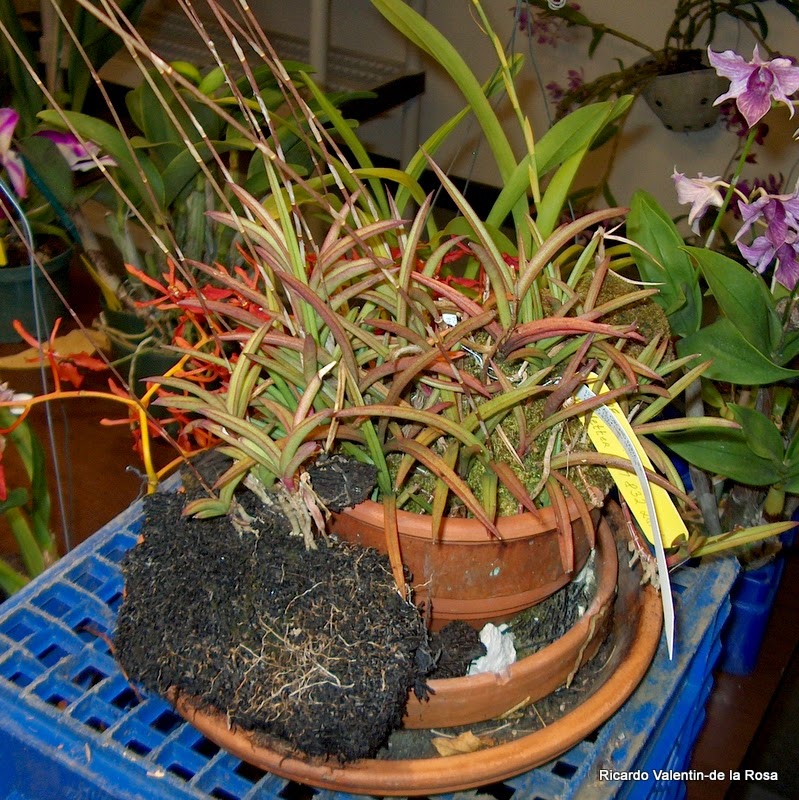
A rare sight, a Tetramica specimen plant


I saw this Tetramica specimen plant in 2007 at a meeting of the Mayaguez orchid society.  At that time I didn't fully appreciate this achievement.  This Tetramica plants don't look lie the local Tetramica species in their body form, the local species has leaves that are terete.  However the flowers do look like those of Tetramica elegans, a species native of PR.  I have never again seen a specimen plant of this species.  In my experience Tetramica plants are intolerant of media that is too water retentive.  The also are vulnerable to scales, which means that you have to check your plants periodically for these pests.

Ludisia discolor [Ker-Gawl.] A. Rich. 1825, a specimen plant


I saw this plant of Ludisia discolor in 2007 at a meeting of the Mayaguez Orchid Society.  It was a beautiful plant with many growing points.  This orchid is very easy to grow if you give it the humidity it needs.  My own plant grows very well with the same care I give my houseplants.  The flowers are a nice bonus.


Encyclia bractescens (Lindl.) Hoehne 1952


I brought this small Encyclia decades ago.  I has not failed to bloom every year between April and May.  I have two plants, both attached to pieces of tree fern.  This plant grows well in the hot, sunny conditions of coastal Puerto Rico.  I have it just under the shadecloth where it gets the brightest light possible without exposing it to direct sun.

The only problem that I have had with this orchid is that it loathes media that is too water retentive.  I had a wonderful specimen plant that would produce hundreds of flowers at a time.  I lost most of the plant because the tree fern plaque in which it was growing decayed so much that it started retaining water to the extent that it would dry very, very slowly.  This caused rot in the center of the specimen plant, I had to cut it in pieces in the process of removing the decayed and rotting parts.

This orchid needs frequent fertilizer applications when it is producing its new pseudobulbs.  If this is not done the pseudobulbs might not reach their full potential.  Given that this plant do best in small mounts that don't retain much water, you have to work out on your own which schedule of watering will produce the best growth.  I have seen plants of this species being grown on terracota mounts with absolutely no media.

Two types of Arundina graminifolia [D Don] Hochr. 1910

Tall type
Tall type
dwarf type
dwarf type
tall type

In Puerto Rico you can commonly find on sale two types of Arundina gramminifolia.  One is a tall plant whose stems can easily reach six feet tall or more under good care.  The other is a much smaller plant that rarely seems to reach over three feet tall.  The tall type is a wonderful garden plant as the tall canes produce inflorescences that can stay in bloom for weeks or months.  If given particularly good care, the tall plant can form large clumps with many inflorescences blooming simultaneously.    The sheer size of the tall form means that it is too big for people with limited space on which to grow its orchids.  The dwarf form takes much less space and blooms at a much smaller size.  I have seen plants under two feet tall blooming.  It used to be that the tall form was the only one available but on recent years the dwarf form has become more common.  

The flowers of the two types can be easily told apart.   The flower of the dwarf form is smaller that the flowers of the tall type, although small plants of the tall type can produce smallish flowers.  The form and colors of the lip of the two types are different.  The lip of the tall form is larger and longer in relation to the rest of the flower.  The lip of the dwarf form had more purple lines in the yellow patch of the lip.   In the photos you can see the difference in the lips.

I only have experience cultivating the tall form, which is a tolerant plant that even people that know little about orchids can cultivate successfully.  The dwarf form seems to be equally hardy.   Both plants grow and bloom better when grown in full sun.  The plants I have that are in shadier spots don't bloom as well as those in full sun.