Sunday, March 6, 2011

Mis experiencias con el pez Angel Pterophyllum scalare

El macho "tiger" con la papilla genital claramente visible en el vientre, al fondo la hembra gris prepara el área escogida para el desove

Este pez tenia unos destellos azules hermosos pero irregulares

La hembra "smoky" tenia la extraordinaria capacidad de invertir los colores de su cuerpo según su estado de animo, esta foto fue tomada luego de un fuerte festin de larvas de mosquito que causo una gran excitación a este pez, vea el estomago fuertemente distendido.

La hembra "smoky" en un momento de tranquilidad

Fuera de cuando estaban desovando los peces se juntaban pacificamente

La pareja defiende el desove de la hembra "smoky"

El macho persigue a la hembra gris despues de haber desovado con la "smoky"

El pez angel Petrophyllum scalare es uno de los peces de agua dulce más distintivos y abundantes del acuarismo.  Es omnipresente en las peceras de las tiendas de mascotas y es muy apreciado por multitudes de acuaristas que los admiran por su belleza, elegancia e interesante comportamiento.  En las próximas líneas detallare mis experiencias con este pez.
Los peces ángeles son originales de Sur América donde habitan ríos y lagos en el corazón del continente, entre ellos el rio Amazonas, Rio Negro y el Orinoco.    Pero hace muchas décadas que la importación de ángeles salvajes desde Sur América no es significativa en Puerto Rico, los peces que hoy vemos en los acuarios locales son criados en cautiverio en las grandes fincas de acuacultura de Asia y los Estados Unidos.  En Puerto Rico también hay algunas personas que los crían para la venta en menor escala.  En pocas ocasiones he visto ángeles supuestamente importados en venta estos han sido presentados como de la especie altum que es nativa del Orinoco.  Pero sospecho que eran híbridos entre altum y scalare porque no recuerdo haber visto en ellos la pronunciada indentación supra orbital que es única de los altum.  Debo añadir que los altum están entre los más difíciles peces de agua dulce en reproducir.  Los altum puros son fáciles de distinguir de los scalare ya que sus aletas dorsales y anales nacen casi perpendiculares al cuerpo y pueden ser muy largas.  Se han reportado individuos de altum en estado salvaje cuyas aletas dorsales y anales combinadas median veinte pulgadas de punta a punta.  Que yo sepa la otra especie de ángel, leopoldii, jamás ha sido importada a nuestra isla.
Los primeros peces ángeles que se importaron eran difíciles de mantener ya que requerían condiciones de agua muy específicas, que debían ser casi exactamente iguales a la de su hábitat nativo.  En ese tiempo reproducirlos era difícil por lo cual inicialmente solo se disponían de peces importados y su costo era elevadísimo.  Debido al pronunciado incentivo económico para reproducirlos en cautiverio y para obtener el mayor número de crías posibles la técnica que se usaba era remover los huevos en cuanto la pareja reproductiva acababa el desove.  Esto resulto en la producción de vastas cantidades de peces lo que abarato su costo pero tuvo consecuencias desastrosas con respecto al comportamiento reproductivo de estos peces.
Los ángeles son cíclidos y demuestran un comportamiento reproductivo que es común en este grupo de peces.  En el estado salvaje macho y una hembra buscan una superficie para depositar los huevos y dedican un tiempo a limpiarla con sus bocas.  Con frecuencia escogen superficies verticales como hojas y raíces para desovar.  Una vez ha ocurrido el desove la pareja defiende los huevos de otros peces, los limpian con sus bocas y cuando los alevines nacen los protegen por un tiempo.
Debido a la forma en que se reproducen en masa estos peces en cautiverio el comportamiento de cuido de huevos y de las crías se ha perdido casi totalmente.   Los ángeles producidos en cautiverio desovan con facilidad y protegen los huevos por un tiempo pero, en mi experiencia, invariablemente merma el instinto de protección y comienzan a devorar los huevos.  Solo una vez he visto un comportamiento distinto y esto ocurrió hace muchos años. 
A mediados de los años setenta, cuando daba mis primeros pasos en la afición del acuarismo, compre un par de peces ángeles que me deleitaron por su vivaz comportamiento.  Ambos tenían la coloración plateada con bandas verticales negras típica de la forma salvaje, pero uno poseía las largas aletas que caracterizan a la mutación conocida como “veil tail”.   Estos peces son voraces y ansiosos cuando tienen hambre y los míos parecían pozos sin fondo.   Me encantaba su entusiasmo a la hora de comer y les daba toda clase de alimentos desde hojuelas “flakes” hasta larvas de mosquito y pequeños crustáceos acuáticos.   Como consecuencia de la aparentemente insaciable necesidad de comida de los peces jóvenes les alimentaba varias veces al día.  Su comida favorita era indudablemente las larvas de mosquito que consumían hasta que sus estómagos estaban distendidos de forma alarmante.  Como resultado de tanta alimentación y de frecuentes cambios de agua, los ángeles crecieron con rapidez, el macho alcanzo las tres pulgadas de largo (sin contar sus largas aletas) y la hembra llego a cuatro.   Pero debo advertir que hoy conocemos que la inclinación de los peces ángeles a comer desmesuradamente una dieta rica en nutrientes les puede hacer tanto daño como darle una dieta una escasa y pobre.  La razón es que los peces desarrollan depósitos de grasa excesivos, una condición nunca vista en el estado salvaje, que tiende a reducir su largo de vida.
Un buen día, a principios del verano, cuando llevaba a cabo un cambio de agua note que los peces parecían estar especialmente perturbados por un procedimiento que era rutina y que normalmente no les causaba mucha angustia.  Pero al bajar el agua note para mi sorpresa que el techo de una pagoda china de porcelana estaba cubierto de huevos.
Me perdonaran que haga aquí un paréntesis en la narración de los ángeles pero creo que es preciso notar algunas características de las peceras de ese tiempo.  La pagoda china en que los ángeles desovaron por primera vez era solo una de los diversos adornos que infestaban el fondo de la pecera de treinta galones en que vivían.  La pagoda era parte de una estructura mayor de porcelana que incluía un puente chino que unía la pagoda con una pequeña isla.  También tenía la pecera una especie de obelisco naranja brillante de cómo nueve pulgadas de alto que era la pieza central de otra cerámica que incluía dos arcos alrededor del obelisco.  En esos tiempos casi todas las peceras locales de mis amistades tenían adornos de todo tipo que se juntaban con una impresionante promiscuidad.  No había el mas mínimo interés en mantener una coherencia temática por lo cual trasfondos que mostraban templos griegos sumergidos eran combinados con esqueletos en baúles de tesoro, barcos piratas y ruedas de molino, todos estos adornos movidos por aire comprimido.  Solo unos pocos mantenían peceras con el estilo naturalista tan de moda actualmente.
Pero volviendo a los ángeles, lleno de alegría por haber encontrado el desove, volví a llenar de agua la pecera y observe a los peces con especial atención.  Desafortunadamente la perturbación fue demasiada para la sensibilidad de los peces y cuando se sintieron más tranquilos procedieron a devorar los huevos.  Ya que los peces habían desovado y era claro que eran macho y hembra (algo que no era nada de obvio antes del desove) decidí tomar algunas medidas para mejorar las posibilidades de que los peces lograran completar su ciclo reproductivo con éxito.  Moví a pecera a un lugar poco transitado de la casa, añadí algunas plantas del tipo  Echinodorus “amazon sword”.  Los peces aceptaron los cambios con rapidez y en un par de semanas comenzaron a dar muestras de interés por volver a desovar.   Pero contra todas las expectativas no desovaron ni en las hojas de las Echinodorus, ni en el obelisco y ni siquiera miraron el techo de la pagoda.   Los peces desovaron pegando sus huevos a los largos tubos de un filtro externo.  Decidí no remover los huevos para aprender de primera mano sobre la reproducción de estos peces.  Deben de recordar que para esos fechas el Internet no existía, solo estaban disponibles el libro de Axelrod y el de Innes, de estos dos volúmenes venia todo lo que sabía sobre la reproducción de los ángeles, lo que no era mucho.
Ambos padres cuidaron del desove con impecable atención aunque la hembra, que era el pez más grande tendía a ser mas solicita que el macho con los huevos.  Los días pasaron sin que los huevos fueran devorados (algo que incluso ya para esos tiempos era inusual).  Finalmente las crías nacieron y la pareja las movió a una depresión en el fondo de la pecera.  Una vez las crías comenzaron a nadar los padres las escoltaban a todos lados y las mantenían juntas en un grupo.
Luego de un par de semanas las crías comenzaron a adquirir la forma distintiva de los peces ángeles por lo cual era todo un espectáculo ver a los padres nadar rodeados de una nube de diminutas replicas de si mismos.   A las tres semanas los separe de los padres y los coloque en una pecera de 10 galones con agua de la pecera parental.  En la pecera de las crías el nivel del agua era de cómo cuatro pulgadas para concentrar a las crías cerca del alimento.  Los alimentaba con microgusanos los cuales se hundían al fondo rápidamente.  Los pececillos igual que sus padres, comían hasta llegar al punto de casi reventar.
Los padres desovaron nuevamente después de cómo dos semanas, pero para mi profunda decepción jamás volvieron a cuidar de sus crías.  En esta ocasión el macho comenzó a devorar los huevos al segundo día y la hembra siguió su ejemplo a las pocas horas.  En los próximos desoves las relaciones entre la hembra y el macho se deterioraron al tal punto que al final de ese verano la hembra ya no permitía que el macho se acercara a los huevos y desovaba sola.  No volví a tener ángeles por décadas hasta que hace algunos años compre algunos.
Recuerdan que cuando comencé a criar peces solo habían dos variedades de ángeles fácilmente accesibles?  Pues ahora la variedad de mutaciones parece no acabar, entre las que se ofrecían en los “pet shop” que viste estaba el “blushing” que no tenia color y como es casi transparente los arcos de las agallas se ven fácilmente y su colorido da la impresión de que se está sonrojando.  Otra variedad era el “tiger” que tiene bandas verticales adicionales, el “smoky” con un patrón de manchas oscuras irregulares y  tantas otras como el “koi”, “marbled”, “diamond”, “gold” que si tratara de describirlas a todas no terminaría.
Compre seis pececillos pequeños, todos distintos para tener una variedad para observar.  El “tiger”, el “smoky” y una forma de color gris no dieron dificultad en su llegada a mi pecera.  El “black”, “veiltail” y “blushing” murieron a los pocos días de una enfermedad que los cubría de una capa blanca y que no respondió a tratamiento alguno.  Compre un par de ángeles mas que sucumbieron a lo que fuera que los mataba.  Los tres iniciales parecían invulnerables, la enfermedad desconocida solo mataba a los ángeles, los otros peces no fueron molestados nunca por la infección.   Los ángeles habitaban una pecera de 30 galones cuya decoración consistía en un masivo crecimiento de “Java Moss” que llenaba dos terceras partes de la pecera y un par de raíces artificiales hechas de resina plástica.
Los peces crecieron con rapidez, la “smoky” (que resulto ser hembra) creció mucho más que los otros dos.  Los compre antes de las navidades y cuando llego el verano del año siguiente comenzaron a desovar.  Resultaron ser un macho, El “tiger” y dos hembras.  Ambas hembras permitían que el macho fecundara los huevos, aunque sospecho que el macho se llevaba mejor con la gris que era de su mismo tamaño.  Cuando desovaban los más pequeños, ambos defendían con tesón los huevos de la otra hembra.  Cuando desovaba la “smoky” la otra hembra gris era perseguida hasta que se le obligaba a esconderse al otro extremo de la pecera.   Tristemente estos peces jamás completaron el ciclo reproductivo por su cuenta.  En esos momentos no tenía el tiempo para dedicarme a criar ángeles así que nunca les quite los huevos.  Eventualmente los moví a un estanque donde vivieron algunos años más.
Hoy en día hay mas variedades de ángeles que nunca en el mercado y las combinaciones de color, largo de aletas y hasta textura de la piel son asombrosas.   Contrario a sus ancestros los ángeles modernos son poco exigentes con respecto a la dureza y el pH del agua.  Pero se quedan enanos si la calidad de la alimentación y los parámetros de agua son pobres.  Pero si usted puede darles a estos maravillosos peces las condiciones que necesitan tendrá unas mascotas interesantes que le entretendrán por horas con sus variados comportamientos. 

Thursday, March 3, 2011

Un barbo similar pero no exactamente igual al barbo cereza "cherry barb"


Un macho adulto dominante con su coloración normal.

Un macho adulto al frente y una hembra atrás.
Los machos muestran su mayor colorido durante el desove pero es casi imposible fotografiarlos en la pecera en esos momentos, por eso fotografié este macho en el cedazo.  La captura le hizo perder casi todo el rojo pero aun se ve algo de la iridicencia azul.
Hace como doce o trece años la Asociación de Acuaristas de Aguadilla llevo a cabo una de las excursiones a visitar criadores de peces y tiendas de ventas de peces que tradicionalmente se hacen dos o tres veces al año.  En este viaje en particular visitamos un criador de peces del área sur.  Este criador de peces nos recibió muy cordialmente y nos escolto en un recorrido por sus facilidades de mantenimiento de peces.  Al final de la visita el criador capturo algunos peces y nos los obsequio.
Entre los peces que nos obsequio se encontraban unos barbos que picaron mi curiosidad.  Estos barbos tenían una clara similitud física con los “cherry barb” (Barbus titteya) pero el color de los machos era distinto y el tamaño de los peces era más del doble de los “cherry barb” promedio que vemos en venta en las tiendas de mascotas.  Los pececillos tenían un color crema con líneas marrón y un leve destello de azul metálico en la línea media de los machos.  El color era agradable pero no puedo decir que era espectacular.
Logre conseguir cuatro de estos barbos y los libere en una pecera de 30 galones densamente plantada de la hierba acuática Echinodorus tennellus.  Los barbos se perdieron en la vegetación y en el curso de los días siguientes apenas los pude ver.  Sin embargo con el paso del tiempo los pececillos perdieron su timidez y empezaron a dejarse ver en las aéreas libres de vegetación de la pecera con frecuencia.  Los barbos aceptaron todos los tipos de comida con el mismo gusto.  La comida seca, las larvas de mosquito y la comida congelada eran atacadas con voracidad y con una impresiónate rapidez.   Tal era la intensidad con la que estos pececillos atacaban la comida que determine no poner otros peces en su pecera ya que concluí que tendían problemas para poder alimentarse ante una competencia tan fuerte.
Los pececillos se adaptaron a la rutina y luego de un par de semanas pude notar que uno de los machos había adquirido un intenso color rojizo con un toque de azul metálico en la línea media.  El macho mantuvo este color por algunos días y luego volvió a su color habitual.  No me acuerdo haber notado que el cambio de color fuera acompañado en ese momento de un cambio significativo en el comportamiento de los peces.
Como dos semanas después de que el macho cambiara los colores, note un alevín nadando cerca de la superficie del agua.   Los pececillos habían desovado en la pecera y unos poquitos de los huevos habían sobrevivido la voracidad de los padres y eclosionado.  A lo largo de los siguientes meses como media docena de pececillos jóvenes sobrevivieron hasta un tamaño que les permitía nadar sin temor con sus los padres a la hora de comer.
Hace once años comencé a trabajar para el Departamento de Recursos Naturales y Ambientales y como me mude al bosque estatal de Rio Abajo decidí desmontar la pecera y mover los barbos a un estanque.  El estanque que prepare para los pececillos era de cuatro pies de largo de cómo seis pulgadas de profundidad y dos pies de ancho.  El estanque fue plantado con Java Moss para que los pececillos tuvieran donde refugiarse.  Los pececillos se adaptaron al estanque sin dificultad y cada vez que me sentaba a observarlos podía  ver a los adultos acompañados de varios tamaños de juveniles.  Una característica de estos peces es que desovan constantemente, si usted los coloca en una pecera que les permita desovar y la misma ofrece algún refugio para los alevines es seguro que con el tiempo algunos de los alevines no serán devorados y sobrevivirán para convertirse en alevines.
Algunos años después de que introdujera a los pececillos al estanque ocurrió un periodo de sequia particularmente severo en el área de Aguadilla donde se encuentra mi casa y el nivel de agua de los estanques se redujo considerablemente.  Cada vez que me acercaba al estanque y lo veía con un nivel bajo lo volvía a llenar.  Pero durante un periodo en que estuve extremadamente ocupado por causa de mi trabajo no me ocupe de atender al nivel de agua del estanque.  Cuando al fin tuve tiempo para darle atención al estanque encontré que el mismo se había secado casi totalmente.  Lo que quedaba en el fondo era una capa de lodo, que en partes estaba seco totalmente y el “Java Moss” que en la parte más profunda del estanque aun conservaba su verdura aun cuando su capa superficial estaba seca.   Llene el estanque con agua para ver si algún pez había sobrevivido escondido en el lodo bajo el “Java Moss”.  Paso una semana completa y en el estanque no se vio ningún rastro de los pececillos.  Sin embargo note que el estanque no era invadido por las larvas de los mosquitos locales que siempre aparecen con rapidez en estanques sin peces, eso me dio un rayo de esperanza que algún pez hubiera sobrevivido.
Dos semanas después de haber llenado el estanque me dedique a observarlo por un rato a ver si veía algo.  No vi ningún pez adulto, pero para mi alegría, encontré a varios diminutos alevines nadando cerca de la superficie.   Algunos de los adultos sobrevivieron la sequia enterrados en el lodo.  El lodo conservo suficiente humedad bajo la cubierta del “Java Moss” para que sobrevivieran algunos de los adultos.  Con el tiempo la población de los peces regreso al nivel que se encontraba antes de la sequia.
Hace como dos años prepare una pecera de treinta galones, de 36 pulgadas de largo, para poder observar el comportamiento comunitario de estos peces.  La pecera contaba con un lado intensamente iluminado y abierto, la otra mitad era oscura y tenía algunos troncos y plantas.  Capture uno veinte juveniles y los deposite en la pecera.  Como es usual, los peces corrieron a ocultarse en las partes oscuras de la pecera y durante los primeros días respondían con terror a la más trivial de las perturbaciones.
Con el tiempo los peces comenzaron a sentirse a gusto y empezaron a portarse con normalidad.  Una de las primeras cosas que pude ver fue que algunos de los peces desarrollaban un intenso color rojizo y nadaban juntos de un lado a otro de la pecera a toda velocidad con las aletas extendidas a su máxima extensión.  A mi parecer este comportamiento está relacionado a las demostraciones de dominancia entre los machos.  Los peces con poco colorido, presumiblemente las hembras o machos subadultos, no participaban en estas actividades.  En ocasiones dos peces se ponían lado a lado y se empujaban con sus colas en lo que me parecía un claro esfuerzo por demostrar su fuerza al pez contrario.  Sin embargo nunca vi muestras de agresión severa entre los contendientes.
Tras algunos meses el número de peces con mucho colorido se redujo a uno o en ocasiones dos.  No estoy seguro si siempre era el mismo pez el que mostraba mucho colorido.  El resto de los peces mantenían las bandas de color marrón y crema típicas de las hembras  Mi impresión es que este pez es una variedad del “cherry barb”.  He llegado a esta conclusión basándome en las similitudes físicas y de comportamiento de ambos peces. 
No he visto a este barbo en venta en ningún sitio.   Desafortunadamente este pez carece de algunos de los atributos que fomentan la popularidad de la mayoría de los peces tropicales.  En lugar de mostrar su brillante color constantemente estos peces solo lo muestran por tiempo limitado.  La mayor parte del tiempo tiene un color poco espectacular.    No son capaces de mostrar un color interesante hasta que son adultos por lo cual no puede competir con peces que aun como juveniles tienen mucho colorido.  Finalmente para que estos peces se sientan verdaderamente relajados tienen que estar en un grupo de entre seis y diez.   Por mi parte continuare criando estos peces y disfrutando de sus inquietas personalidades.

Friday, February 25, 2011

Vanilla claviculata, an orchid species endemic to the Greater Antilles


Only a single flower is open at a time
The lip is waxy and heavily hairy and sculpted
Side view of the flower, note the dense undergrowth where this plant grows
A weak inflorescence in the middle of a landslide area where the substrate is bare rock

Flower buds in various stages of develpment

A  seed pod which is known in horticulture as a bean

Vanilla claviculata is found naturally in the wild only in the Greater Antilles.  In Puerto Rico I have unequivocally identified it only in Maricao.  Unfortunately I can’t say where I have seen this plant aside from the spot where I found the plant with flowers because I am not familiar with the characteristics that distinguish one species of leafless Vanilla from another.   To makes things worse this species occurs simpatrically with another species of leafless Vanilla, and they sometimes hybridize giving rise to plants with flowers with intermediate characteristics.
The plants I found in flower were blooming in the summer.  For me one of the most vexing things about local Vanilla orchids is the difficulty of finding plants with flowers.  I have walked many hours through forests in Aguadilla, Guajataca, Maricao, Rio Abajo and Susua where Vanilla grow wild and seen areas literally carpeted with Vanilla vines which also draped trees nearby tree and any supporting object, but there wasn’t even a single flower in evidence anywhere.  From time to time I would find the odd spent inflorescence and in even fewer occasions the bean, but finding plants in bloom has been a thing that has mostly eluded me.  I have on occasion seen plants high up in the canopy that might have flowers but the height of the trees precluded any access to the flowers if they were present.
In local forests it can difficult to predict where Vanilla can be found.  I have seen them growing with the same gusto in intact primeval forest and in landslides where the forest was ripped down to the bedrock.  However those species with leaves seem to be confined to relatively intact primeval or secondary forest while those without leaves seem to be much less fastidious on where they grow.
In Maricao I have seen the leafless type grow from the edge of the forest into landslide areas that consists of little more than exposed rock.  As a result you can see vines that extends for dozens of feet into a bare area.  In spite their poor appearance they seem to be surviving quite well in this very sunny environment.  One good place to see this is the road that crosses the Maricao forest.  But don’t expect to see flowers.
The flowers are light green with a massive lip and measure between one and half and two inches.  The lip is waxy, hard and brittle, considering the texture of the lip you would have expected this flower to be longer lasting.  But as other Vanilla these flowers only last one or two days days in good condition.  In the place where I found the flowers there were many inflorescences a reversal of the usual situation.  But most of the inflorescences were confined to an area where the floor of the forest was carpeted with water holding bromeliads.  I don’t know if the presence of the bromeliads is significant or just a coincidence but there may be a clue there that might help with blooming this species.  The patch were the flowers were found had another interesting characteristic, it was chock full of other orchid genera, growing cheek by jowl in this small area.  There are in the area plants of Eltroplectis, Epidendrum, Pleurothallis, Polystachia, Prosthechea, Oncidium and Vanilla.
This plant produces seed pods that can be used to produce vanilla.  However the vanilla from this species is considered of inferior quality to that produced by pompona.  Seedpods in this species are produced rarely but they are way easier to find than flowers and you can occasionally spy them in one or twos hanging from the spent inflorescences.

Wednesday, February 23, 2011

Epidendrum anceps, a green flowered native orchid of Puerto Rico


Bottoms up look of the inflorescence

A secondary inflorescence 

Flowers with a greenish yellowish tinge
A plant in situ


Epidendrum anceps is a epiphytic and lithophytic orchid that is native of Puerto Rico.  It has a vast geographical distribution that goes from Florida in North America to the West Indies and tropical South America.  It has been reported from several of the Virgin Islands.

 I have seen this plant in the wild in forests in Maricao and in Rio Grande.  In Maricao I have seen it growing on gravelly soil under low bushes that protect it from full sunlight.  In Rio Grande I have found it growing low on the trunk of a tree that bordered an area that had been cleared by man of its forest cover.

The plants I have seen in the wild follow a growing and blooming schedule that is coordinated with the wet and dry seasons.  In the wet seasons all the plants I have found are growing, not a single one was blooming although it is reported that they bloom year round.  I is said to smell like vegetables that are starting to rot.  

The plants I have found blooming have had an inflorescence that is hanging downwards and presents the flowers in a short dense cylinder called a raceme.  Some inflorescences are shorter and dome shaped.  Some plants can rebloom from axillary buds in the year’s inflorescence.  The flowers I have seen in PR have been green and yellowish but else where they can be bicolored with the lip being purple and the rest of the flower muddy brown, in a plant that was apparently photographed in Japan the flowers had red over the margins of the petals and lip. 
  
Although this flower is not as showy as many other orchids it does have its followers and it can be seen with some regularity at orchid shows that feature local orchids.  I have seen some plants in captivity over the years but most local orchidists are not interested in this plant.  It seems to adapt well to captivity and those plants that I have seen were big and bushy.  Unfortunately the fact that the flowers are very small in comparison to the plant that produces than and that they are an unremarkable green color militates against this plant becoming a popular horticultural subject.

I have never cultivated this plant so I can’t give any tips on its culture in captivity.  In the wild it seems to prefer places that get plenty of rain during the wet season and are not severely affected by drought in the dry season.  The largest and healthiest plants I have ever seen were in Maricao in an area where there were many of the bromeliads known as “water tank” bromeliads growing in the ground.  The water stores of these ground dwelling bromeliads help to maintain a high level of environmental humidity around them even when there has been no rain for a while.

There have been some confusion over the years about the proper name of this plant.  I think this quote from Dr. Ackermann book on the orchids of Puerto Rico and the Virgin Islands can be very illuminating in this respect.  From Ackermann’s book, “ Garay and Sweet (1974) and Liogier and Martorell (1982) listed this species as 
Epidendrum secundum, but this is a misapplication of the name caused by confusion over typification.  Subsequently the problem has been resolved: the Committee for Spermathophyta of the I.A.P.T.  declared that Jacquin names should be typified by Jacquin specimens (Brummitt, 1978; see also Dressler and Williams, 1975, 1982; Hagsater 1993.”   In  October 2009 Kew Gardens in England released a name list that sunk Epidendrum galleotianum into the Epi. anceps name.

Sunday, February 20, 2011

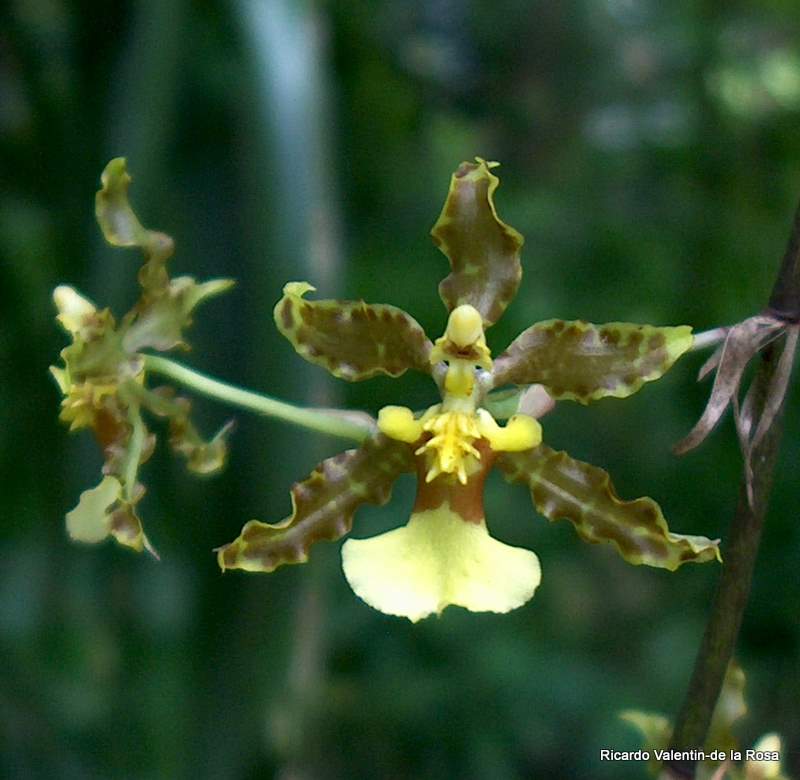
Oncidium altissimum, a native orchid with very long inflorescences and small yellow flowersl


Around the base of the lip there are some sharp pointed protuberances that form two groups of five
 around a central "tooth" 


A slightly different colored flower, however the flash and a degree of back lighting accentuate the difference with the flower on the top photo

The inflorescence is branched among most of its lenght, but the tip has two rows of flowers

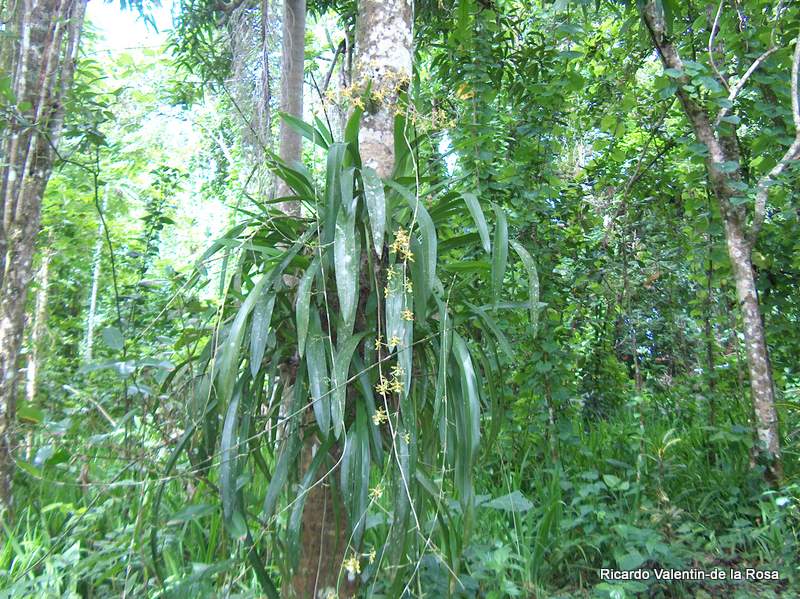
A plant blooming in the wild, notice the many old inflorescences
This bottom view of a wild plant shows the root basket
These plants were attached to the trunk of a large Teak tree.  They bloomed riotously but due to the flaky nature of the bark of the teak tree they eventually lost their grip and fell.  Note the many old inflorescences.

Oncidium altissimum is an orchid whose geographical distribution includes Puerto Rico and the lesser Antilles.  In favorable habitats its relatively common and sometimes large specimen plants can be found growing on the trunks of tall trees.  I have seen this plant in the forests of the Northern part of Puerto Rico and into the mountainous interior of the Island.   When I started learning about orchids there were few orchid books that covered the orchids of Puerto Rico, the ones that were available were taxonomic treatises that were difficult to digest due to the obscure taxonomic terms and my own lack of familiarity with the characteristics of the orchids.  For years I didn’t know if the yellow flowered Oncidium that I saw in the forest was Onc. altissimun, Onc. wydleri or Onc. baueri.    Eventually this question was settled and with the books on orchids of Puerto Rico authored by Ackermann learning about the local orchid became much easier.
 This orchid is remarkably indiscriminate about its growing substrate.  I have seen it growing on rocks, on the leaf litter of a gravelly slope, on small understory trees and on the top branches of the largest forest trees.  There is however one thing that this species doesn’t tolerate and that is deep shade.  I recall finding a plant in 1999 in the Rio Abajo forest that was blooming gloriously and growing with great vigor because hurricane Georges had opened the canopy over its growing spot and it was getting lots of sunshine.  But as the forest canopy healed and the amount of light began to diminish the plant started weakening and dying.  Now in 2011 what remain of the huge plant are a few small scattered pseudobulbs that are bidding their time until the canopy opens again.
Unlike most Puerto Rican orchids Onc. antissimun makes itself quite a home in captivity and will thrive as long as a few precautions are taken that are generally the same as one would use with any other epiphytic orchid.  This orchid is intolerant of decayed, anoxic, tightly packed media, it needs an airy mix and under my care has accepted a wide variety of growing media such as coconut, bark and stones.   When the new growth has achieved a few inches in height the plant will start producing many slender roots that will grip the media and literally engulf it in a mass of roots.  This tendency to produce a plethora of roots results in the wild in the formation of a root basket that surrounds the trunk or branch of the tree that hosts the orchid.  Sometimes these roots baskets can become large, but this can spell the doom of the plant, as the new pseudobulbs become separated from the trunk and more attached to the root basket the new roots may not reach all the way to the trunk.  The result is that if the part of the root basket that is in contact with the trunk decays a portion, or most of the orchid might fall from the tree to the forest floor.   It is not rare, if a storm hits Puerto Rico during the hurricane season, to find pieces of this orchid in the forest floor along with branches and other debris.
I no longer grow this plant because it would be like going to the bother of having a refrigerator in Antartica.  They are everywhere in Rio Abajo and many plants can be seen growing in the trees that surround my house.  You can also see this orchid in the gardens of local people where they grow quite well.   One of the most distinctive characteristics of this orchid is the length of its inflorescences, they can reach a length of ten feet although most are shorter than this.  A mature plant often has many old inflorescences in various stages of decay hanging from it.  The pseudobulbs can reach six inches tall in the largest and most vigorous specimens.
This plant is rarely seen in orchid shows, it makes its appearance mainly when someone makes a educative exhibition that features native orchids.  This orchid was relatively common in orchid collection in previous decades but it has been totally superseded in the local orchid grower tastes by new hybrids that feature much larger flowers with shorter and denser displays of flowers.  As far as I know it is not subjected to systematic collection in the wild although it is not rare for visitors to the forest to carry home plants found fallen in the forest floor, but his doesn’t seem to make a dent in the wild populations.
I have an interesting anecdote about this orchid.  When I was in college I visited the home of a fellow student that lived in the metropolitan area.  His mother was proud of her plant collection and we spent some time in the garden talking about her plants.  As we walked through the garden she pointed to me an orchid and declared it her greatest disappointment, in spite of much fussing and devoted care the plant had never produced a single flower.  The said plant was an Onc. altissimum specimen about two feet across with dozens of large pseudobulbs.  Mystified by her assertion I examined the plant and to my surprise found the remains of inflorescences in practically every bulb.  Nevertheless, she insisted the plant had never bloomed.  Baffled I asked her if she had noticed the inflorescences, she answered that yes, she had waged a continuous battle against the vines that kept invading the pot of her precious orchid.  She thought the inflorescences were the expression of an invading weedy vine!  No wonder she had never seen a flower!  I educated her about the plant and next year she enjoyed a massive blooming showfrom her plant as many years of frustration was poured on an exceptional flower display.
The plants in Rio Abajo bloom in the early summer around June.  In spite of the many plants that bloom together seed capsules are not common and I have yet to find one in the many wild plants I have found in the wild.  It is said that these plant are pollinated by bees but I have yet to see any bee visit or even hang around the flowers.  The proposed method for pollination for these orchids is called pseudoantagonism.  The proposed mechanism for pollination is that when aggressive territorial bees see the flowers, they attack the flowers head on, taking them for territorial rivals.  In the process of this attacks the pollinia of the flowers is transferred from flower to flower.

Saturday, February 19, 2011

Tolumnia (Oncidium) variegata, a native orchid locally known as angel of the coffee plantation


Tolumnia variegata from Rio Abajo

Note the large and prominent callus at the center of the flower

Two flowers from a Rio Abajo plant

This fan of four leaves produced an inflorescence that is astonishly disproportionate to the size of the plant.  It can be seen the lower two pictures.  This is a Rio Abajo plant.


The several feet long inflorescence carried the flowers high over the host bush
Tolumnia hybrid

Tolumnia hybrid

The previous Tolumnia hybrid flower produced after the plant was grown in high light conditions in my garden

A Rodricidium hybrid that has Tolumnia in his ancestry

This little orchid is among the most widespread species of orchid native of the island of Puerto Rico.   I have seen it in many places in the island, from the moist forests of the Northern part of the Karst area to the dry scrub in the south west.   I have also seen this orchid in the island of Hispaniola in Santo Domingo.  The carefully manicured shrubs in the area of the Japanese Garden in the world famous Jardin Botanico of the capital of Santo Domingo have in their branches a dense population of this orchid.  The density of plants I saw among the branches of some of the shrubs in the Japanese Garden is among the greatest I have seen in any epiphytic orchid, the plants were tiny, had four fat and short leaves and were blooming abundantly at the time of my visit.  I have also seen this plant in coffee plantations that are at middle elevations in the central mountainous area of Puerto Rico as well as in coastal forest that is still reasonably intact.
This plant has an equitant arrangement of the leaves, this means the leaves are arranged in a flattened fan shape.  One of the peculiarities of this species is that plant size varies wildly even in areas where you would think all plants would be closely related.  In an area of less than one acre in the forest of Rio Abajo in Puerto Rico you can find small plants with four short and thick leaves that produce two of three flowers and larger plants with longer leaves that produce disproportionally huge inflorescences with dozens of flowers.  The largest plant of this species that I have ever seen was growing in the Guanica dry forest.  I saw it when I was walking through a small ravine in the forest where conditions were slightly moister than in the surrounding forest.  Growing in the understory, among the slender branches of a tall bush the plant I saw had long and slender leaves about four or five inches long.  The plant was growing with its roots spreading in the air in all directions, unattached to anything, the plant was tangled in the branches by its long stolon which joined the newest fan with the remains of older leave fans.  It could have been that the plant had fallen from a high branch, gotten tangled in the low branches and had kept growing unfazed by its new circumstances.
But no matter the size and shape of the leaves the flowers of all the plants are nearly identical.  There some plants that have a pronounced lilac coloring in the lip and floral segments, but I have seen those only in photos, I have never seen one of this type growing in the wild.  The flowers are constant in size with the flowers produced by the tiniest plants being only slightly smaller than those produced by the largest ones.
I have seen plants of this species in bloom in March sometimes in good numbers in favorable habitats.  However they can be common in highly modified habitats such coffee plantations and I have found from time to time plants growing in trees and bushes in urban areas and even in a tree in the central plaza of a small town.
People often collect these plants and they are seen from time to time at local orchid shows with relative frequency. Any time somebody makes a display of native orchids in an orchid show that falls on their blooming season this orchid is almost sure to be a present.  Puzzlingly, in spite of this being a common orchid, it seems few people are adept at keeping them alive in a long term basis.  The very few that I have found to be successful with this orchid, were growing them in their native haunts in conditions that closely resemble what they experience in nature.  I have observed a few plants growing in the wild and the lifespan seems to be relatively short.  None of the plants I have observed lasted more than five years from the time I found them and some disappeared after only two years of blooming activity.
Tolumnia hybrids made with other species of Tolumnia are highly valued by orchid growers and are relatively inexpensive and easy to find.  The flowers of the hybrids are often vividly colored and sometime feature lurid color combinations arranged in stripes and spots in ways seldom seen in other similarly sized flowers.
I have kept many hybrids of Tolumnia and a few have survived for a significant period of time under my care.  All have eventually died, mainly of root loss but also from what appears to be fungal/bacterial infections.  My guess is that there is a key feature of their habitat that I have failed to replicate in a consistent manner.  Of those the plants growing in the wild that I had have the opportunity to observe over several years, the plants that survive the longest are those growing among the leaves of the shrubs in the top part of the shrub where they get bright light filtered through the leaves most of the day and probably a bit of full sun at midday when sunlight is striking the shrubs at its most vertical.   I suspect that the leaves of the host shrubs also provide a microclimate of higher environmental humidity that insulates the plants against desiccation.
Few orchidists locally cultivate this species, probably because it is just too drab when compared with the hybrids and the fact that they are neither prestigiously rare nor difficult to replace.  Most of those that keep these orchids do so by dint of cutting a branch of the shrub tree where they are growing in the wild and bringing it into their collections.  Many of the plants collected this way survive happily, at least for a time, in captivity.
If you want to try to grow this plant in the Island of Puerto Rico I would advice to grow it inside a leafy bush that still allows a significant amount of light to sift through its leaves.  A particularly good host is the Higuera tree.  But please don’t go stripping our State Forests of this orchids, there are probably plenty growing in private lands and in coffee plantations.  Owners of coffee plantations have been known to rip out these plants from the coffee bushes in the mistaken belief that they are parasitic and drain the coffee bush of vigor.